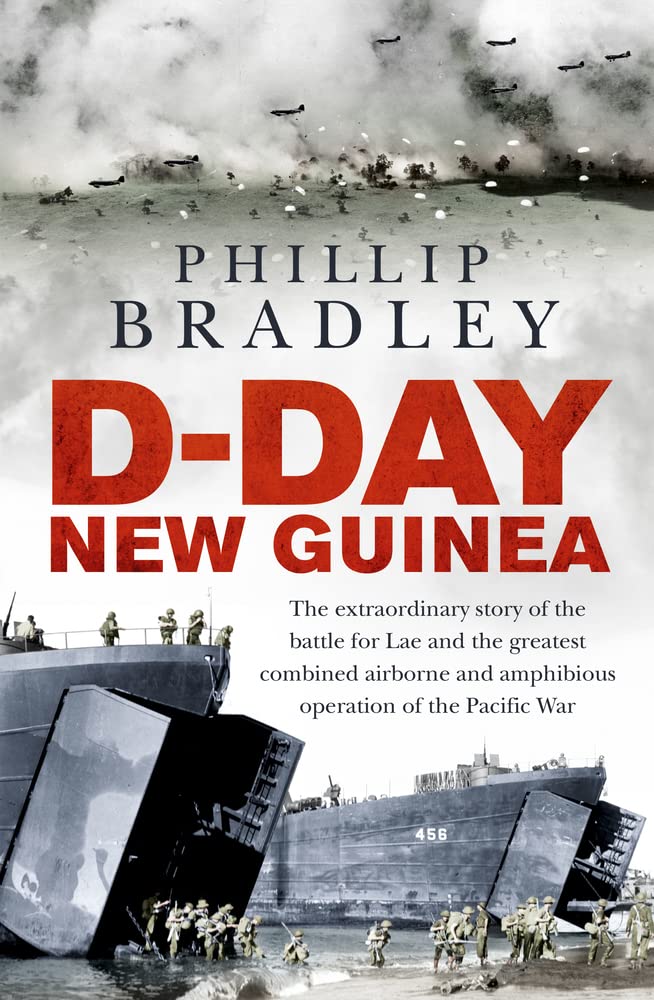
D-Day New Guinea: The Extraordinary Story of the Battle for Lae and the Greatest Combined Airborne and Amphibious Operation of the Pacific War
$31.69
by Phillip Bradley



'Java is heaven, Burma is hell, but you never come back alive from New Guinea' - Japanese military saying The capture of Lae was the most complex operation for the Australian army in the Second World War. In many ways it was also a rehearsal for the D-Day invasion of France, with an amphibious landing combined with the first successful large-scale Allied airborne operation of the war. D-Day New Guinea brings together the extraordinary stories of the Australian, American and Japanese participants in this battle, and of the fight against the cloying jungle, the raging rivers and the soaring mountain ranges that made New Guinea such a daunting battlefield. Phillip Bradley brings a compelling clarity, humanity and new insight into a little known but crucial Australian battle of the Pacific War. Phillip Bradley , author of the ground-breaking Hell's Battlefield , is a leading Australian military historian. He has spent many years since researching the battle for Lae. D-Day New Guinea The extraordinary story of the battle for Lae and the greatest combined airborne and amphibious operation of the Pacific War By Phillip Bradley Allen & Unwin Copyright © 2019 Phillip Bradley All rights reserved. ISBN: 978-1-76063-258-8 Contents List of maps and sketches, Abbreviations, Prologue, Chapter 1 The observation game, Chapter 2 'Such a dangerous looking mob', Chapter 3 'We will die fighting', Chapter 4 Mountains to climb, Chapter 5 The secret airbase, Chapter 6 MacArthur's navy, Chapter 7 Airborne infantry, Chapter 8 D-Day dawns, Chapter 9 'The wolf at the back gate', Chapter 10 'A terrifying but magnificent spectacle', Chapter 11 'Fix bayonets', Chapter 12 'A precarious retreat', Chapter 13 'Like beggars in a procession', Chapter 14 Beyond Lae, Acknowledgements, Notes, Bibliography, Index, CHAPTER 1 THE OBSERVATION GAME War came to Lae on 21 January 1942. The German settlement of Lae, assigned to Australian control with the rest of German New Guinea after the First World War, would now be a key objective in the Second World War. Just before midday Lloyd Pursehouse, a Coastwatcher at Finschhafen on the north-eastern coast of New Guinea, reported that about 60 enemy aircraft were flying west along the coast towards Lae. As the air raid siren rang out across Lae the Japanese fighters came in from the sea and strafed the township and adjoining airfield. A large formation of bombers followed, dropping their loads across the town, after which the fighters continued their strafing. The raid left the Guinea Airways hangars, workshops and stores as well as the power plant completely destroyed and many other buildings damaged. Before the war Lae airfield had been the supply hub for extensive gold mining operations and the valuable runway was deliberately left intact though five aircraft were destroyed. Fortunately Pursehouse's timely warning had prevented any casualties. One Junkers transport piloted by Bertie Heath managed to take off before the raid and reach Bulolo carrying a load of beer. He was initially waved off while obstructions were cleared from the airfield so that he could land. However, it was only a temporary reprieve for Heath as 'five Japanese Zeros arrived hedge hopping with the sound of angry bees'. The Zeros began flying back and forth, strafing the three Junkers transports on the airfield. The seven New Guinea Volunteer Rifles (NGVR) guards at the airfield soon depleted their few Lewis gun magazines to no effect and could only watch on as the three Junkers aircraft burned. Other raids hit Salamaua, on the coast 40 kilometres south of Lae, and Wau which was 50 kilometres inland from Salamaua (see Map 2). Lloyd Pursehouse and the airfield guards at Bulolo typified Australia's role in the opening months of the war in New Guinea. Given the almost total neglect of the responsibility for defending the islands to the north of Australia, the Australian government and people were reduced to the role of hapless observers as the Japanese moved south. * * * After the air attacks of 21 January a Japanese landing was considered imminent and it was decided that the government and civilian population should immediately be evacuated from Lae to a hidden position further inland. Under NGVR supervision, all available motor transport was assembled to move foodstuffs and other goods from the Burns Philp store and the airfield, and this work continued throughout the night. The stores were temporarily distributed along the Markham Road west of Lae in various houses and under tarpaulins in the bush. The work was hampered by heavy rain, which rendered the road practically impassable beyond 8 kilometres from Lae. At this stage the total strength of the NGVR and attached personnel in the Lae area was twelve officers and 327 other ranks under the command of Captain Hugh Lyon. On 27 January authority was granted to compulsorily call up all males of European origin between eighteen