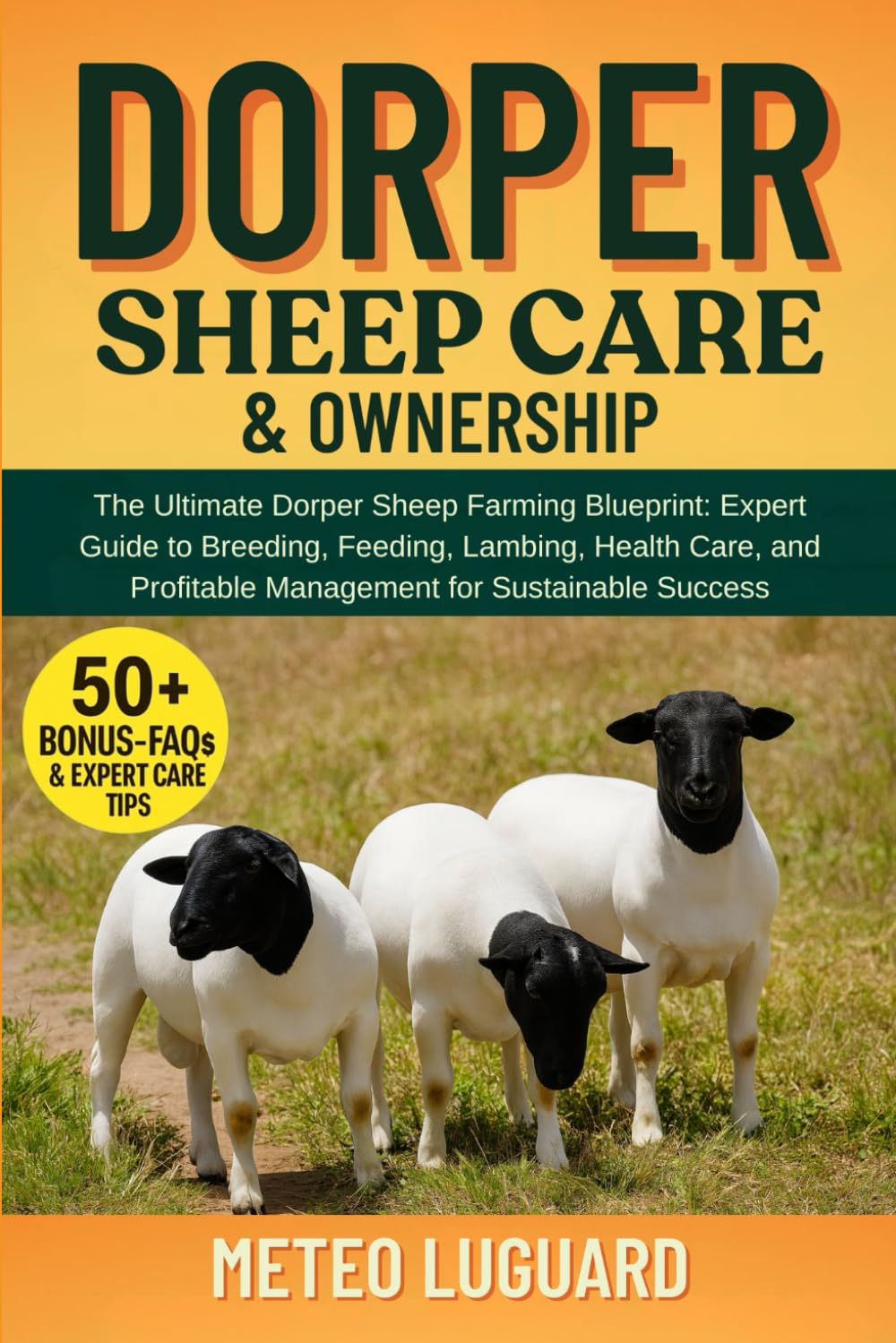
DORPER SHEEP CARE & OWNERSHIP: The Ultimate Dorper Sheep Farming Blueprint: Expert Guide to Breeding, Feeding, Lambing, Health Care, and Profitable
$16.99
by METEO LUGUARD



Introduction to Dorper Sheep The Dorper sheep stands today as one of the most iconic and successful meat sheep breeds in the world—a breed that blends efficiency, resilience, and exceptional productivity. Its journey began in the dry, rugged landscapes of South Africa during the early 1930s, when local breeders sought to develop a sheep capable of thriving under harsh, semi-arid conditions while still producing high-quality meat. The creation of the Dorper was not a product of chance, but a deliberate and visionary breeding program initiated by the South African Department of Agriculture and pioneering farmers who understood that the region’s future in livestock depended on adaptability, fertility, and sustainability. The Dorper’s development involved crossing the Dorset Horn, a British breed known for its year-round breeding capacity, excellent muscle development, and rapid growth, with the Blackhead Persian, a hardy fat-tailed breed from Somalia renowned for its resistance to heat and drought, and its ability to survive on limited grazing resources. This carefully engineered genetic blend resulted in a new breed that inherited the Dorset’s prolific reproductive ability and meat quality, along with the Persian’s toughness and tolerance to arid climates. The outcome was a medium-sized, muscular sheep that could thrive on sparse vegetation, lamb frequently, and produce tender, flavorful meat with minimal input. From the beginning, the objective was not just to create a hardy sheep, but one that could transform the economics of meat production in Africa’s dry zones. Traditional European breeds struggled in these conditions due to their heavy wool coats and high feed demands, while indigenous fat-tailed sheep often produced lean meat and matured slowly. The Dorper became the bridge between these two extremes—an animal that combined hardiness with high productivity, and low maintenance with superior carcass quality. Over time, two main varieties of the Dorper emerged: ● The Blackhead Dorper, easily identified by its distinctive black head and white body, and ● The White Dorper, developed later through selective breeding for an all-white coat, appealing to markets that preferred lighter skins for leather production. Both types share the same essential characteristics—remarkable adaptability, strong mothering instincts, and the ability to thrive under a wide range of environmental conditions. Adaptability and Global Expansion The Dorper’s reputation spread quickly beyond the borders of South Africa. Its ability to convert poor-quality forage into lean meat and maintain body condition in drought-prone areas caught the attention of farmers worldwide. The breed’s resilience made it particularly attractive in regions such as Australia, the United States, the Middle East, South America, and various parts of Asia and Africa, where challenging climates often limit livestock success. The Dorper’s global expansion was not only a testament to its adaptability but also its contribution to food security and sustainable livestock farming. One of the most striking features of the Dorper is its self-shedding coat, which eliminates the need for shearing—a significant advantage for farmers in hot climates or remote areas with limited labor availability. This coat is a mixture of hair and wool, which naturally sheds as seasons change, helping regulate body temperature and reducing the risk of external parasites. The skin of the Dorper, thick and supple, has become a valuable by-product in its own right, highly prized by the leather industry for making fine garments and gloves.