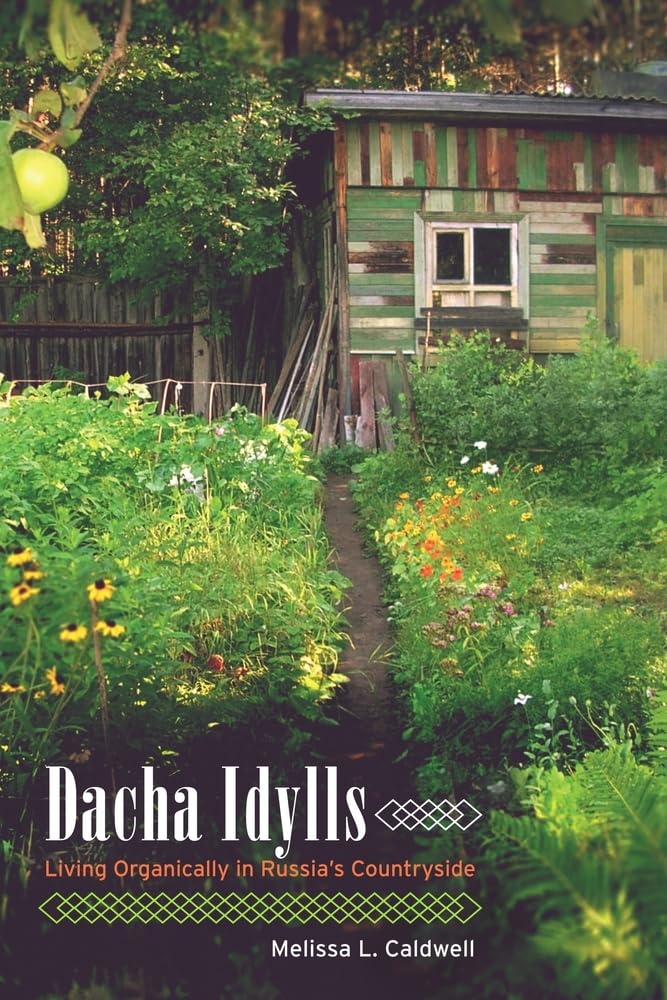



Dacha Idylls is a lively account of dacha life and how Russians experience this deeply rooted tradition of the summer cottage amid the changing cultural, economic, and political landscape of postsocialist Russia. Simultaneously beloved and reviled, dachas wield a power that makes owning and caring for them an essential part of life. In this book, Melissa L. Caldwell captures the dacha’s abiding traditions and demonstrates why Russians insist that these dwellings are key to understanding Russian life. She draws on literary texts as well as observations from dacha dwellers to highlight this enduring fact of Russian culture at a time when so much has changed. Caldwell presents the dacha world in all its richness and complexity―a “good life” that draws inspiration from the natural environment in which it is situated. “[Caldwell’s] insight into Russian life is impressive. . . . The book undeniably deserves to be read and appreciated.” ― Europe-Asia Studies Published On: 2012-08-16 "Valuable and accessible. . . . Dacha Idylls is an evocative and original examination of a central aspect of Russian life." -- Susanne Cohen ― American Anthropologist Published On: 2013-06-01 "Any future scholar working on modern Russian rural life would do well to read this book. It provides an excellent survey of the field." -- John Randolph ― Journal of Modern History Published On: 2013-06-01 "Anyone who has spent time in Russia knows the importance of 'going to the dacha.' In this ethnography Melissa Caldwell reveals the mystique of rural life by exploring the social nature of gardening and making food, and Russian relationships to the land. It's truly an innovative study!" Catherine Wanner, author of Communities of the Converted: Ukrainians and Global Evangelism "In this engaging ethnography, Melissa Caldwell brilliantly demonstrates what is peculiarly Russian about the dacha, long an object of literary and nostalgic imagining, while simultaneously situating the 'vacation cottage' within larger histories of leisure, consumption, home, and post-socialist transition. A must-read for scholars of Russia or tourism." Pamela Ballinger, author of History in Exile: Memory and Identity at the Borders of the Balkans "Anyone who has spent time in Russia knows the importance of 'going to the dacha.' In this ethnography Melissa Caldwell reveals the mystique of rural life by exploring the social nature of gardening and making food, and Russian relationships to the land. It's truly an innovative study!"―Catherine Wanner, author of Communities of the Converted: Ukrainians and Global Evangelism "In this engaging ethnography, Melissa Caldwell brilliantly demonstrates what is peculiarly Russian about the dacha, long an object of literary and nostalgic imagining, while simultaneously situating the 'vacation cottage' within larger histories of leisure, consumption, home, and post-socialist transition. A must-read for scholars of Russia or tourism."―Pamela Ballinger, author of History in Exile: Memory and Identity at the Borders of the Balkans Melissa L. Caldwell is Associate Professor of Anthropology at the University of California, Santa Cruz. She is the author of Not by Bread Alone: Social Support in the New Russia (UC Press). Dacha Idylls Living Organically in Russia's Countryside By Melissa L. Caldwell UNIVERSITY OF CALIFORNIA PRESS Copyright © 2011 The Regents of the University of California All rights reserved. ISBN: 978-0-520-26285-0 Contents Illustrations, ix, Note on Transliteration and Pronunciation, xi, Preface, xiii, 1. Dacha Enchantments, 1, 2. Intimate Irritations: Living with Chekhov at the Dacha, 28, 3. The Pleasure of Pain: Gardening for the Soul, 48, 4. Natural Foods: Feeding the Body and Nourishing the Soul, 74, 5. Disappearing Dachniki, 101, 6. Dacha Democracy: Building Civil Society in Out-of-the-Way Places, 130, 7. The Daily Dacha Soap Opera, 162, Notes, 175, Bibliography, 183, Index, 197, CHAPTER 1 Dacha Enchantments The city is always a stress ... But with nature, it is like you have gone to another planet. —Irina, sixties, Berezka (Birch Tree) dacha community Here [at the dacha] it is a piece of a different life. It is impossible to compare this life with the life you live the rest of the year. —Veronika, fifties, Iablochnyi Sad (Apple Orchard) dacha community The dacha is, in general, a place of refuge from the usual problems. —Mila, thirties, Nadezhda (Hope) dacha cooperative In summer, it may appear that all of Russia has gone on vacation. The bustle and noise of daily life in towns and cities noticeably ease with the departure of residents to public parks, summer camps, cottage communities, and tourist destinations elsewhere. The pace of life slows down as people meander aimlessly through the dense thickets of parks and forests, nap on blankets spread along riverbanks, or read while absently pushing baby carriages containing contentedly sleeping infants t