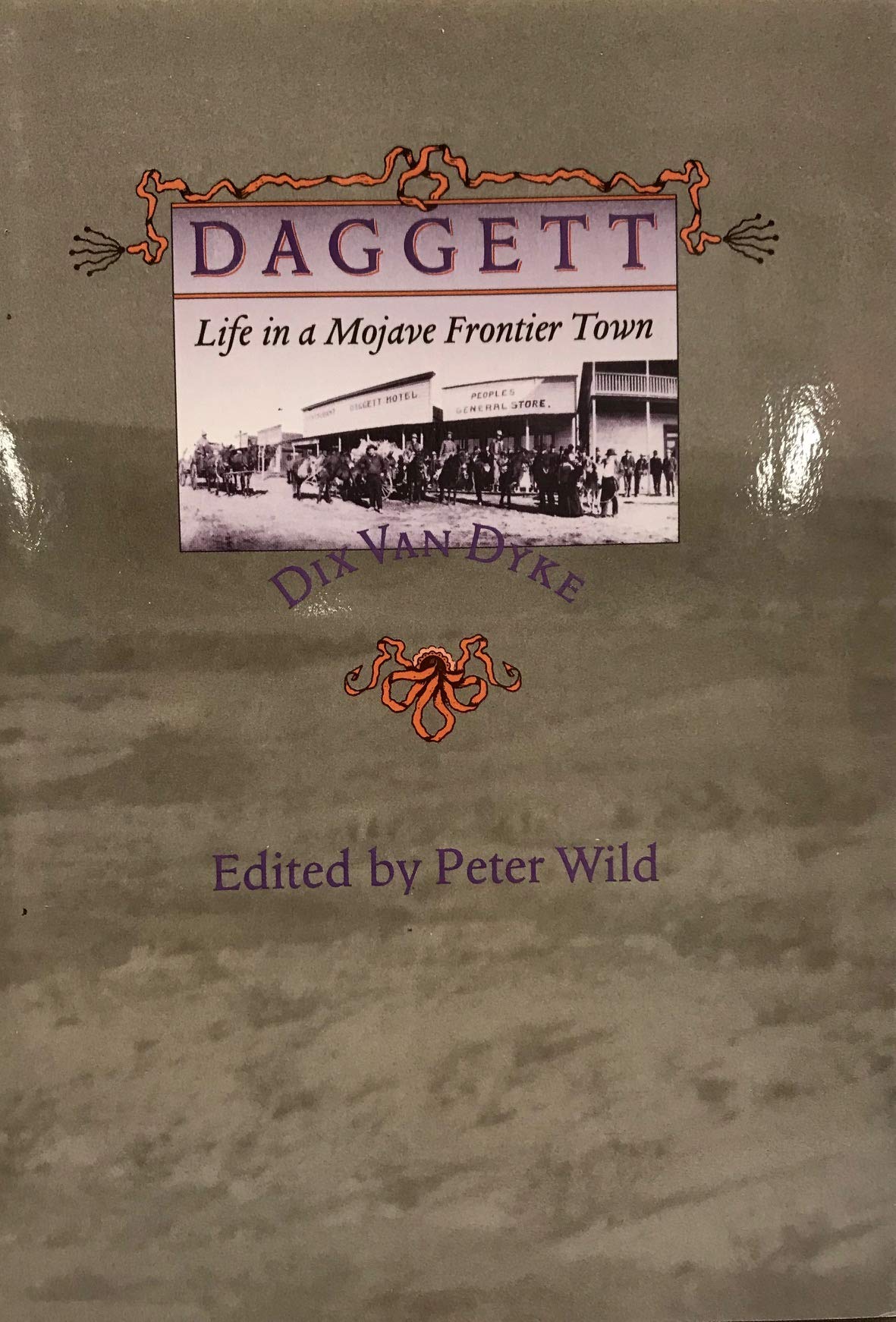
Daggett: Life in a Mojave Frontier Town (Creating the North American Landscape)
$29.95
by Professor Dix Van Dyke



When twenty-two-year-old Dix Van Dyke arrived in Daggett, California, in 1901, the town was a wild and raucous frontier settlement, with barrooms and brothels, silver mines and land swindles, cattle drives, and shootouts at the Bucket of Blood saloon. Dix, a ranch-boy with no formal education but whose father and uncle were writers, became the town's unofficial historian. Edited and introduced by award-winning poet and nature writer Peter Wild, this is Dix Van Dyke's account of how the twentieth century arrived in a California frontier town. Located a hundred miles outside Los Angeles and just east of Barstow in the Mojave Desert, Daggett attracted a rich assortment of settlers lured by the wealth of nearby silver mines or the promise of cheap farmland conjured up by dubious irrigation schemes. With wit, humor, and a writer's eye for the telling detail, Dix describes the delicate beauty of the desert and the human hopes that often ended in folly there. Among the citizenry: Mother Preston, a madam of sumptuous proportions and valorous spirit, capable of locking the head of an unruly client in the crook of an immense arm and pummeling his face with her windmilling fist. Death Valley Scotty, who claimed to have a fabulously rich gold mine at a secret location north of Daggett. Only decades later was it discovered that Scotty's wealth came from an eccentric Chicago millionaire. Bill Frakes, who tried unsuccessfully to breed "coyote-killing sheep," and who prowled the wild riverbottoms tracking real and imagined malefactors. Dix also reveals the Van Dyke ranch as an unlikely crossroads for intellectuals, some of them famous. Conservationist JohnMuir's visits included one memorable argument with Dix's Uncle John. Muir admirers may be surprised at the tangle of family relationships begun when daughter Helen married Daggett resident Buel Funk -- a story never told in print before. Van Dyke's account of turn-of-the-century Daggett, California, in the Mojave Desert region first appeared as a series of columns in the local newspaper in the early 1950s. The author paints a vivid, insightful portrait of the West. His father was a writer and a businessman who helped orchestrate the piping of water to San Diego; his uncle John wrote The Desert (1901), an early and still well-known study of the region. Van Dyke's colorful character depictions and frequent defiance or willful ignorance of the country's natural limitations would not be out of place in descriptions of the West today. Essential for collections concerned with California and its desert regions and likely to be of interest to both lay and scholarly readers concerned with the subject.?Charles V. Cowling, Drake Memorial Lib., SUNY at Brockport Copyright 1997 Reed Business Information, Inc. "This is a chronicle of ordinary people living ordinary lives, albeit in a quite extraordinary place... The Mojave Desert in the years Van Dyke lived and farmed there was a place where a keen observer could see the face of America changing, and Van Dyke was nothing if not a keen observer." -- Jonathan Yardley, Washington Post The colorful account of how the twentieth century arrived in a California frontier town -- a hundred miles outside Los Angeles and just east of Barstow in the Mojave Desert. Dix Van Dyke was the son of nature writer Theodore Van Dyke and nephew of John C. Van Dyke, author of The Desert, the first book to praise America's arid lands. Peter Wild is one of the foremost poets of the American West. Of his twenty volumes of poetry, Cochise was nominated for the Pulitzer Prize. He teaches creative writing at the University of Arizona. Used Book in Good Condition