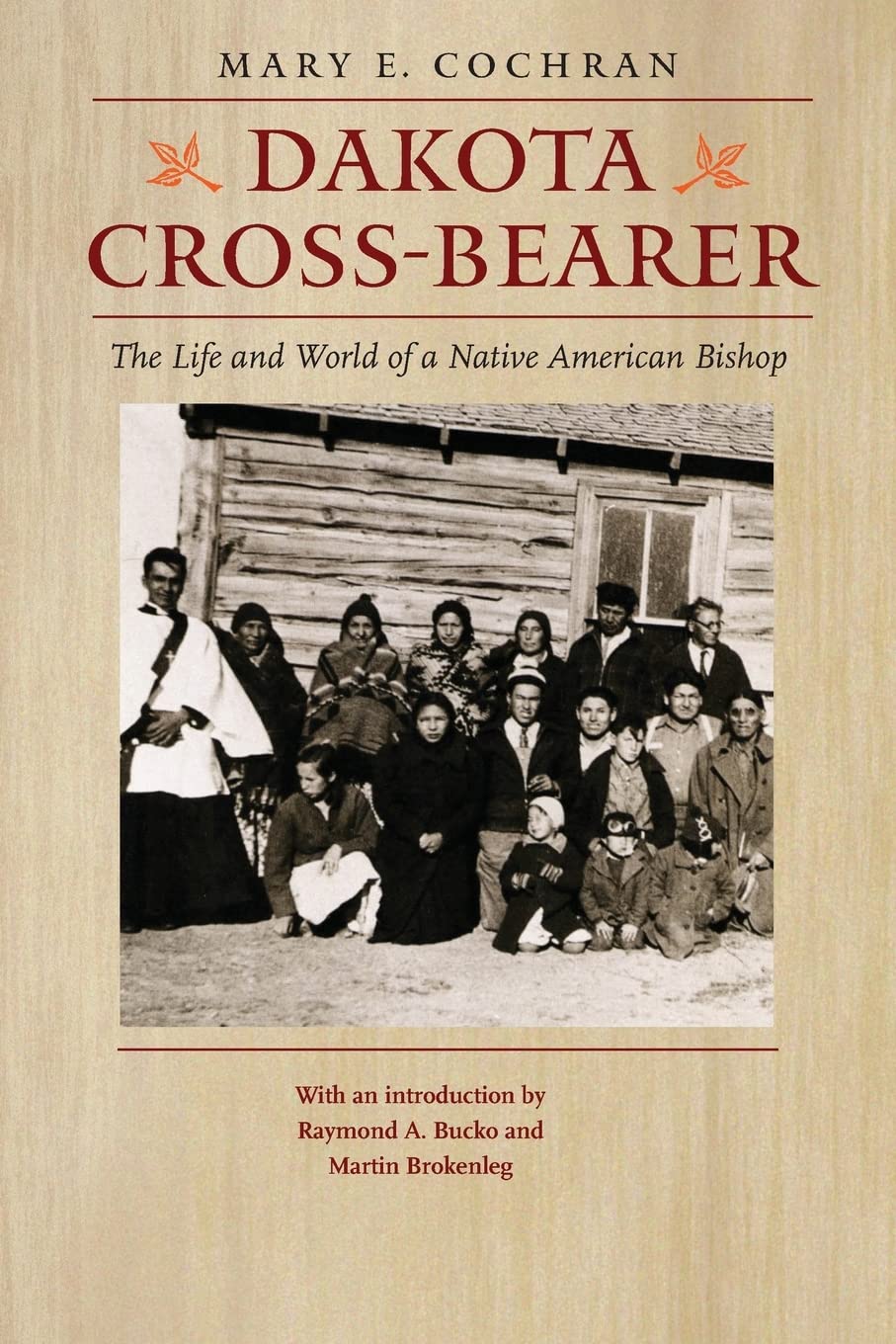
Dakota Cross-Bearer: The Life and World of a Native American Bishop
$11.50
by Mary E. Cochran



Dakota Cross-Bearer is the story of Harold S. Jones, a Dakota Indian born in 1909 and raised on the Santee Reservation in Nebraska, who rose through the ranks of the Episcopal Church to become the first Native bishop of a Christian church. Jones’s biography sheds light on the importance of Christianity for the Dakotas and other Native peoples during the twentieth century. His story yields insights into the history of twentieth-century missionary activity among Native communities and illuminates instances of conflict and discrimination within the Episcopal Church, the processes of clerical training and testing, and the demands of constant relocation. ""Dakota Cross-Bearer" offers a view like no other into the life of an unusual but no less dedicated man of the cloth and faith."--"The Midwest Book Review" "Cochran's prose reads well and Jones's inspirational life makes a compelling subject. .the book provides an engaging account of a Christian Dakota negotiating twentieth-century America."--Todd M. Kerstetter, "Nebraska History" "Mary E. Cochran's "Dakota Cross-Bearer" demonstrates the best elements of good historic biography . . . [and] has made a major contribution to our understanding of religion and Native American identity."-"North Dakota History," "Reading the account will bring tears for this is a very readable biography, written with all the suspense and emotion found in good fiction, but seldom in nonfiction."--"Roundup Magazine" "Mary E. Cochran's "Dakota Cross-Bearer demonstrates the best elements of good historic biography...[and] has made a major contribution to our understanding of religion and Native American identity." Dakota Cross-Bearer is the story of Harold S. Jones, a Dakota Indian born in 1909 and raised on the Santee Reservation in Nebraska, who rose through the ranks of the Episcopal Church to become the first Native bishop of a Christian church. Jones s biography sheds light on the importance of Christianity for the Dakotas and other Native peoples during the twentieth century. His story yields insights into the history of twentieth-century missionary activity among Native communities and illuminates instances of conflict and discrimination within the Episcopal Church, the processes of clerical training and testing, and the demands of constant relocation. Dakota Cross-Bearer is the story of a remarkable man, Harold S. Jones, a Dakota Indian who rose through the ranks of the Episcopal Church to become the first Native American bishop of a Christian church. Born in 1909 and raised on the Santee Reservation in Nebraska, Jones lost his parents at an early age and was adopted by his grandparents, who brought him up as a Christian. Each year his family attended the Niobrara Convocation, a large gathering of Episcopalians drawn from all of the Siouan communities. Jones attended Seabury-Western Seminary in Illinois. After graduating he was assigned to a variety of Native American missions across the northern plains, including those at Wounded Knee, Oglala, and the Cheyenne River Reservation as well as the Navajoland mission in the southwest. Despite encountering discrimination from within the Episcopal Church throughout his career, in 1971 he was elected suffragan bishop of the diocese of South Dakota. Jones's biography sheds light on the importance of Christianity for the Dakotas and other Native American peoples during the twentieth century. His story yields interesting insights into the history of twentieth-century missionary activity among Native Americans and illuminates instances of conflict and discrimination within the Episcopal Church, the processes of clerical training and testing, and the demands of constant relocation. Mary E. Cochran is the wife of an Episcopal bishop who worked on the Standing Rock Reservation and who later was named bishop of Alaska. She and her husband live in Tacoma, Washington. Raymond A. Bucko, S.J., a Catholic priest, is the director of the Native American Studies Program and an associate professor of anthropology at Creighton University. He is the author of The Lakota Ritual of the Sweat Lodge: History and Contemporary Practice (Nebraska 1998). Martin Brokenleg, an enrolled member of the Sicangu Lakota, is a professor of Native American studies at Augustana College and an Episcopal priest. He is a coauthor of Reclaiming Youth at Risk: Our Hope for the Future . Used Book in Good Condition