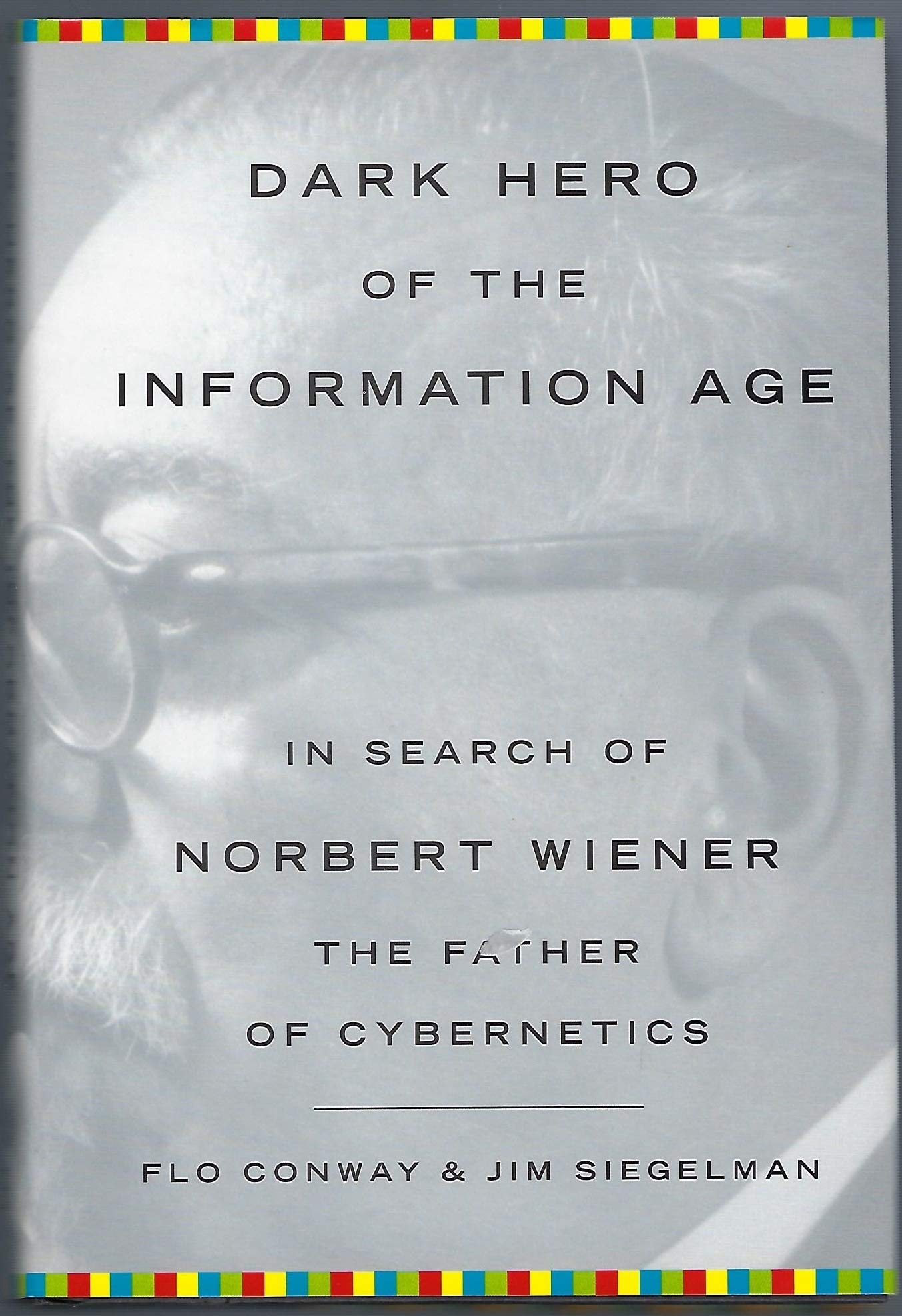
Dark Hero of the Information Age: In Search Of Norbert Wiener--Father of Cybernetics
$47.09
by Flo Conway



In the middle of the last century, Norbert Wiener-ex-child prodigy and brilliant MIT mathematician -founded the science of cybernetics, igniting the information-age explosion of computers, automation, and global telecommunications. Wiener was the first to articulate the modern notion of "feedback," and his ideas informed the work of computer pioneer John von Neumann, information theorist Claude Shannon, and anthropologists Gregory Bateson and Margaret Mead. His best-selling book, Cybernetics , catapulted him into the public spotlight, as did his chilling visions of the future and his ardent social activism. So what happened? Why is his work virtually unknown today? And what, in fact, is Wiener's legacy? In this remarkable book, award-winning journalists Conway and Siegelman set out to rescue Wiener's genius from obscurity and to explore the many ways in which his groundbreaking ideas continue to shape our lives. Based on a wealth of primary sources (including some newly declassified WW II and Cold War-era documents) and exclusive interviews with Wiener's family and closest colleagues, the book reveals an extraordinarily complex figure, whose high-pressure childhood, manic depression, and troubled relationships had a profound effect on his scientific work. No one interested in the intersection of technology and culture will want to miss this epic story of one of the twentieth century's most brilliant and colorful figures. No one saw earlier or more fully the possibilities and perils of automated information systems than did Norbert Wiener, whose remarkably prescient vision receives overdue attention in this compelling biography. Beginning with the wunderkind years that put Wiener in graduate school at age 14, the authors limn the development of the brilliant mind that created the basic framework for a statistical science of communication. As that mind pioneered new understandings of feedback loops and analog information systems, a cybernetic paradigm emerged, opening new horizons for computer designers, biologists, and sociologists. Conway and Siegelman chronicle Wiener's highly fruitful collaboration with the computer maven John von Neuman, anthropologist Margaret Mead, and others who applied cybernetic principles. They also detail Wiener's estrangement from cold warriors he accused of misusing his discoveries for political purposes and from corporate leaders he feared would use cybernetics to exploit and displace workers. At a time when information technology is delivering new powers to government security agencies and new clients to unemployment offices, readers will read this life story with great interest. Bryce Christensen Copyright © American Library Association. All rights reserved "A brilliant biography... The authors... bring back the forgotten Dark Hero... [Wiener s] rebellion was something that Einstein would approve of." -- The Hindu Business Line (February 21, 2005) "A brilliant mind....Wiener...founding [information age] theorist...defined...computer[s]...robotics and automation....He was chronically ahead of his time." -- The New York Times (March 1, 2005) "Editors' Choice....The great pioneer of information science whose personal life was a mess." -- New York Times Book Review (March 27/April 3, 2005) "Excellent original of great interest not only for neophytes but also for those who had the privilege to know him." -- Robert Vallée, President, World Organisation of Systems and Cybernetics "Hopefully, with this well-written and important biography Wiener will no longer be a forgotten hero of the information age." -- ETC.: A Review of General Semantics "Poignant, beautifully told....Wiener [descended from] famous...rabbis...and Moses Maimonides....Delightful sentences...pepper the book....The...prose flow[s] seamlessly." -- Cleveland Jewish News (February 18, 2005) "Well worth reading .Capture[s] the enthusiasm of the early years of our information age...uncover[s] many facts that were not commonly known." -- Notices of the American Mathematical Society "Well-written, well-researched .Librarians and information scientists confront issues of control over information, privacy, and identity .Wiener s words and actions provide models for information professionals." -- College and Research Libraries "[Dark Hero] shines .A fascinating account .Wiener was both brilliant and personally intriguing .As a character, he was larger than life." -- The New York Times Book Review (March 20, 2005) "[Wiener] put the ghost in the machine .[He] was a visionary .Cybernetics forever altered the course of automation in devices from electric coffeepots to computers." -- Investors Business Daily (January 5, 2005) [AUTHORIZED "BLURBS" PRINTED IN FULL ON BACK COVER/INSIDE FLAP:] "I cannot imagine a new history more significant in the here and now than this one, eight years in the making. The wisdom and grace of its presentation, moreover, put me in mind of Edward Gibbon." - Kurt Vonnegu