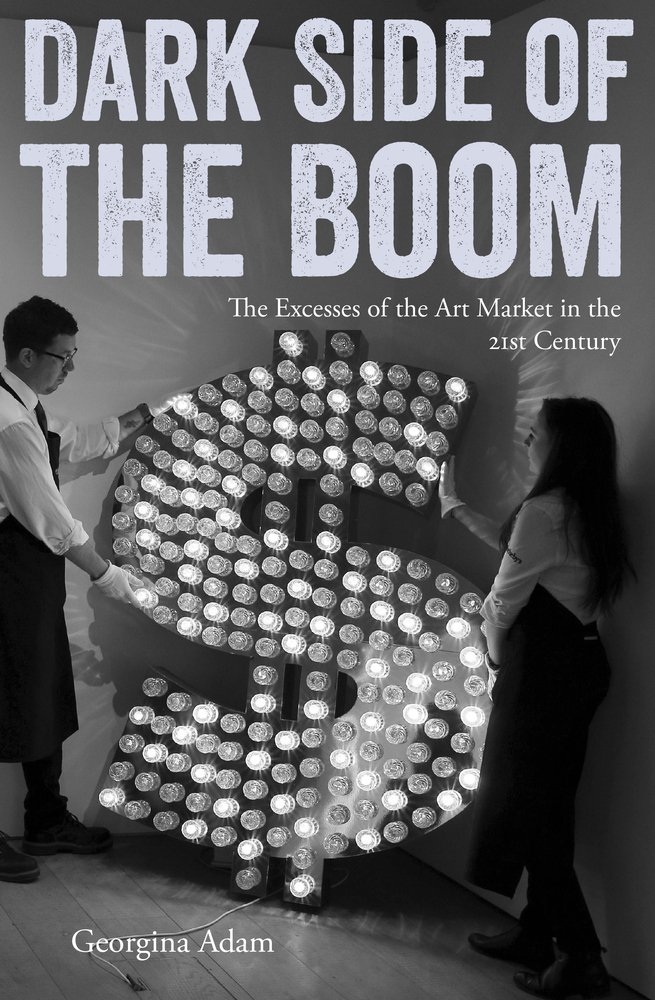
Dark Side of the Boom: The Excesses of the Art Market in the 21st Century
$27.35
by Georgina Adam



This book lifts the lid on some of the excesses that the 21st-century explosion of the contemporary art market brought in its wake, notably at its very top end. The buying of art as an investment, temptations to forgery, tax evasion, money laundering and pressure to produce more and more art all form part of this story, as do issues over authentication and the impact of the enhanced use of financial instruments on art transactions. Drawing on a series of revealing interviews with artists, lawyers, dealers, law-enforcement agents, tax specialists and collectors, the author charts the voracious commodification of artists and art objects, and art's position in the clandestine puzzle of the highest echelons of global capital. Adam's revelations appear even timelier in the wake of the Panama Papers disclosures, for example incorporating examples of the way tax havens have been used to stash art transactions – and ownership – away from public scrutiny. With the same captivating style of her bestselling Big Bucks: The Explosion of the Art Market in the 21st Century , Georgina Adam casts her judicious glance over a section of the art market whose controversies and intrigues will be of eye-opening interest to both art-world players and observers. "In a nutshell, over a period of 14 years, Rybolovlev coughed up some $2 billion for Bouvier to buy art quietly, then discovered how much profit Bouvier had made and sued him. You should read the book . . . because it is the most detailed account I have read of the affair, down to the mansion in Monaco where Rybolovlev staged his trap for Bouvier’s arrest in February 2015." —Colin Gleadell, Daily Telegraph "AS ADAM POINTS OUT, ‘ART’S SPECIAL QUALITIES OF PORTABILITY MEANS IT CAN BE BOUGHT WITH ONE CURRENCY IN ONE COUNTRY, BUT RESOLD IN ANOTHER—ACTING IN EFFECT AS A SORT OF ALTERNATIVE CURRENCY OR SHADOW MONEY.’" —J. J. Charlesworth, Art Review "a 'must-read' for anyone with an interest in the relationship between art and money." —Colin Gleadell, Telegraph 'A “must-read” for anyone with an interest in the relationship between art and money.' Daily Telegraph Georgina Adam has spent more than 30 years writing about the art market and the arts in general. She was editor of the Art Market section of The Art Newspaper 2000-2008, then editor at large. She wrote a weekly column for the Financial Times for eight years, until 2016. In 2014 she published Big Bucks: The Explosion of the Art Market in the 21st Century (Lund Humphries). In addition to her specialisation in the art market, Adam is particularly interested in emerging cultural centres. She lectures at Sotheby's Institute in London and participates in panels about the market: she is a board member of Talking Galleries, patron of the Association of Women Art Dealers and member of the International Association of Art Critics (AICA). Dark Side of the Boom The Excesses of the Art Market in the Twenty-First Century By Georgina Adam Lund Humphries Copyright © 2017 Georgina Adam All rights reserved. ISBN: 978-1-84822-220-5 Contents Introduction, Prologue: Le Freeport, Luxembourg, PART I: SUSTAINING THE BIG BUCKS MARKET, 1 Supply, 2 Demand: China Wakes, PART II: A FORTUNE ON YOUR WALL?, 3 What's the Price?, 4 The Problems with Authentication, 5 A Tsunami of Forgery, PART III: MONEY, MONEY, MONEY, 6 Investment, 7 Speculation, 8 The Dark Side, Postscript, Appendix, Notes, Bibliography, CHAPTER 1 SUPPLY Over-production is a serious problem; I would say the limit was reached in 2013 or 2014. And it has got to change, because it could eventually destroy confidence in the contemporary art market. Stéphane Custot, art dealer and gallerist November 2016: The taxi to Zhang Huan's studio in the suburbs of southwest Shanghai takes over an hour, and deposits me in front of a barred entrance, with a gatekeeper's hut inside. As the gate slides back, a uniformed guard lets me in; I wait. Soon the studio curator and a translator arrive, and then a photographer, who records every detail of my visit, followed by Zhang Huan himself. Neat, lithe, dressed in his trademark high-necked sweatshirt, glasses propped on his peaked cap, Zhang moves with cat-like grace as he shows me around his domain. Zhang bought the site, formerly a state-owned hydraulics machine factory, in 2005, after his return to China following 20 years in New York. The sheer scale of the factory/studio begins to dawn on me as we step over train tracks and past three wrecked carriages, one propped up against buffers – salvaged from the 2008 Sichuan earthquake. As our little group sets off, we see vast, neatly swept hangars displaying Zhang's characteristic ash paintings and further on, a cathedral-like workshop houses a huge cow-hide sculpture, Hero (2009). Motioning to a giant bear and her baby made of flawless polished stainless steel, Zhang informs me that it is destined for a casino hotel in Vancouver. An architectural