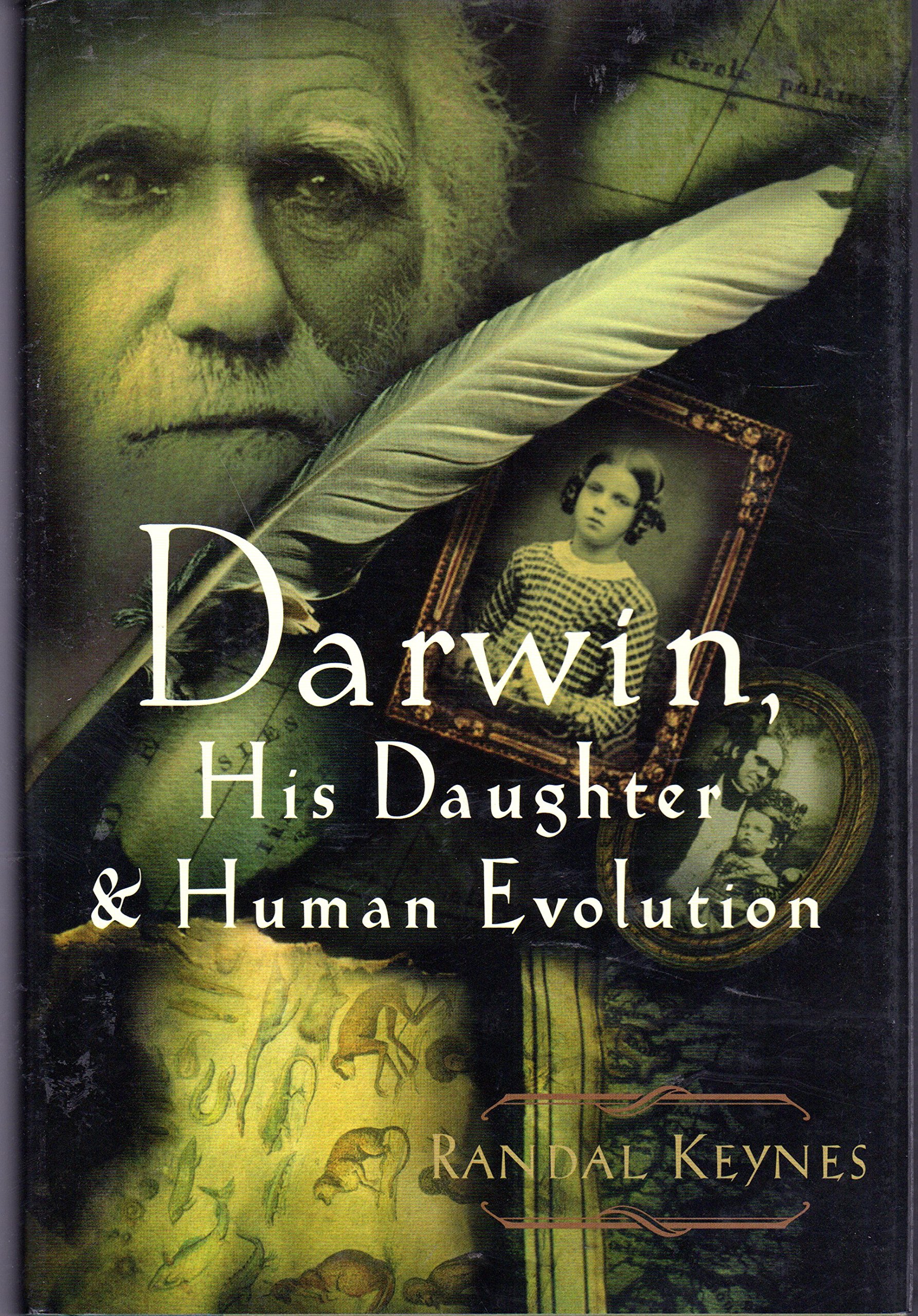



Drawn from never-before-published material, an intimate glimpse into the life of the man who changed the world's way of comprehending the origins of human nature, presented by his great-great grandson, tells the story of Darwin's home life, his inner turmoil, his wife Emma, a complex and independent woman, and his beloved daughter Annie, who died at the age of ten. 30,000 first printing. When the great-great-grandson of Charles Darwin inherited the writing case of Darwin's daughter Annie, who died at age ten, he discovered notes from his famous forbear that he used to reinvestigate the entire family. Copyright 2001 Reed Business Information, Inc. When descendants of Charles Darwin get together, some still tell the story of a long-ago servant who expressed pity for the family patriarch. The poor man, she said, was so idle that she saw him staring at an ant heap for a whole hour. Darwin's full-time, self-created job, of course, was to observe every animate creature, from the ants and bees in his garden, to giant tortoises in the Galápagos, to his own family. He even published a monograph on the behavior of his infant children. Randal Keynes, a great-great-grandson of Charles Darwin (and also a descendant of John Maynard Keynes), has crafted a superb intellectual and social history about Darwin's quiet years (c. 1842-1882) at his country estate, long after his HMS Beagle adventures. Charles and Emma Wedgwood Darwin produced 10 children but lost three--an infant daughter and son, and the bright and charming 10-year-old Annie, whose death plunged her parents into profound bereavement. Annie's fatal tuberculosis (a cogent diagnosis suggested by Keynes, although it was problematic in Darwin's day) was the most wrenching event of the naturalist's middle age. Among his family's heirlooms, Keynes discovered Annie's writing case, containing her goose-quill pens and stationery, a lock of her hair, and her father's mournful yet objective daily notes on her deteriorating condition. (The British edition of the book is titled Annie's Box.) Initially inspired and affected by these mementos, Keynes came to realize that "Charles's life and his science was all of a piece." With impeccable scholarship, he has woven clips from Victorian magazines, contemporary poems and novels, family letters and keepsakes, and even recollections of living people into a stylish narrative that is both moving and thoroughly documented. Darwin had often wondered whether his powerful affection for family could be explained in evolutionary terms. His then radical conclusion: our deepest emotions are rooted in the evolution of primate social organization. If we had descended from bees instead of from apes, he once opined, "there can hardly be a doubt that our unmarried females would, like the worker-bees, think it a sacred duty to kill their brothers, and mothers would strive to kill their fertile daughters; and no one would think of interfering." According to Keynes, Darwin was at a loss to understand why most naturalists at the time thought they saw evidence of ubiquitous, benevolent design in a world so full of pain, death and disease. "There seems to me," he wrote, "too much misery in the world" for a loving deity to have designed it that way. He had witnessed genocide of the Indians in Argentina and the torture of slaves in Brazil. He had written of wasps whose larvae devour a living caterpillar from within, leaving the beating heart for last. With the slow death of Annie, the misery became personal. Some contemporary critics painted Darwin as a cold intellect with no place for love in his famous "struggle for existence." Keynes shows he was actually a man of uncommon warmth. While he was "anxious to observe accurately the expression of crying child," according to his son Francis, he usually found that "his sympathy with the grief spoiled his observation." To comfort his friend Sir Joseph Hooker when the botanist's young son fell ill, Darwin drew on his own agonizing deathwatch of Annie: "Much love, much trial, but what an utter desert is life without love." As the first evolutionary psychologist, Darwin was breaking new ground by seeking the roots of human behavior in our species' mammalian history. In On the Origin of Species (1859), he had predicted that "psychology will be based on a new foundation," which he attempted to establish in his 1872 book The Expression of the Emotions. Comparing the behavior of dogs, cats, monkeys, orangutans, infants and tribal peoples from all over the world, he argued that human affection, sympathy, parental love, morality and even religious feelings had gradually developed from a primate base. Such "evil passions" as rage and violence were also part of Grandfather Baboon's legacy. Once I had a rare chance to examine Darwin's printer's proofs of this treatise on comparative psychology, which contain his handwritten corrections. The title, as printed, was The Expression of the Emotions in Man and Lower Animals.