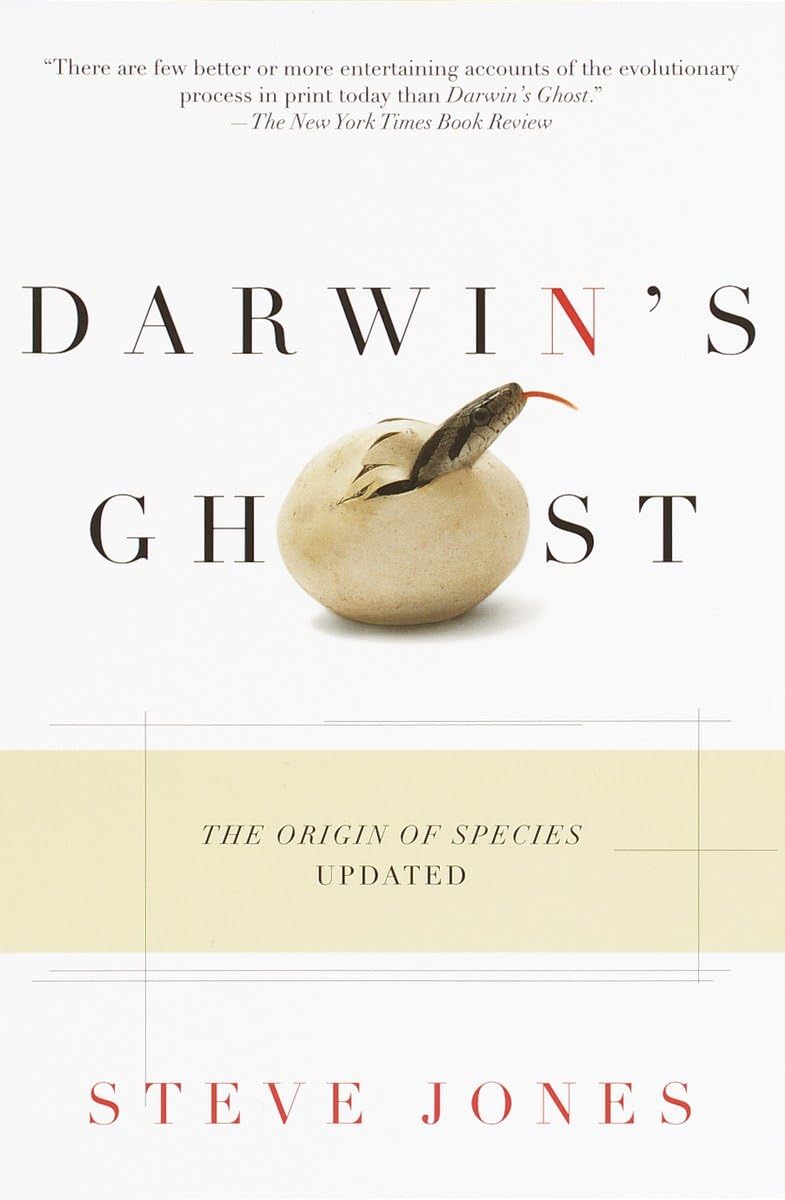



Charles Darwin's The Origin of Species is probably the best-known, least-read book. One of the most important achievements of the past millennium, it did for biology what Galileo did for astronomy: made it into a single science rather than a collection of unrelated facts. Important though Origin remains, its examples and intricate Victorian prose are now a century and a half old. They are ripe for renewal and reaffirmation. Writing as "Darwin's ghost," eminent geneticist Steve Jones updates this seminal work—and restates evolution's case for the 21st century. Jones is a writer of engaging wit and dazzling erudition and has been called "the British Carl Sagan." Using modern examples—the AIDS virus, the puzzles of sexual selection, the physiology and psychology of pets, and the unparalleled genetic success of our own species—he shows the power and immediacy of Darwin's great argument and makes us appreciate how it makes life make sense. Eye-opening and entertaining, filled with astonishing facts, amusing anecdotes, and the very latest research, Darwin's Ghost is contemporary science writing at its very best. "There are few better or more entertaining accounts of the evolutionary process in print today than Darwin's Ghost." --The New York Times Book Review "FASCINATING AND WITTY. . . WRITTEN WITH GREAT AUTHORITY AND A FLUID STYLE . . . [STEVE JONES IS A] SUPERIOR COMMUNICATOR--HUMANE, APPROACHABLE, FUNNY." --The Boston Sunday Globe Charles Darwin's The Origin of Species is probably the best-known, least-read book. One of the most important achievements of the past millennium, it did for biology what Galileo did for astronomy: made it into a single science rather than a collection of unrelated facts. Important though Origin remains, its examples and intricate Victorian prose are now a century and a half old. They are ripe for renewal and reaffirmation. Writing as "Darwin's ghost," eminent geneticist Steve Jones updates this seminal work—and restates evolution's case for the 21st century. Jones is a writer of engaging wit and dazzling erudition and has been called "the British Carl Sagan." Using modern examples—the AIDS virus, the puzzles of sexual selection, the physiology and psychology of pets, and the unparalleled genetic success of our own species—he shows the power and immediacy of Darwin's great argument and makes us appreciate how it makes life make sense. Eye-opening and entertaining, filled with astonishing facts, amusing anecdotes, and the very latest research, Darwin's Ghost is contemporary science writing at its very best. Charles Darwin's The Origin of Species is probably the best-known, least-read book. One of the most important achievements of the past millennium, it did for biology what Galileo did for astronomy: made it into a single science rather than a collection of unrelated facts. Important though Origin remains, its examples and intricate Victorian prose are now a century and a half old. They are ripe for renewal and reaffirmation. Writing as "Darwin's ghost," eminent geneticist Steve Jones updates this seminal work--and restates evolution's case for the 21st century. Jones is a writer of engaging wit and dazzling erudition and has been called "the British Carl Sagan." Using modern examples--the AIDS virus, the puzzles of sexual selection, the physiology and psychology of pets, and the unparalleled genetic success of our own species--he shows the power and immediacy of Darwin's great argument and makes us appreciate how it makes life make sense. Eye-opening and entertaining, filled with astonishing facts, amusing anecdotes, and the very latest research, Darwin's Ghost is contemporary science writing at its very best. Steve Jones is Professor of Genetics at University College London and has worked at universities in the U.S., Australia and Africa. His previous books include The Language of the Genes and In the Blood. According to a 1991 opinion poll, a hundred million Americans believe that "God created man pretty much in his present form at one time during the last ten thousand years." A large majority saw no reason to oppose the teaching of creationism in schools. They followed in a long tradition. A text of 1923, Hell and the High Schools, claimed that: "The Germans who poisoned the wells and springs of northern France and Belgium and fed little children poisoned candy were angels compared to the text-book writers and publishers who are poisoning the books used in our schools . . . Next to the fall of Adam and Eve, Evolution and the teaching of Evolution in tax-supported schools is the greatest curse that ever fell upon this earth." Fifty pieces of legislation tried to put a stop to the subject. All failed. Undeterred, Alabama called for a note to be pasted into textbooks: "This book may discuss evolution, a controversial theory some scientists give as a scientific explanation for the origin of living things, such as plants, animals and humans . . . No one was present when life