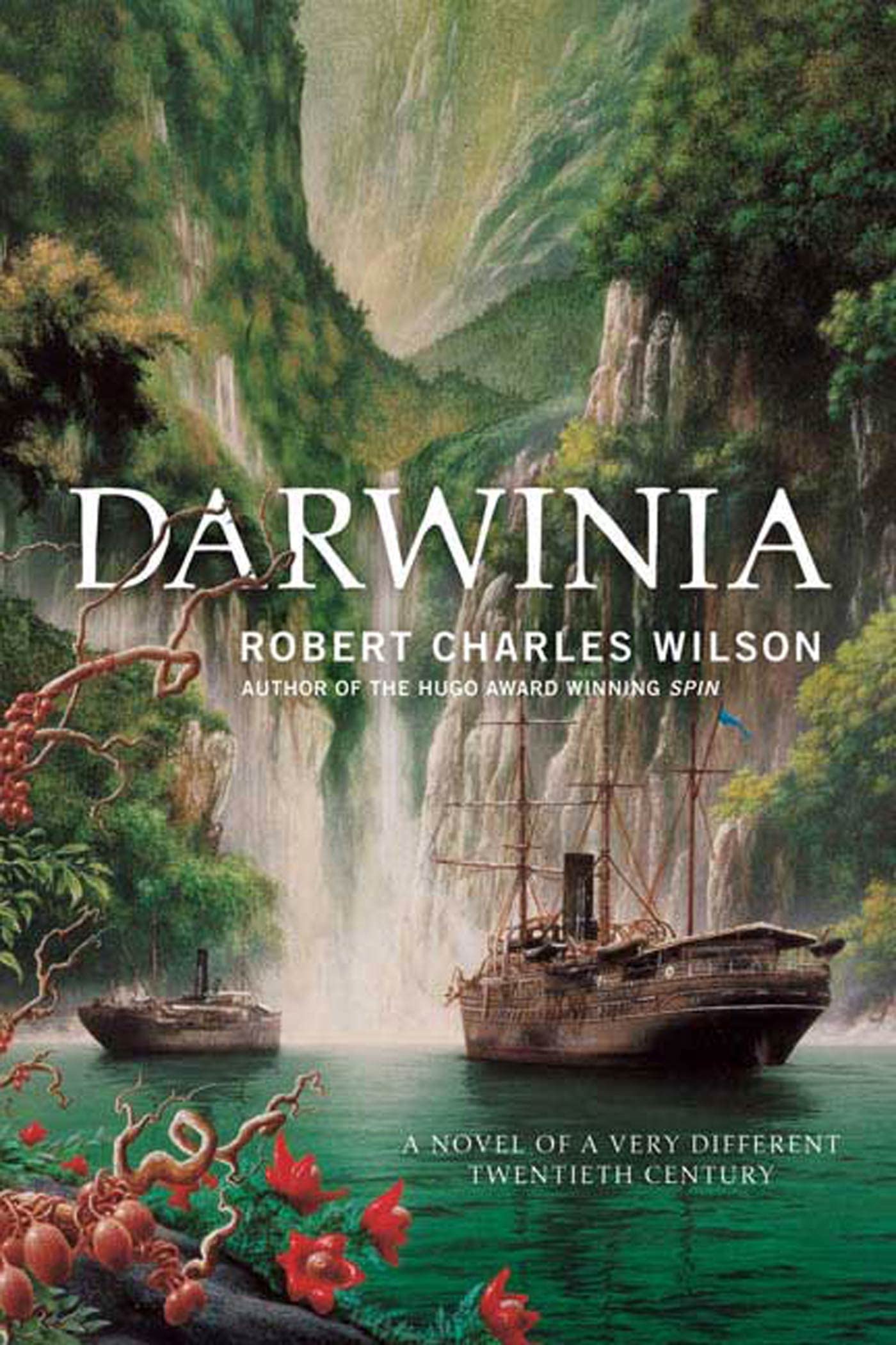



In 1912, history was changed by the Miracle, when the old world of Europe was replaced by Darwinia, a strange land of nightmarish jungle and antediluvian monsters. To some, the Miracle was an act of divine retribution; to others, it is an opportunity to carve out a new empire. Leaving an America now ruled by religious fundamentalists, young Guilford Law travels to Darwinia on a mission of discovery that will take him further than he can possibly imagine…to a shattering revelation about mankind's destiny in the universe. Robert Charles Wilson has crafted a brilliant science fiction novel―a view of an utterly different 20th century. Darwinia is a 1999 Hugo Award Nominee for Best Novel. “In the best tradition of Edgar Rice Burroughs, Jules Verne, and H. G. Wells…A page-turner.” ― Toronto Globe and Mail on Darwinia “Rich, lucid, and literate…Comparable to Philip D. Dick or A. E. Van Vogt. Remarkable indeed.” ― Publishers Weekly (starred review) on Darwinia “Robert Charles Wilson is a hell of a storyteller.” ― Stephen King, Entertainment Weekly, on Spin Robert Charles Wilson was born in California and lives in Toronto. His novel Spin won science fiction’s Hugo Award in 2006. Earlier, he won the Philip K. Dick Award for his debut novel A Hidden Place; Canada’s Aurora Award for Darwinia; and the John W. Campbell Award for The Chronoliths. Darwinia By Wilson, Robert Charles Orb Books Copyright © 2007 Wilson, Robert Charles All right reserved. ISBN: 9780765319050 CHAPTER ONE The men who crewed the surviving steamships had invented their own legends. Tall tales, all blatantly untrue, and Guilford Law had heard most of them by the time the Odense passed the fifteenth meridian. A drunken deck steward had told him about the place where the two oceans meet: the Old Atlantic of the Americas and the New Atlantic of Darwinia. The division, the steward said, was plain as a squall line and twice as treacherous. One sea was more viscid than the other, like oil, and creatures attempting the passage inevitably died. Consequently the zone was littered with the bodies of animals both familiar and strange: dolphins, sharks, rorqual whales, blue whales; anguilates, sea barrels, blister fish, banner fish. They floated in place, milky eyes agape, flank against flank and nose to tail. They were unnaturally preserved by the icy water, a solemn augury to vessels unwise enough to make the passage through their close and stinking ranks. Guilford knew perfectly well the story was a myth, a horror story to frighten the gullible. But like any myth, taken at the right time, it was easy to believe. He leaned into the tarnished rail of the Odense near sunset, mid-Atlantic. The wind carried whips of foam from a cresting sea, but to the west the clouds had opened and the sun raked long fingers over the water. Somewhere beyond the eastern horizon was the threat and promise of the new world, Europe transformed, the miracle continent the newspapers still called Darwinia. There might not be blister fish crowding the keel of the ship, and the same salt water lapped at every terrestrial shore, but Guilford knew he had crossed a real border, his center of gravity shifting from the familiar to the strange. He turned away, his hands as chill as the brass of the rail. He was twenty-two years old and had never been to sea before Friday last. Too tall and gaunt to make a good sailor, Guilford disliked maneuvering himself through the shoulder-bruising labyrinths of the Odense , which had done yeoman duty for a Danish passenger line in the years before the Miracle. He spent most of his time in the cabin with Caroline and Lily, or, when the cold wasn’t too forbidding, here on deck. The fifteenth meridian was the western extremity of the great circle that had been carved into the globe, and beyond this point he hoped he might catch a glimpse of some Darwinian sea life. Not a thousand dead anguilates “tangled like a drowned woman’s hair,” but maybe a barrelfish surfacing to fill its lung sacs. He was anxious for any token of the new continent, even a fish, though he knew his eagerness was naive and he took pains to conceal it from other members of the expedition. The atmosphere belowdecks was steamy and close. Guilford and family had been allotted a tiny cabin midships; Caroline seldom left it. She had been seasick the first day out of Boston Harbor. She was better now, she insisted, but Guilford knew she wasn’t happy. Nothing about this trip had made her happy, even though she had practically willed herself aboard. Still, walking into the room where she waited was like falling in love all over again. Caroline sat with back arched at the edge of the bed, combing her hair with a mother-of-pearl brush, the brush following the curve of her neck in slow, meditative strokes. Her large eyes were half-lidded. She looked like a princess in an opium reverie: aloof, dreamy, perpetually sad. She was, Guilford thought, quite sim