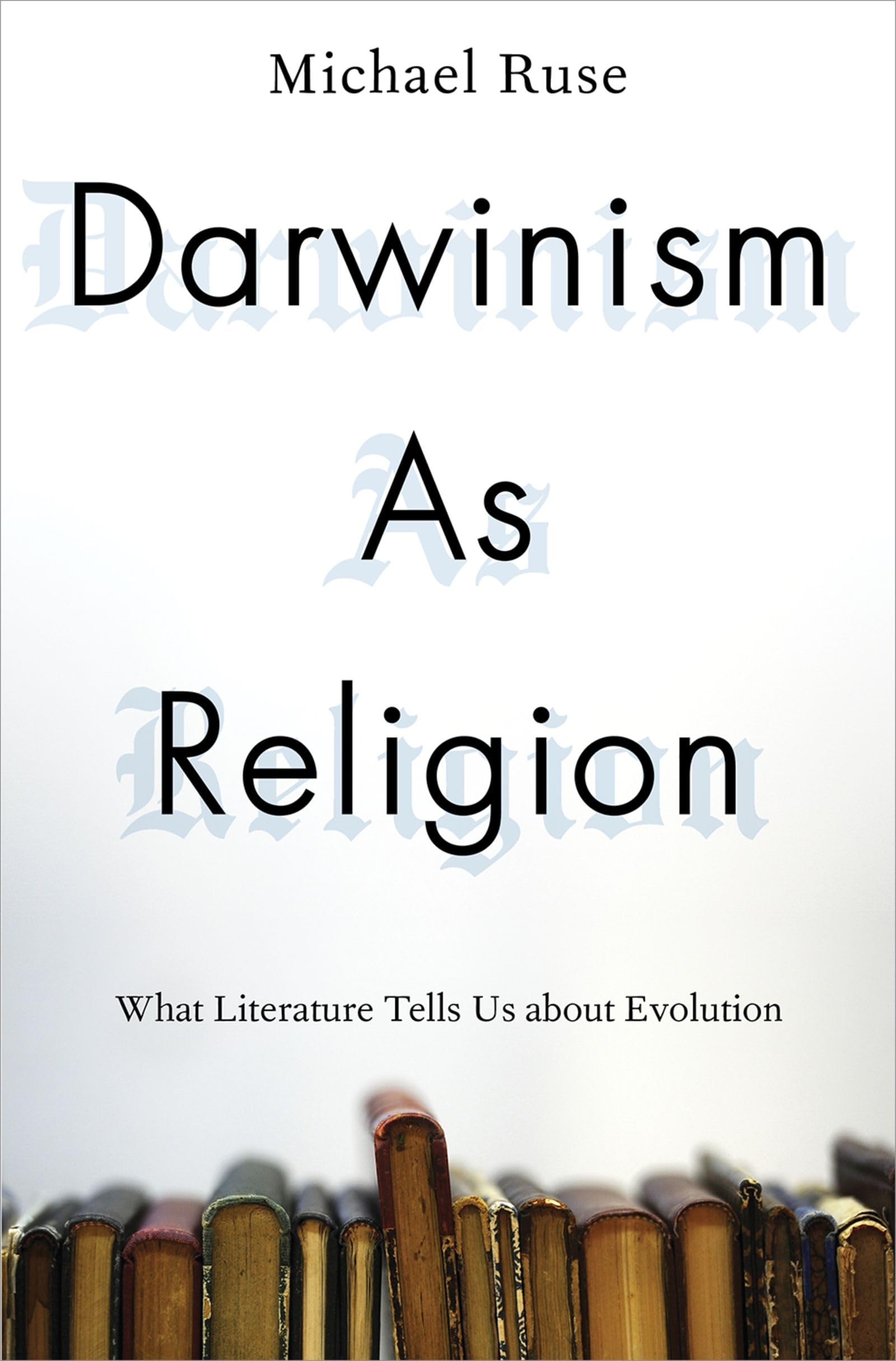



The Darwinian Revolution--the change in thinking sparked by Charles Darwin's On the Origin of Species, which argued that all organisms including humans are the end product of a long, slow, natural process of evolution rather than the miraculous creation of an all-powerful God--is one of the truly momentous cultural events in Western Civilization. Darwinism as Religion is an innovative and exciting approach to this revolution through creative writing, showing how the theory of evolution as expressed by Darwin has, from the first, functioned as a secular religion. Drawing on a deep understanding of both the science and the history, Michael Ruse surveys the naturalistic thinking about the origins of organisms, including the origins of humankind, as portrayed in novels and in poetry, taking the story from its beginnings in the Age of Enlightenment in the 18th century right up to the present. He shows that, contrary to the opinion of many historians of the era, there was indeed a revolution in thought and that the English naturalist Charles Darwin was at the heart of it. However, contrary also to what many think, this revolution was not primarily scientific as such, but more religious or metaphysical, as people were taken from the secure world of the Christian faith into a darker, more hostile world of evolutionism. In a fashion unusual for the history of ideas, Ruse turns to the novelists and poets of the period for inspiration and information. His book covers a wide range of creative writers - from novelists like Voltaire and poets like Erasmus Darwin in the eighteenth century, through the nineteenth century with novelists including Elizabeth Gaskell, George Eliot, Thomas Hardy, Henry James and H. G. Wells and poets including Robert Browning, Alfred Tennyson, Walt Whitman, Emily Dickinson and Gerard Manley Hopkins, and on to the twentieth century with novelists including Edith Wharton, D. H. Lawrence, John Steinbeck, William Golding, Graham Greene, Ian McEwan and Marilynne Robinson, and poets including Robert Frost, Edna St Vincent Millay and Philip Appleman. Covering such topics as God, origins, humans, race and class, morality, sexuality, and sin and redemption, and written in an engaging manner and spiced with wry humor, Darwinism as Religion gives us an entirely fresh, engaging and provocative view of one of the cultural highpoints of Western thought. "[T]he point of Ruse's book is not to analyze the details of the arguments for and against Darwinism as a religion. Rather, Ruse seeks simply to demonstrate the existence of such a religious perspective, and to show that its influence can be fruitfully studied by analyzing literature. In this task Ruse succeeds, and his book will surely inspire further research into the topic." --Erkki Vesa Rope Kojonen, Reading Religion "The contribution of Ruse's book lies in the breadth and accessibility of its account of the intersection of Darwinism and imaginative literature."--Charles LaPorte and Joseph LaPorte, Los Angeles Review of Books "This is certainly not conventionally an academic book: it's copious, opinionated, sweeping. It is also wonderfully impassioned. The book comes bubbling up out of a deep well of enjoyment. Professor Ruse has read an immense array of Victorian and later anglophone literature and shares his surprise and pleasure in it. He has read it all with eyes that have also focused intensely on Charles Darwin's ideas and their influence. His pursuit in this study is inclusiveness: he is absorbed in close-grained appreciation of particular cases and curious instances...the pleasure of the work is its intensely personal reading of deep questions that have preoccupied writers, and people at large, over the last hundred and fifty years." -- Dame Gillian Beer, DBE, King Edward VII Professor of English Literature Emeritus, University of Cambridge, and author of Darwin's Plots "Michael Ruse traces various notions of progress and of natural religion that came to offer a comfortable nest for the fledgling evolutionary theory in the mid-Nineteenth Century, and he follows its flight into celestial realms, showing how Darwinism became transformed into a kind of religion. He detects the path of this new theology especially as it was manifested in the novels and poetry of the period. Ruse reveals a dimension to the works of Eliot, London, Dreiser, Hardy, Sinclair, and Steinbeck that lay in the shadows. Even social patterns displayed by Henry James's characters are refracted differently through Ruse's scholarship. Ruse's touch is light and his insights multiple." -- Robert J. Richards, Morris Fishbein Distinguished Service Professor of History of Science, University of Chicago "A solid literary analysis by a well-read, fair-minded author...Ruse has done a great work to produce this volume. It adds to the field of scholarship on the topic and is a great addition to the library of both Christians and atheists seeking to understand the histori