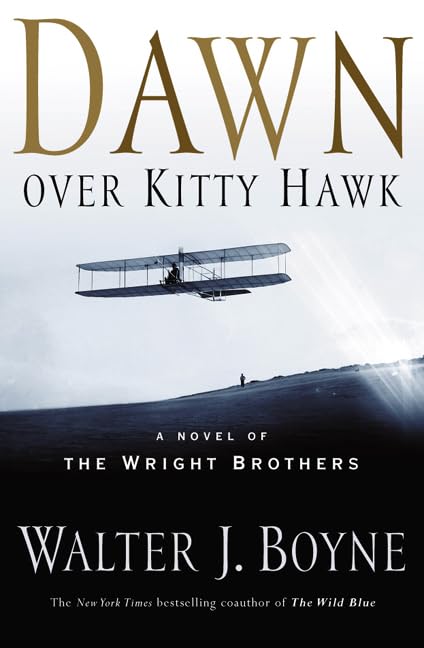



The names Wilbur and Orville Wright stand out in history as the inventors of the airplane, but lost in history are those who in the closing years of the nineteenth century and the first years of the twentieth shared the same passion: to develop the first powered aircraft. Some spent entire lives and fortunes chasing the dream, including men like the embittered Augustus Herring, who'd flown a heavier than air machine for several seconds in 1898; the pompous Samuel Pierpont Langley, of the Smithsonian Institution, who was backed by the US War Department, and even the legendary American inventor Alexander Graham Bell. These men, along with European competitors such as Louis Blériot, chased what many believed to be the impossible dream of manned, powered flight. But the Wright Brothers were the first to succeed, thanks to a combination of courage, genius, and downright stubbornness! Many followed in their footsteps, including such arch-competitors as Glenn Curtiss. The Wright Brothers' father was a huge factor who dominated their lives, trying to control their every thought and action. A bishop of the United Brethren Church, Milton Wright wanted his sons to succeed in their bicycle shop in Dayton, Ohio, not risk their lives. Bishop Wright saw no reason for his sons to risk everything on an isolated, windy beach in faraway North Carolina a beach called Kitty Hawk. He tried to quash their dream, but Orville and Wilbur rebelled, ultimately proving the impossible by flying on December 17, 1903. They brought the dawn of aviation, the industry that dominated the twentieth century and set the stage for the space race. With the hundredth anniversary of Wilbur and Orville Wright's flight at Kitty Hawk, several nonfiction books have commemorated the historic event. Now comes a novel about these brothers who developed the first powered aircraft. Blending fact and fiction, Boyne offers an interesting cast of characters, primarily Wilbur and Orville, who owned a bicycle shop, and their father, Milton, a 70-year-old preacher who opposed his sons' plans to fly, fearing they would be killed. But there is also sister Katharine, who is having a torrid affair with a friend; Samuel Langley, a scientist and secretary of the Smithsonian Institution; and Octave Chanute, an aeronautics expert. But let us not forget Albert Blohm, a scientist and professor who tried to repudiate the Wright brothers' claim to be the first to fly; Annette Coujade, Blohm's mistress; and Augustus Herring, an aviation pioneer. The love affairs may be fact or fiction, but Boyne, a former director of the National Air and Space Museum and author of Weapons of Desert Storm (1991), has written an absorbing book, rich in detail. George Cohen Copyright © American Library Association. All rights reserved Walter J. Boyne is the former Chairman of the Board of Wingspan, the Air and Space Aviation Channel, and President of his own firm, Walter Boyne Associates. The author of 42 books, he is one of the few persons to have had best sellers on both the fiction and the non-fiction list of the New York Times. His books have been published in nine countries. His Beyond the Wild lue: A History of the United States Air Force was made into a five part television series for the History Channel, and his Clash of Wings: World War II In The Air was made into a thirteen party series for PBS. Boyne hosted and narrated both series. A career Air Force officer, Boyne retired as a Colonel with 5,000 hours flying time in everything from the T-6 to the B-1B. After his retirement in 1974, he joined the National Air & Space Museum of the Smithsonian Institution. He became Acting Director in 1981 and Director in 1983. Upon his retirement in 1986, he began a third career of writing and consulting. His fourth career, in television, began seven years ago when he co-founded Wingspan the Aviation Channel, of which he was Chairman of the Board. His consulting clients include aviation, publishing and television companies. A honor graduate of the University of California, Berkeley, with a BSBA, he graduated magna cum laude from the University of Pittsburgh with an MBA. He received an honorary Doctorate of Aeronautical Science from Salem University in West Virginia. He is married to his wife of 50 years, Jeanne; they have four adult children, five paragons of virtue grandchildren, two priceless dogs and two perfect cats. CHAPTER 1 She'd been dead these seven years, but the image of Susan Wright still loomed large in the Bishop's consciousness. She had been a good wife: docile, obedient, and handy around the house. And she knew how to take care of her husband's needs--she had given him pleasure in bed, decorous but spirited, able to take part in God's gift of marriage with a good will and even sometimes with a laugh. She'd delivered seven children and five had survived; he still regretted the loss of the twins and celebrated their birthday every year, just as he did for the other childr