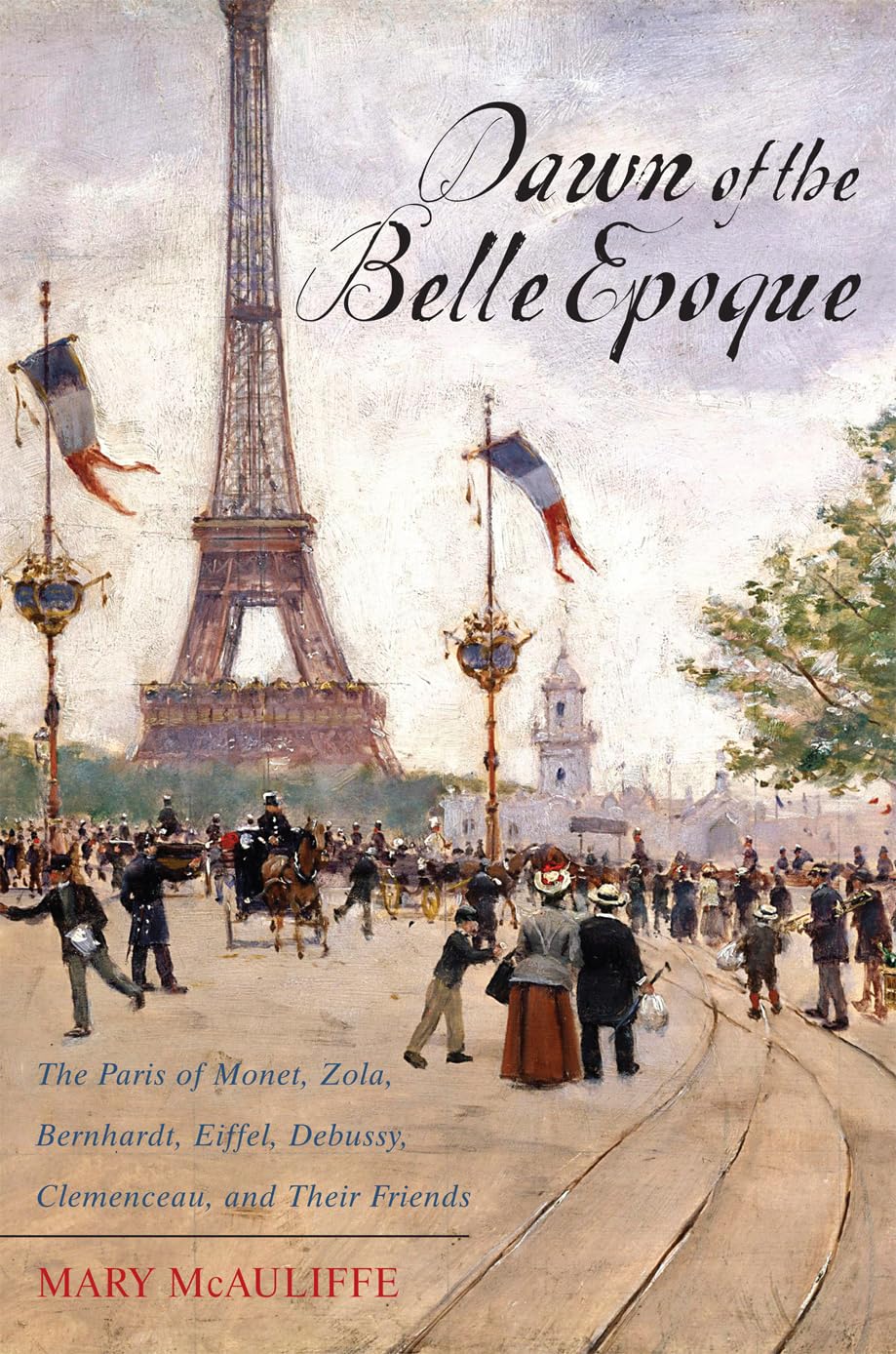
Dawn of the Belle Epoque: The Paris of Monet, Zola, Bernhardt, Eiffel, Debussy, Clemenceau, and Their Friends
$26.20
by Mary McAuliffe



A humiliating military defeat by Bismarck's Germany, a brutal siege, and a bloody uprising―Paris in 1871 was a shambles, and the question loomed, "Could this extraordinary city even survive?" With the addition of an evocative new preface, Mary McAuliffe takes the reader back to these perilous years following the abrupt collapse of the Second Empire and France's uncertain venture into the Third Republic. By 1900, Paris had recovered and the Belle Epoque was in full flower, but the decades between were difficult, marked by struggles between republicans and monarchists, the Republic and the Church, and an ongoing economic malaise, darkened by a rising tide of virulent anti-Semitism. Yet these same years also witnessed an extraordinary blossoming in art, literature, poetry, and music, with the Parisian cultural scene dramatically upended by revolutionaries such as Monet, Zola, Rodin, and Debussy, even while Gustave Eiffel was challenging architectural tradition with his iconic tower. Through the eyes of these pioneers and others, including Sarah Bernhardt, Georges Clemenceau, Marie Curie, and César Ritz, we witness their struggles with the forces of tradition during the final years of a century hurtling towards its close. Through rich illustrations and vivid narrative, McAuliffe brings this vibrant and seminal era to life. “[In her] splendid . . . work, Dawn of the Belle Epoque, Mary McAuliffe strikingly evoked the three flourishing decades of culture that followed France’s humiliation by Germany and the never-to-be-forgotten crowning, in 1871, of a German emperor at Versailles.” ― The New York Times “Rising from the ashes of the Franco-Prussian War and the Commune, the tumultuous Third Republic's early years from 1870 to 1900, known as the Belle Epoque, was an era in which groundbreaking artists flourished: Monet, Eiffel, Rodin, Debussy, and other one-name legends. McAuliffe chronicles the story of Paris's rebirth, capturing the artistic freedom of impressionism in painting and music, and new ideas in sculpture and on the stage even as Republican secularists, lingering Communards, and the royalist Catholic hierarchy fought for political and popular control, a struggle wonderfully illustrated through the construction in this era of the Statue of Liberty, the Eiffel Tower, and the Basilique du Sacré Coeur. [McAuliffe offers] fascinating glimpses into the lives of each significant figure . . . including Sarah Bernhardt's, whose self-marketing could well have served as a blueprint for Lady Gaga. The author doesn't overlook the Dreyfus affair and economic hard times, but the relationships and creative output of the era's innovators create a marvelous vision of Paris at its heady, uncertain best.” ― Publishers Weekly “In Dawn of the Belle Epoque, Mary McAuliffe―who earned a Ph.D. from the University of Maryland and wrote for Paris Notes―tells the intriguing story of how Paris came alive again after that black period of French history. . . . To tell this incredibly complicated story, Ms. McAuliffe uses an interesting technique, one that might be identified more with fiction than nonfiction. Arranged chronologically into 28 chapters year by year from 1871 to 1900, the book consists of short scene-like vignettes featuring key historical figures and their actions during the year in question. Thus Dawn of the Belle Epoque reads more like a novel than an academic history. . . . Rich with the flavor of words taken from primary sources, the book provides an intimate look at the very human side of history. An extensive bibliography including French sources and 24 pages of endnotes allow for much further reading investigation. . . . Today's Paris rose from war and ashes, as Mary McAuliffe's Dawn of the Belle Epoque so eloquently proves.” ― New York Journal of Books “Today, Paris retains its allure as a mecca for lovers of art, fashion, and high culture. To an extent, that allure is a legacy of the Belle Epoque, an age from roughly the end of the Franco-Prussian War in 1871 to the onset of WWI in 1914. McAuliffe examines the earliest phase of the period, up to the turn of the century. As the term indicates, this was an era of wonderful cultural flowering. In literature, giants like Zola and Hugo were active. The list of painters and sculptors who emerged seems endless, including Toulouse-Lautrec, Manet, Monet, and Rodin. McAuliffe tracks, on a year-by-year basis, this explosion of artistic expression. She does not ignore the seamy underside of this glittering picture. She pays ample attention to the political turmoil, beginning with the horrors of the Paris Commune and ending with the disgrace of the Dreyfus Affair, which virtually dominated French political discourse for years. This is an excellent and honest portrayal of an exciting and vital era in European history.” ― Booklist “It is within this psychologically damaged milieu that McAuliffe deftly explores the inner lives of the artists and those who surround