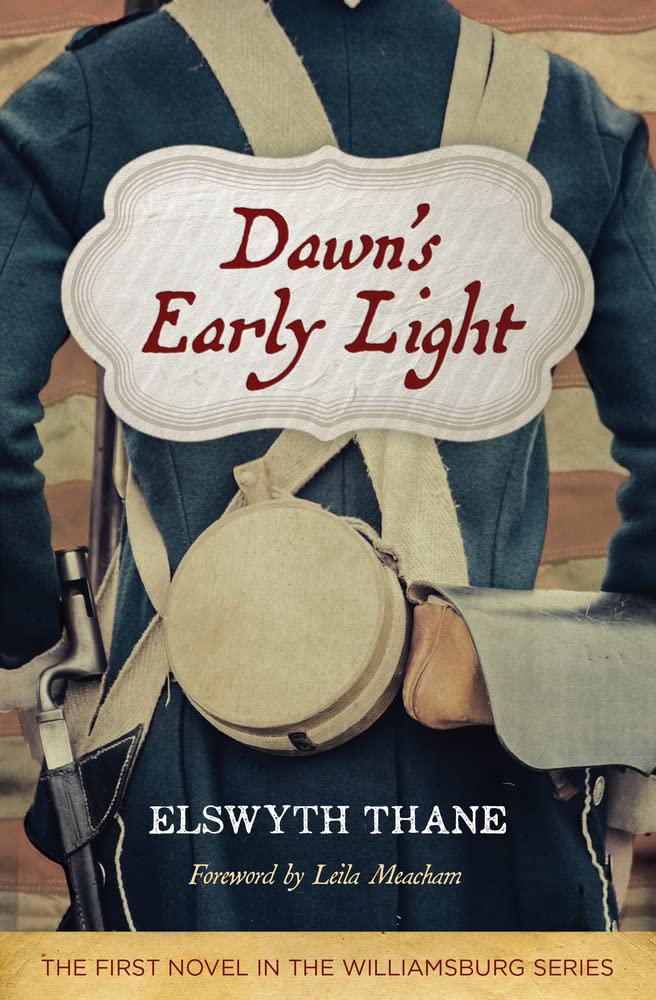



Elswyth Thane is best known for her Williamsburg series, seven novels published between 1943 and 1957 that follow several generations of two families from the American Revolution to World War II. Dawn’s Early Light is the first novel in the series. In it, Colonial Williamsburg comes alive. Thane centers her novel around four major characters: the Aristrocratic St. John Sprague, who becomes George Washington’s aide; Regina Greensleeves, a Virginia beauty spoiled by a season in London; Julian Day, a young schoolmaster who arrives from England on the eve of the war and initially thinks of himself as a Tory; and Tibby Mawes, one of his less fortunate pupils, saddled with an alcoholic father and an indigent mother. But we also see Washington, Jefferson, Lafayette, Greene, Patrick Henry, Francis Marion, and the rest of that brilliant galaxy playing their roles not as historical figures but as men. We see de Kalb’s gallant death under a cavalry charge at Camden. We penetrate to the swamp-encircled camp which was Marion’s stronghold on the Peedee. We watch the cat-and-mouse game between Cornwallis and Lafayette, which ended in Cornwallis’s unlucky stand at Yorktown. Dawn’s Early Light is the human story behind our first war for liberty, and of the men and women loving and laughing through it to the dawn of a better world. “A work of extraordinary historical fiction . . . a memorable testament to the price paid for our nation’s freedom.” —Leila Meacham, from her foreword Elswyth Thane (1900–1984) was the author of over thirty books of fiction and nonfiction. Leila Meacham is the bestselling author of Roses , Tumbleweeds , Somerset , and Titans , among others. Dawn's Early Light By Elswyth Thane Chicago Review Press Incorporated Copyright © 1943 Elswyth Thane All rights reserved. ISBN: 978-1-61373-812-2 Contents I WILLIAMSBURG NECK. 1774–1779, II THE CAROLINAS. 1780, III VIRGINIA. 1781, CHAPTER 1 Williamsburg Neck 1774–1779 I He stood remote and alone amid the cheerful bustle of the dock at Yorktown. Around his feet in their silver-buckled shoes was stacked enough luggage for two men. Behind him rose the proud, sharp prow and slender spars of the Mary Jones, which had brought him across the Atlantic from Southampton. The hot Virginia sun was in his eyes below the point of his tricorne. He wore his own brown hair unpowdered and tied with a black ribbon notched into swallow-tails. His blue broadcloth coat and knee breeches were London-cut, making the most of his rather overgrown height, his narrow waist and straight back. A black cloak lined with silk was folded over his arm. He would have, if he ever filled out a bit, an excellent leg. It was his twenty-first birthday. Patiently in the pelting sunlight he surveyed the ambling colored longshoremen who threw ropes to one another, or passed heavy boxes from hand to hand in a sweating chain, or toiled past him under towering bales of goods, while good-natured white men bawled orders at them. To look at him, one would never have guessed at the hollowness of his inside. He was not new to travel. He had seen Rome and Berlin and Paris and Vienna — to say nothing of Edinburgh, Bath, and his native London. The noise and excitement of a ship's arrival in port were familiar to him. Since childhood he was accustomed to see strange sights and smell strange odors and hear strange speech. But now, at the beginning of a new year in his life, he stood on the threshold of a new continent — quite alone. He felt the way he had felt on his first day as a scholar at Winchester. He felt the necessity of a stiff upper lip. Finally a man a little older than himself, with a thin, sunbrowned face, approached him through the confusion. "You must be Julian Day," he said, and the tall boy bowed. "I have been wasting my time trying to find the captain to introduce me. I'm Sprague, from Mr. Wythe's law office in Williamsburg. Mr. Wythe did me the honor to send me down to welcome you and your father to Virginia." "That is very kind. My father died at sea." The simple words fell gently into the clamor all about them. Young Mr. Sprague's sympathy sprang quick and sincere. "My dear fellow," he said, and set his hand briefly on the dark blue sleeve. "They read a service and put him over the side three days ago." "I'm sorry, I — can't seem to think of the right thing to say," Sprague confessed in genuine distress. "But perhaps the best thing I can do is to get you away from here at once. I've got a coach waiting, and I have engaged rooms for you at Williamsburg. That is —" He tripped on his own words, and his honest eyes were anxious. "That is, now that you are here, you will, of course, come on to Williamsburg?" "I suppose so," said Julian Day. "I don't mean to sound ungracious, I just —" He made a little gesture with his empty hands. "— I just seem to have no plans!" The hot, overpowering scent of tar and tobacco and bi