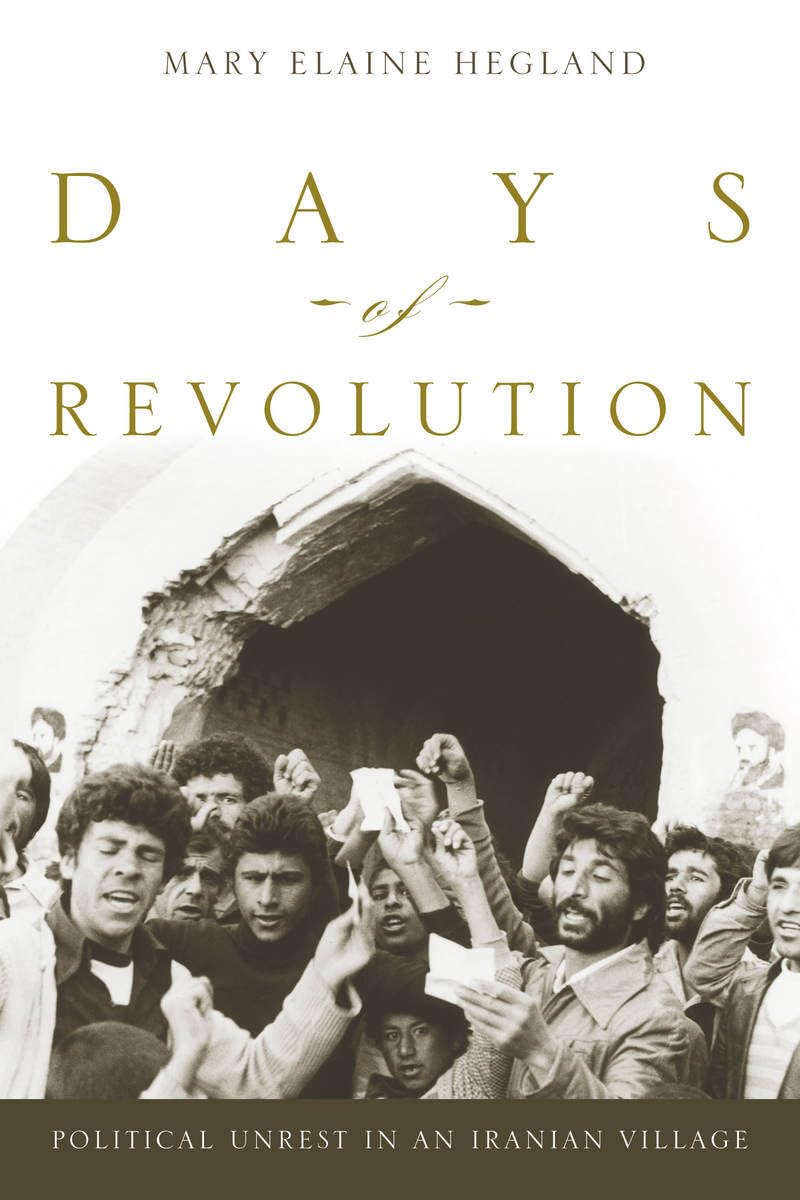



Outside of Shiraz in the Fars Province of southwestern Iran lies "Aliabad." Mary Hegland arrived in this then-small agricultural village of several thousand people in the summer of 1978, unaware of the momentous changes that would sweep this town and this country in the months ahead. She became the only American researcher to witness the Islamic Revolution firsthand over her eighteen-month stay. Days of Revolution offers an insider's view of how regular people were drawn into, experienced, and influenced the 1979 Revolution and its aftermath. Conventional wisdom assumes Shi'a religious ideology fueled the revolutionary movement. But Hegland counters that the Revolution spread through much more pragmatic concerns: growing inequality, lack of development and employment opportunities, government corruption. Local expectations of leaders and the political process―expectations developed from their experience with traditional kinship-based factions―guided local villagers' attitudes and decision-making, and they often adopted the religious justifications for Revolution only after joining the uprising. Sharing stories of conflict and revolution alongside in-depth interviews, the book sheds new light on this critical historical moment. Returning to Aliabad decades later, Days of Revolution closes with a view of the village and revolution thirty years on. Over the course of several visits between 2003 and 2008, Mary Hegland investigates the lasting effects of the Revolution on the local political factions and in individual lives. As Iran remains front-page news, this intimate look at the country's recent history and its people has never been more timely or critical for understanding the critical interplay of local and global politics in Iran. "This refreshingly people-centred account of the Revolution drama in Iran in 1979 uses a new focus to demonstrate and understand how the Revolution happened in one large village in Iran, what preceded it there and how local people fit their own situations into the revolutionary frame . . . Well written [...], this book is a gem in political anthropological writing. No other text about modern Iran provides such clear insights into the relationships among political, economic and cultural factors, between the personal and political, rural and urban dynamics in rapid culture change in Iran."―Erika Friedl, Anthropology of the Middle East "The account she skillfully weaves is one of the more engaging studies of Iranian culture to come out in recent years. The personal details of a young American with a one-year-old child settling in to do research in Aliabad, near Shiraz, is captivating as well as instructive in the best reflexivist manner. Being an American at the time of the Iranian revolution created problems beyond the usual settling-in tropes, but also provided an opportunity to witness the revolution from the group up . . . [I]t is her acute observation and interaction that inform her work. The primary value of Hegland's study is her narration of the Iranian revolution outside Tehran. She provides a detailed account of the local economic and political history in cultural context."―Daniel Martin Varisco, Contemporary Islam "There are a few ethnographic works dealing with politics at a rural level and almost none on the intersection of the revolutionary politics and inner family―kinship dynamics. Mary Hegland's book fills such a gap by offering a close look at how a village becomes engaged and affected by a revolution . . . Written as a clear, lively, and meaningful ethnography, Days of Revolution narrates Hegland's field experiences and demonstrates the dynamics of political engagement at the rural level, interrelations of local influential characters, and the forces and mechanisms connecting local politics to national processes."―Ali-Akbar Mahdi, American Anthropologist "Through numerous interviews and eighteen months of participant observation, Hegland is able to decipher the individual and collective norms, practices, and perceptions related to traditional, kinship-based political competition and conflict that influenced peasants to join or resist the revolution . . . Beyond Iranian history and politics, Days of Revolution will equally appeal to readers with a broader interest in revolutions and social movements . . . Days of Revolution is an impressive work and makes a significant contribution to the scholarship on Iran, revolutions and social movements."―Eric Lob, Anthropology of the Contemporary Middle East and Central Eurasia "In this fascinating study, written with the hindsight of 34 years, Hegland shows that in Iran, no less than in America, the late Speaker of the House of Representatives Tip O'Neill's adage that 'all politics is local' applies."―Jonathan G. Katz, Middle East Journal "There are a great number of books on the Islamic Revolution, but none have accomplished what Mary Hegland has. This is an exceptional study of modern Iran, offeri