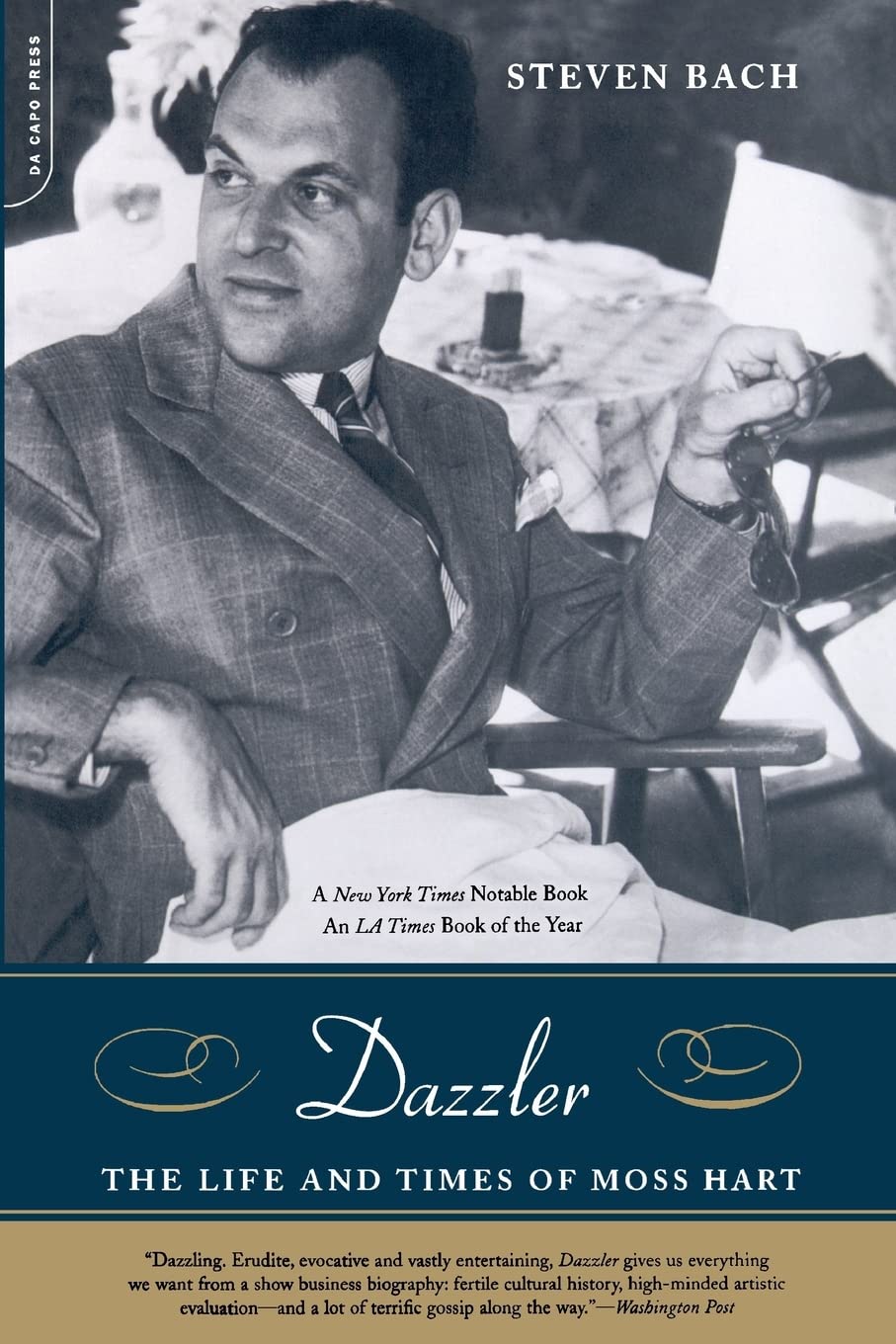



From the Algonquin Round Table to the Gershwins and the Hollywood moguls, Moss Hart knew and delighted everybody. Vanity Fair has called him "one of American theater's greatest geniuses," the man responsible for such indelible successes as A Star Is Born , Camelot , and My Fair Lady . His rags-to-riches autobiography, Act One , became one of the most successful and beloved books ever published about the lure of the theater. But it ended at the beginningwhen Hart was only twenty-five. Now, at last, we have the whole and far richer story in this first full-scale biography of "the Prince of Broadway." Here Steven Bach explores the private Moss Hart, revealing his struggles with self-doubt, depression, and sexual identity, and the public one, recounting his creativity and charisma, his wit and grace. With thorough research and graceful prose, Steven Bach takes us on a journey to another time and place, where one man created a dazzling world for himself and for all American theatergoers. "Bach's sensitive handling of the private and public ...weaves a life that is balanced, whole, and fascinating." -- Eric Lax, Los Angeles Times Steven Bach , author of the bestselling Final Cut and Marlene Dietrich , teaches at Columbia University and Bennington College and divides his time between Europe and the United States. Dazzler The Life and Times of Moss Hart By Steven Bach Da Capo Press Copyright © 2002 Steven Bach All right reserved. ISBN: 9780306811357 Chapter One Broadway Baby The residents of Manhattan are to a large extent strangers who have pulledup stakes somewhere and come to town, seeking sanctuary or fulfillment or somegreater or lesser grail. The capacity to make such dubious gifts is a mysteriousquality of New York. It can destroy an individual, or it can fulfill him,depending a good deal on luck. No one should come to New York to live unless heis willing to be lucky. ?E. B. White "I was born on Fifth Avenue," Moss Hart liked to say. Then, when eyebrows hadgone up all over the room, he would ricochet the very notion with a punch line:"The wrong end!" The joke always worked, but was never as self-deprecating as itsounded; he wanted you to know how far he'd come. Wherever he was?in the precincts of the Shuberts and Ziegfelds or theplaygrounds of the Thalbergs and Zanucks, on croquet lawns or in paneled drawingrooms?was Broadway. When he walked into the room, people say, the party gotbetter, and because it did he loved to call himself "the Darling of Everyonethere," no matter where "there" was. But the airy witticism floated oh socasually over cocktails or at Sardi's had been as carefully rehearsed in theshaving mirror as any actor's speech on any stage. He had a performer's timingand need for applause and a style so theatrical no mere actor would have daredpull it off. What made his grand manner easy to like was his unabashed love forthe Broadway he came to personify. Even when his ardor for it was unrequited, hecouldn't wait to entertain you with tales of his rejection, hilarious orheart-rending or both. He was not born on any end of Fifth Avenue, but in a tenement at 74 East 105thStreet, a neighborhood not of carriages and hansom cabs, but of dray wagons,pushcarts, and immigrants. It was an uptown version of the Lower East Side andnot much farther from Broadway, he liked to quip, than, say, Yakima, Washington. The tenement he was born in fell long ago to the wrecker's ball. In its placestands the DeWitt Clinton housing project, just where East 105th Street isinterrupted by a hard-packed urban playground behind a chain-link fence. Aromasin the air today are not from the shtetl, but from the islands. Neighborhoodwisdom comes not from rabbis, but from psychics and palm readers who hang neonpromises in storefront windows. One suspects that few of them know or care thatjust a few blocks away a museum dedicated to the city of New York celebratesHart as a son of this very neighborhood. What remains of him uptown is mostlybehind glass: some glossy eight-by-tens, a tarnishing cigarette case, anddog-eared contracts that hint at the terms and conditions of fame and fortune onBroadway. On the day Hart was born?October 24, 1904?this part of town was dominated notby nearby Central Park, but by the New York Central Railroad roaring north andrattling fire escapes all the way to the East River. The trains rumbled througha tunnel beneath what we now call Park Avenue and emerged into daylight, as itdoes today, at Ninety-sixth Street, where the tracks climb above ground to runin the channel of a stone viaduct. Those massive walls built to protect UpperEast Siders from the railroad?and vice versa?must have looked like the wallsof a prison in 1904. They still do, but modernity and mobility were popularissues early in the century and, to prove it, three days after Moss was born theNew York subway system opened for business. Hart's birthplace on East 105th Street drifted with railroad soot and