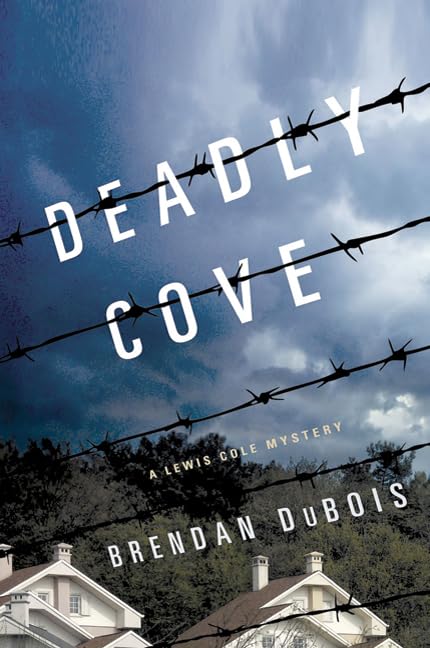



In Deadly Cove, the seventh novel in the Lewis Cole mystery series, magazine columnist and former Department of Defense research analyst Lewis Cole is covering an anti-nuclear protest when gunfire breaks out, injuring his journalist friend and killing a charismatic activist. Not content to let the professionals investigate this shooting, Cole begins to dig into the background of the murdered activist, as well as the anti-nuclear protesters who are gathering by the thousands on the New Hampshire seacoast, promising violent action in order to take over a nuclear power plant and halt its power production. But someone is also gunning after Cole, obstructing his investigation and making attempts on his life, as his inquiries bring him to question construction union members who favor nuclear power and the protesters who oppose it. In a time of economic uncertainty, when Cole’s own future is threatened, he presses ahead to solve this murder while also trying to protect the women who are closest to him. Award-winning author Brendan DuBois delivers another fascinating and adventurous mystery, starring a hero mystery fans will love. "Suspenseful, satisfying...Well-drawn and sympathetic characters add to the story's authenticity. The cliffhanger ending will leave series fans anxious for the follow-up."-- Publishers Weekly Brendan DuBois has received the Shamus and Barry Awards for his short fiction and has been shortlisted for three Edgar Awards. Along with six previous books in the Lewis Cole series, DuBois has published several suspense thrillers. He lives in New Hampshire with his wife. CHAPTER ONE I’m sure the events that autumn at the Falconer nuclear power plant will eventually spawn magazine articles, documentaries, and books about the demonstrations, the unsuccessful fight to keep the peace, the violence, and the tragic and unnecessary deaths, but all I know is the little corner of what I saw during those cold and gray days, and that corner was depressing enough. For me and thousands of others, it began on a Thursday afternoon in October when I was standing on a piece of land owned by a New England consortium of ten utilities, which was home to the only nuclear power plant in New Hampshire. Placed in Falconer, at the southernmost end of New Hampshire’s eighteen-mile shoreline, the property contained hundreds of acres with fields, marshes, and boxy concrete buildings that looked like they belonged in a 1950s science fiction film, complete with transmission lines heading out to the rest of New England, generating nearly twelve hundred megawatts of electricity and lots of controversy. The particular piece of land on which I stood jutted out onto the wide salt marsh, and on either side of me were members of the news media, including Paula Quinn, assistant editor and reporter for the Tyler Chronicle, and one of the two best writers in this part of the state. She’s a number of years younger than me, slim, and blond, and she was wearing jeans and a black wool coat. She had a digital Canon camera slung over one arm, and her small hands held a reporter’s notebook. With us there were also reporters from every major newspaper in New England, as well as the New York Times, and a host of television crews. We members of the alleged elite news media were looking out over a fence about fifty yards away, ringed on the top by three strands of barbed wire, with most of us shivering from the cold breeze coming off the ocean. Paula leaned into me. “The natives are restless.” I followed her look out to the salt marsh. “Most aren’t natives, but they’re restless enough.” Out beyond the fence a rocky outcropping fell to the flatlands of the salt marsh, a large expanse of grassland that flooded every high tide and was furrowed by creeks and old drainage ditches. Beyond the salt marshes toward the left and a couple of miles away was a thin strip of land with buildings that marked the beaches of Tyler and Falconer. To the right and much closer, a thick stream of people was emerging from wooded areas bordering the marsh, coming out onto the grasslands. They marched in ragged lines, chanting and yelling, waving banners and flags, a few beating drums. Some of the banners were huge, carried by a host of people, and even at this distance, I could make them out: NO NUKES. PEOPLE BEFORE PROFITS. SUN POWER, NOT NUKE POWER. Balloons on strings bounced and rippled above the demonstrators, and there were a couple of huge papier-mâché puppets. A few banners announced the name of the group supposedly in charge of the protesters: the Coalition for a Livable Future. The mass of people kept on streaming out and out, and Paula gave a nervous laugh. “You know, you look at those protesters … maybe they’ll do it this time. They might actually do it.” I did know, and though I knew the demonstrators were mostly peaceful, there was a little gnawing sense of unease that grew at the base of my skull. I thought of the outnumbered defenders of the Alamo