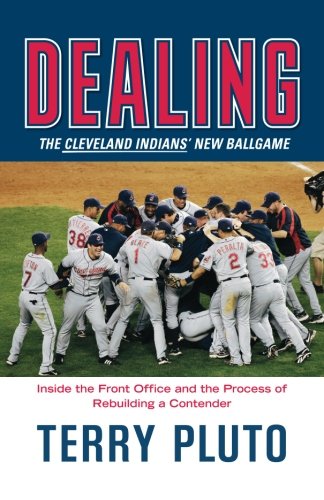
Dealing: Inside the Front Office and the Process of Rebuilding a Contender
$15.95
by Terry Pluto



For Indians fans who want to know what goes on inside the front office, this book tells all. It’s an in-depth look at how the team was taken apart and rebuilt as a contender again in spite of Major League Baseball’s competitive imbalance. Tribe fans grew accustomed to winning in the late 1990s. They had an owner with deep pockets, a brand-new ballpark, and a team of All-Stars who delivered a division championship nearly every year. Then, in 2002, the team’s new owners began a controversial plan to unload their popular but expensive stars and replace them with a steady stream of young prospects and veteran rehab projects. Critics scoffed, and fans stayed away. But by 2005 the plan showed promise with a 95-win season. And in 2007 it paid off, as the Indians beat the top-dollar Yankees in the playoffs and came within one game of the World Series—with a payroll less than half that of their competition. How did they do it? Veteran sportswriter Terry Pluto (who had unprecedented access to the Indians front office) carefully analyzes each big decision and tells which ones worked, which ones didn’t, and why. This rare behind-the-scenes look at a modern front office will intrigue any fan fascinated by baseball deal-making. A wealth of baseball detail that will intrigue serious fans and fantasy leaguers. Fair, honest and insightful throughout . . . The book is a compelling look at the Indians’ organizational thought process in what has become a challenging baseball market. -- Anthony Castrovince ― MLB.com Published On: 2006-06-27 There’s enough new stuff in “Dealing” that even diehard fans will learn something. The days of the sellout streak are over, and it’s often painful to read why . . . Rebuilding a baseball team is no easy task, and the Indians and Shapiro did it quicker than most. This is the story of how, and it’s a pretty good one. -- Jason A. Kline ― News-Journal Published On: 2006-06-04 Pluto’s surprisingly frank interviews with Shapiro, former manager Mike Hargrove, Indians president Paul Dolan and current manager Eric Wedge provide a fascinating glimpse into the gritty business of running a competitive big league club. -- Jim Vickers ― Cleveland Magazine Published On: 2006-05-01 For Tribe fans and serious baseball fans who are intrigued by the business side of the game, the book is a joy. Indians’ officials reveal their reasons for all the significant trades, free-agent signings and other baseball decisions of the past five years. -- Jerry Roche ― Smart Business Network Published On: 2006-08-01 It goes to a few places where “Moneyball” and Bob Costas have gone, but really, it’s almost the bookend for “Weaver on Strategy.” With Weaver, [Pluto] covered the on-the-field stuff, and here it’s behind-the-scenes. It teaches responsibility in a game where I don’t even want to think about the absurdity of the salaries. -- Mark Zimmerman ― WCRF FM Radio Published On: 2006-05-30 Terry Pluto is a sports and faith columnist for Cleveland.com/The Plain Dealer and the author of more than 30 books. He has twice been honored by the Associated Press Sports Editors as the nation’s top sports columnist for medium-sized newspapers and has received more than 50 state and local writing awards. He was called “Perhaps the best American writer of sports books” by the Chicago Tribune in 1997. “Is this team for sale?” Dick Jacobs Buys Low, Sells High He always wanted to get there first. Remember that about Dick Jacobs. He always believed in buying low, selling high. Remember that about Dick Jacobs, too. Those attributes explain why Jacobs bought the Indians after the 1986 season, and why he put them up for sale during the 1999 season, eventually cutting a deal with the Dolan family that led to a sale approved on January 19, 2000. Jacobs bought very low, sold very high. In between, he pulled off some very shrewd moves. He convinced the county to build Jacobs Field, which became one of the game’s new breed of cash-cow stadiums, gushing profits for Jacobs. Then he took the team to Wall Street, putting together a public stock offering that, over eighteen months, paid a 50 percent return to its investors, the biggest of whom was Dick Jacobs. No other Major League Baseball franchise had ever sold shares like this before. In between, the Indians had their best run in franchise history. Start with a story Jacobs told me before the 1995 season. I was asking him about business, how much money he’d make that year, how much he lost at the old stadium, the financial health of the franchise. He declined to talk recent profits, though he mentioned about $40 million in losses from 1987 to 1993. Instead, he talked about Swenson’s, an Akron hamburger joint, a drive-in with real carhops, still around, still a local legend. Jacobs grew up in the Goodyear Heights section of Akron, where he said you could smell burning rubber from the plant where his father worked. By the time he was ten years old, Jacobs was mowing lawns for nickels and