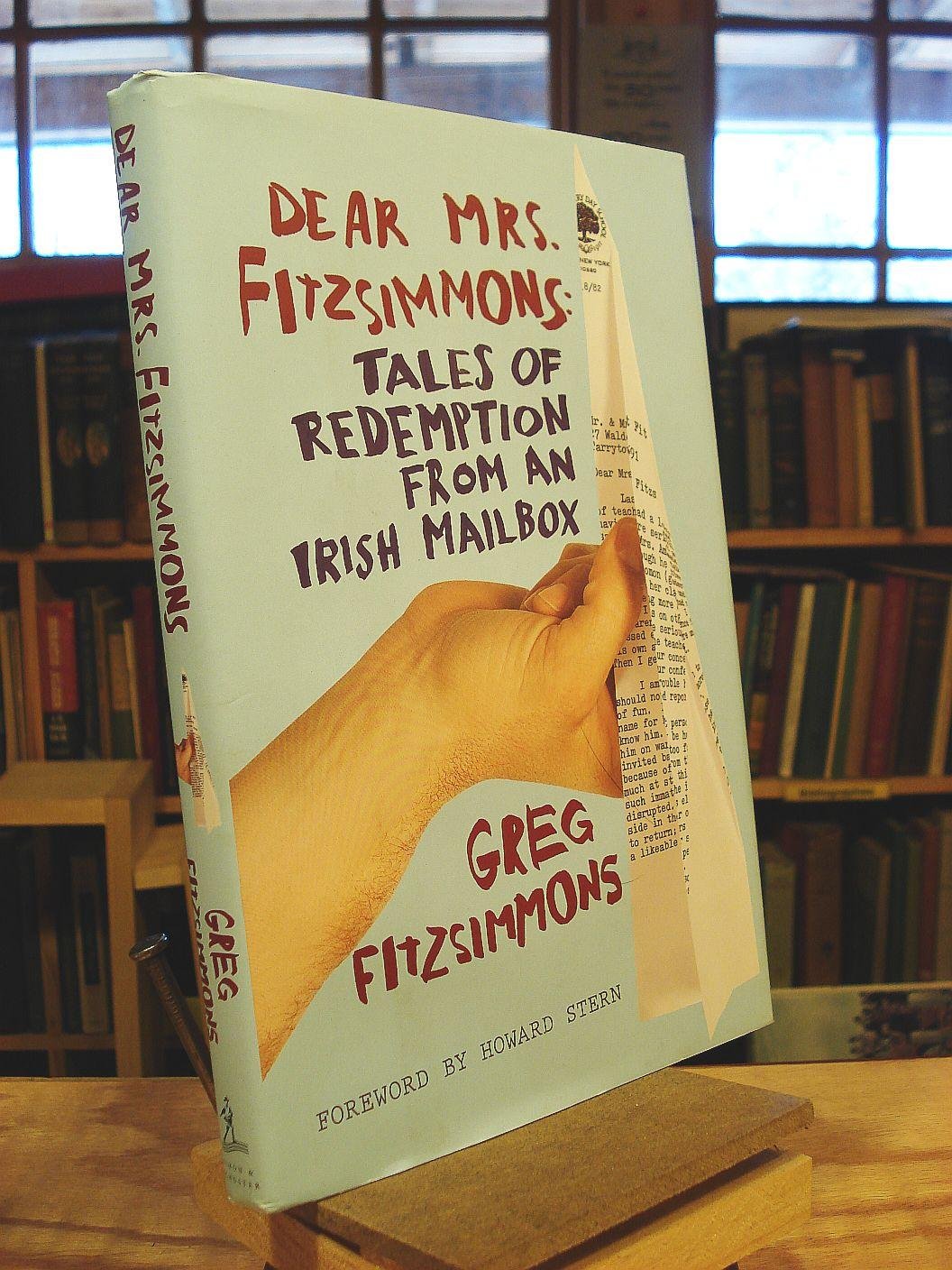
Dear Mrs. Fitzsimmons: Tales of Redemption from an Irish Mailbox
$12.26
by Greg Fitzsimmons



PARENT S: DO NOT TRY THIS AT HOME Greg Fitzsimmons has made a lot of what appear to be bad decisions. Its what he was raised to do. Most parents would hide or destroy any evidence so clearly demonstrating their childs failures, butlucky for usGreg Fitzsimmonss family has preserved each mistake in its original envelope like a trophy in a case, lest he ever forget where he came from. Dear Mrs. Fitzsimmons is Gregs life, told through this cavalcade of disciplinary letters, incident reports, and newspaper clippings that his parents received from teachers and school officials. Greg picks up where his parents left off with his own collection of letters received during college and throughout his successful career as a writer, producer, and stand-up comic. Revealing the larger story of how Gregs distinctly dysfunctional Irish-American family bred him to blindly challenge anyone, anytime, anywhere, over anything, Dear Mrs. Fitzsimmons comes full circle to show that the Fitzsimmons torch has been passed on proudly to a new generation. With a lethal (and improbably likeable) mix of wit and sarcasm Greg Fitzsimmons has achieved success as a stand-up, Emmy Award winning writer/producer and Radio/TV host. A regular with David Letterman, Conan O’Brien, Jimmy Kimmel, and Jay Leno, Greg has made more than fifty visits to “The Howard Stern Show” and hosts his own weekly radio show on Sirius XM’s "Howard 101.” His bi-weekly podcast "FITZDOGRADIO" is one of the most downloaded on iTunes. Kick Me, I’m Irish Their wailing cries shook the very heavens, and my four green fields ran red with their blood, said she. —Traditional Irish ballad Patricia Marie Judith McCarthy Fitzsimmons did not receive a very good education—not at home and not in Catholic school. Fifteen years of abuse from the nuns at St. Benedict’s Catholic School left her feeling below average. Most of the holy sisters had signed up for the “I’m a lesbian in the 1950s, so hide me in a nunnery” program. Instead they were directed to their worst nightmare: teaching pasty-faced wiseass Irish and Italian kids (who became their human punching bags). From what I understand, both of my parents got into a lot of trouble in their Catholic schools. The worst part was that if they told their folks that the nuns had slapped them around, their parents would beat them again. It’s the classic Irish “double beating.” What endured was a reflexive disrespect for authority. While my mom is the first person to stop and help a homeless person, a cashier undercharging her was seen as a stroke of good luck. Any rule that meant extra effort or less fun for her kids was stamped “irrelevant.” Height lines for a roller coaster were for wimpy kids, not us. This attitude never affected her love of people and joy for life. She has always left an indelible mark on everyone she meets. When my mother flies, she takes a long cab ride to the airport. Without exception, whether the driver is fat or elderly, black or Hispanic—it doesn’t matter—when he arrives at the airport, he gets out of the cab, pulls my mom’s bag from the trunk, and then gives her a hug. Because she listened to him for the entire ride; she laughed with him and cared about what he told her. But if he undercharged her, she didn’t say shit about it. My mother was the youngest of six kids (one died young from tuberculosis). Both her parents immigrated here as teenagers by themselves before meeting at a church dance in the Bronx. Pop worked for Con Edison (the electric company) for forty years and, after retiring, worked part-time at Baskin-Robbins so he could swipe ice cream for the grandkids. He’d cheerfully deliver pints of bright green chocolate chip mint during every visit, and his fridge was packed with the stuff. Pop had also pocketed washers from work, which doubled as slugs for pay phones. The ruse went on well into my mother’s adulthood, and was finally busted by a cop when my mother, with me in a stroller, told him that her dime was stuck in the payphone. When he pushed on the coin return, the washer came tumbling out, and the gig was up. My maternal grandmother seems to have displayed little of Pop’s spirit. While he sat at the dinner table reciting limericks he learned as a boy back in County Kerry, Ireland, she holed up alone in the kitchen, telling her kids, “It’s less work for me to just do it on my own.” My hunch is that Grandma was more interested in spending quality time with a little Bushmills whiskey than with five hungry children. She was the classic Irish matriarch, and although her kids feared her, they respected her intelligence. They knew that she was capable of more in life, but college and a career were never in the cards for an immigrant woman with a life of financial struggle and annoying children. My mother’s father, Francis, was a real character. If he liked you, he’d call you “one of the best.” His real name was Florence, and back in County Kerry, he ran messages for the Irish Republican Army