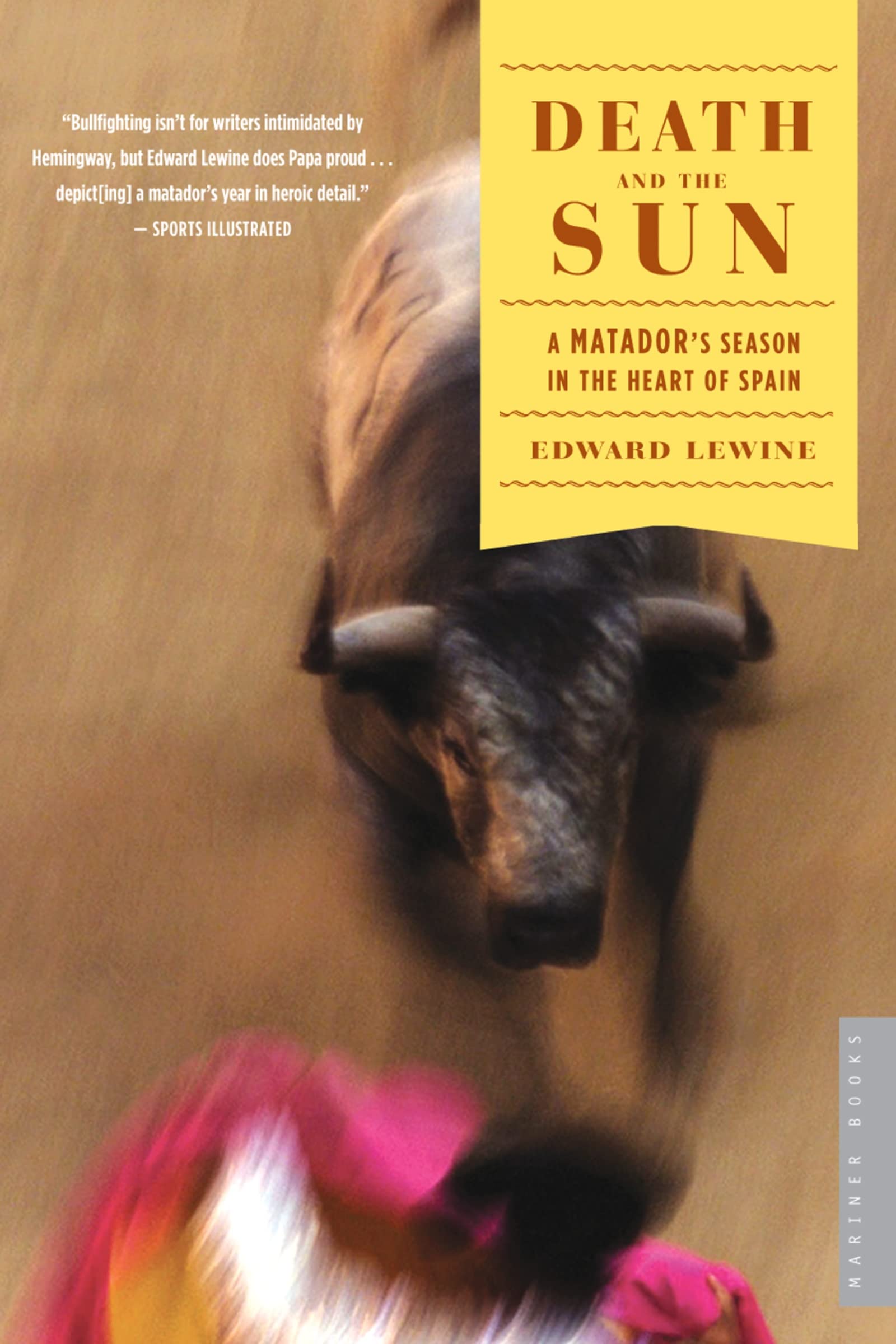
Death And The Sun: A Matador's Season in the Heart of Spain – Following a Legendary Matador Through Ancient Ritual and the Weight of Family History
$17.55
by Edward Lewine



A brilliant observer in the tradition of Adam Gopnik and Paul Theroux, Edward Lewine reveals a Spain few outsiders have seen. There's nothing more Spanish than bullfighting, and nothing less like its stereotype. For matadors and aficionados, it is not a blood sport but an art, an ancient subculture steeped in ritual, machismo, and the feverish attentions of fans and the press. Lewine explains Spain and the art of the bulls by spending a bullfighting season traveling Spanish highways with the celebrated matador Francisco Rivera Ordónez, following Fran, as he's known, through every region and social stratum. Fran's great-grandfather was a famous bullfighter and the inspiration for Hemingway's matador in The Sun Also Rises . Fran's father was also a star matador, until a bull took his life shortly before Fran's eleventh birthday. Fran is blessed and haunted by his family history. Formerly a top performer himself, Fran's reputation has slipped, and as the season opens he feels intense pressure to live up to his legacy amid tabloid scrutiny in the wake of his separation from his wife, a duchess. But Fran perseveres through an eventful season of early triumph, serious injury, and an unlikely return to glory. EDWARD LEWINE is a frequent contributor to the New York Times. This is his first book. Formerly an expert in old master drawings at Christie’s, he graduated from the Columbia School of Journalism. He lives in Brooklyn, New York. Death and the Sun A Matador's Season in the Heart of Spain By Edward Lewine Houghton Mifflin Company Copyright © 2007 Edward Lewine All right reserved. ISBN: 9780618872305 1 A Man, a Bull, a Small Town Pozoblanco, September 26, 1984. They couldn't see more than a few feet ahead of them. Within the obsessive compass of the headlights the black road uncoiled, split by the white line, stretching and bending with the land. The BMW sedan was bone white, built heavy, well suited to drone out the thousands of miles a top matador must travel from town to town, from bullfight to bullfight, from February to October, through the eight-month marathon of the bullfighting season. Sometime early that morning—later documents would differ on the exact time—the car pulled into a small town and stopped before a building with the words Hotel Los Godos spelled out over the doorway. The driver got out, opened one of the rear doors, and prodded the shoulder of the man who lay asleep in the back seat. "Paco," the driver said. "We've arrived." His full name was Francisco Rivera y Pérez, but he was best known as Paquirri, a variant of Paco, which is a nickname for Francisco. This Paco, Francisco, Paquirri, whatever you wish to call him, was a bullfighter— in Spanish, a torero. More precisely he was a matador, the category of bullfighter who stars in the bullfight, employs a team of five assistant bullfighters, and finishes each performance by facing the bull alone, playing it with a red cape, and killing it with a sword. The most successful matadors are rich and famous entertainers, like professional athletes or movie stars. It is a hard trade. The elite minority of matadors who work regularly tend to end up in the hospital for a few weeks each season, but at least they work at their chosen profession. The rest of Spain's matadors spend their time in cafés, waiting for their cell phones to chime with an offer of a bullfight somewhere. Paquirri never had that problem. He spent many years at the top, as a sought-after performer who by the end of his career commanded ten thousand dollars a bullfight, more than any other matador of the time. Paquirri was also a celebrity to nonbullfighting fans, thanks to two high-profile marriages: the first to Carmen Ordóñez, daughter of the legendary matador Antonio Ordóñez; the second to Isabel Pantoja, a curvy pop star. Paquirri drove the women crazy. He was dark, with ice-blue eyes, high cheekbones, and dimples. He was also a classic tough guy. He could be private, stern, quiet, independent, and full of pride, but he also took pleasure in horses and running and open fields, and was a fierce and loyal friend. He adored each of his wives in her time and always adored his sons: Francisco and Cayetano from his first wife, and Francisco José from his second. Paquirri's life was a constant struggle. He was born poor in a small town at the southern tip of Spain, near the port city of Cádiz, and was given his nickname by his father, a failed torero who encouraged his sons to fulfill his bullfighting dreams. Lacking the natural grace that has been the basis of so many matadors' careers, Paquirri worked and studied and bled, literally, until he had forged himself into a technical master of his craft. He took the alternativa—the ceremony that elevates an apprentice matador to full rank—on August 11, 1966, and sweated for years to gain and then maintain the respect of the small cartel of bullring operators, talent