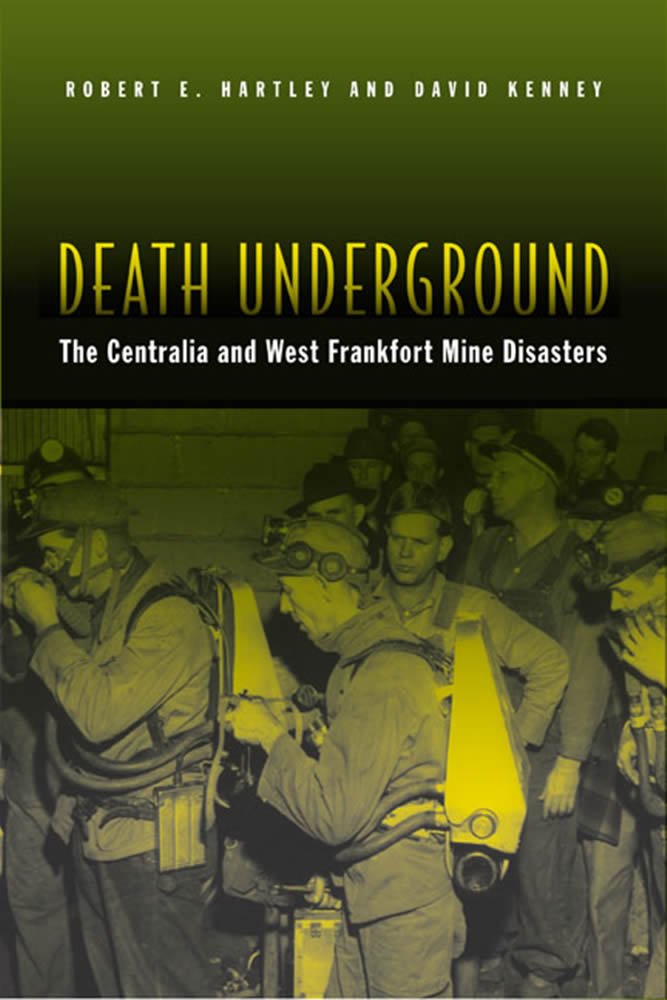
Death Underground: The Centralia and West Frankfort Mine Disasters
$22.95
by Robert E Hartley



Death Underground: The Centralia and West Frankfort Mine Disasters examines two of the most devastating coal mine disasters in United States history since 1928. In two southern Illinois towns only forty miles apart, explosions killed 111 men at the Centralia No. 5 mine in 1947 and 119 men at the New Orient No. 2 mine in West Frankfort in 1951. Robert E. Hartley and David Kenney explain the causes of the accidents, identify who was to blame, and detail the emotional impact the disasters had on the survivors, their families, and their communities. Politics at the highest level of Illinois government played a critical role in the conditions that led to the accidents. Hartley and Kenney address how safety was compromised when inspection reports were widely ignored by state mining officials and mine company supervisors. Highlighted is the role of Driscoll Scanlan, a state inspector at Centralia, who warned of an impending disaster but whose political enemies shifted the blame to him, ruining his career. Hartley and Kenney also detail the New Orient No. 2 mine explosion, the attempts at rescue, and the resulting political spin circulated by labor, management, and the state bureaucracy. They outline the investigation, the subsequent hearings, and the efforts in Congress to legislate greater mine safety. Hartley and Kenney include interviews with the survivors, a summary of the investigative records, and an analysis of the causes of both mine accidents. They place responsibility for the disasters on individual mine owners, labor unions, and state officials, providing new interpretations not previously presented in the literature. Augmented by twenty-nine illustrations, the volume also covers the history, culture, and ethnic pluralism of coal mining in Illinois and the United States. “A book on the two disasters is long overdue, and Bob Hartley and David Kenney are a perfect pair to tell the story. Their account is an important contribution to the historical literature of downstate Illinois.”— Taylor Pensoneau , former president of the Illinois Coal Association and author of Governor Richard Ogilvie: In the Interest of the State Illinois possesses a fascinating labor history that offers historians an opportunity to explore the working lives of men and women in a variety of trades and industries over the course of many decades. Robert E. Hartley and David Kenney have made a useful addition to that history in their collaborative monograph Death Underground: The Centralia and West Frankfort Mine Disasters. Hartley and Kenney present a detailed account of these two mine tragedies of the mid-twentieth century when coal mining was still a major industry and trade for the state's working class. The authors take the reader on a journey into the mines, the state bureaucracy of mine inspections and party politics, and into the lives of the miners and their families. This comprehensive history is both academically sound and interesting to read. The voices of the historical actors are present throughout the narrative, making this a work of history that could appeal to a popular audience as well as to students of Illinois and labor history. The authors set the context for the Centralia and West Frankfort mine disasters with a brief history of mining in the United States, but most appropriately in Illinois. They examine the early coal industry in the state, its first workers and communities, mining accidents, and union organization. John L. Lewis and the United Mine Workers of America (UMWA) feature prominently in this introductory chapter and in later sections of the book. In part one, the local history of mining really begins. Centralia's origins as an important rail stop for the Illinois Central and an early coal source as railroads transitioned from wood to coal as locomotive fuel demonstrates the town's long association with coal mining. Quickly, the authors move to the issue of mine safety, a major theme of Death Underground. Centralia's mine No. 5 had serious safety problems, particularly regarding combustible coal dust. The miners realized that there was a serious problem with coal dust and sought assistance from the state. Mine inspector Driscoll Scanlan -- according to the authors -- tried to warn his superiors in the Department of Mines and Minerals and on the State Mining Board, but to no avail. The death and destruction at the mine in March 1947 left deep anguish for families of the victims and devastating political consequences in its wake. Hartley and Kenney delve into the fallout of the mine disaster with a detailed examination of the political process to determine why the disaster took place and who was to blame. As intense investigations and testimony ensued, Scanlan and his superior, Robert Medill, locked horn's over culpability. The authors paint a rather sympathetic portrait of Scanlan, though they do mention that he did have the power to close the mine. Moreover, Hartley and Kenney thoro