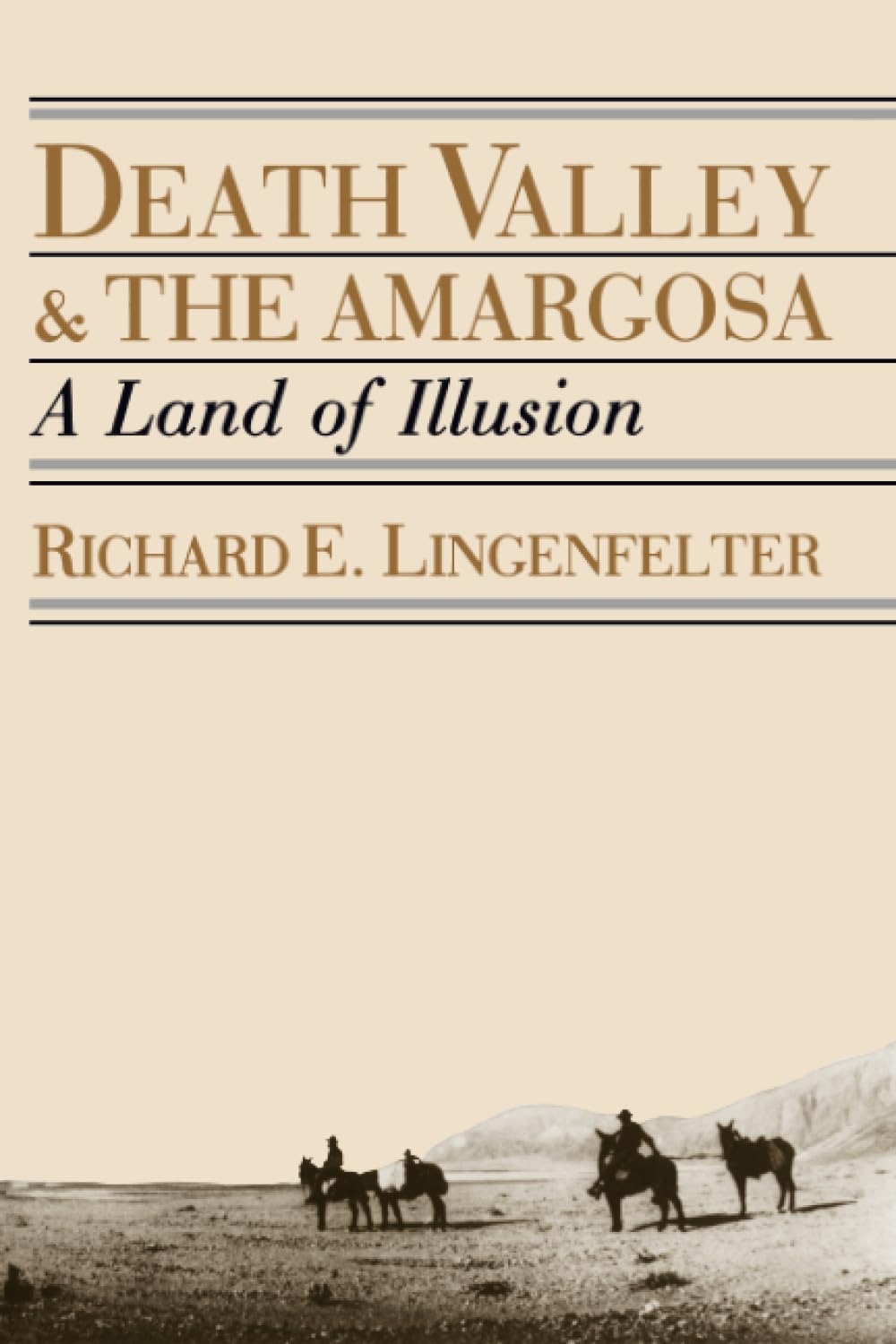



This is the history of Death Valley, where that bitter stream the Amargosa dies. It embraces the whole basin of the Amargosa from the Panamints to the Spring Mountains, from the Palmettos to the Avawatz. And it spans a century from the earliest recollections and the oldest records to that day in 1933 when much of the valley was finally set aside as a National Monument. This is the story of an illusory land, of the people it attracted and of the dreams and delusions they pursued-the story of the metals in its mountains and the salts in its sinks, of its desiccating heat and its revitalizing springs, and of all the riches of its scenery and lore-the story of Indians and horse thieves, lost argonauts and lost mine hunters, prospectors and promoters, miners and millionaires, stockholders and stock sharps, homesteaders and hermits, writers and tourists. But mostly this is the story of the illusions-the illusions of a shortcut to the gold diggings that lured the forty-niners, of inescapable deadliness that hung in the name they left behind, of lost bonanzas that grew out of the few nuggets they found, of immeasurable riches spread by hopeful prospectors and calculating con men, and of impenetrable mysteries concocted by the likes of Scotty. These and many lesser illusions are the heart of its history. "A definitive piece of Western history . . . thorough, judicious and consistently entertaining."--Michiko Kakutani, The New York Times "Death Valley is a wilderness of extremes--the lowest, the driest, the hottest--and not surprisingly, its human history representes one more extreme, a bumptious, sleazy, hilarious Wild West Show of horse raiders, swindlers, drunks, explorers, prospectors, madmen and other such types as blast about from one outermost fringe to another."--Mark Muro, The Boston Globe "A definitive piece of Western history . . . thorough, judicious and consistently entertaining."--Michiko Kakutani, The New York Times "Death Valley is a wilderness of extremes--the lowest, the driest, the hottest--and not surprisingly, its human history representes one more extreme, a bumptious, sleazy, hilarious Wild West Show of horse raiders, swindlers, drunks, explorers, prospectors, madmen and other such types as blast about from one outermost fringe to another."--Mark Muro, The Boston Globe Richard E. Lingenfelter is a research physicist at the University of California, San Diego. He has written over a dozen books on Western American history and lore. Death Valley and the Amargosa: A Land of Illusion By Richard E. Lingenfelter University of California Press Copyright © 1988 Richard E. Lingenfelter All right reserved. ISBN: 0520063562 A Land of Extremes The sharpest realities of Death Valley are its extremes of depth and heat and aridity. It is, in fact, the lowest, hottest, driest spot in America. Joel Brooks was the first to guess, in February 1861, that the floor of Death Valley might actually be below sea level. He was better acquainted with the valley than almost anyone else at the time, having helped surveyor Henry Washington run the township lines through the valley four years before, and having just returned the previous spring as a guide for the army. But Brooks was also a braggart and border ruffian, said to have been run out of every town in the southern San Joaquin Valley. He boasted that he had killed more Indians both in battle and in captivity than any man in California, and he didn't stop there; he had most recently killed a man on the Mojave River. A government officer, branding him "a vagrant and outlaw," had concluded, "It is hardly necessary for me to add that his statements are totally unworthy of credit." Still, Brooks was hired as guide for the California boundary reconnaissance party heading for the Death Valley country early in 1861—but then they also brought along camels!1 Considering his reputation, it is not surprising that when Brooks suggested to his companions that the valley they were about to enter was below sea level, he was answered with unbelieving, if cautious, scoffs and challenges to bet. Sides were quickly drawn and each new barometer reading was anxiously awaited as they moved into the valley. To the chagrin of the doubters, Brooks was right: they paid up on March 11, when the barometer set up on the salt flat below Furnace Creek indicated they were 377 feet below sea level. Later, more conservative analysis of the barometer readings, considering uncertainties in atmospheric conditions, showed that the lowest point reached by the survey was somewhere between 100 and 250 feet below the sea. But the startling fact remained that Death Valley, hundreds of miles from the sea, was well below sea level.2 California State Geologist Josiah Whitney eagerly spread the word of the valley's great depth. Perhaps from some notion of the symmetry of nature, he also called attention to the fact that this lowest point in the country was only 60 miles from the hi