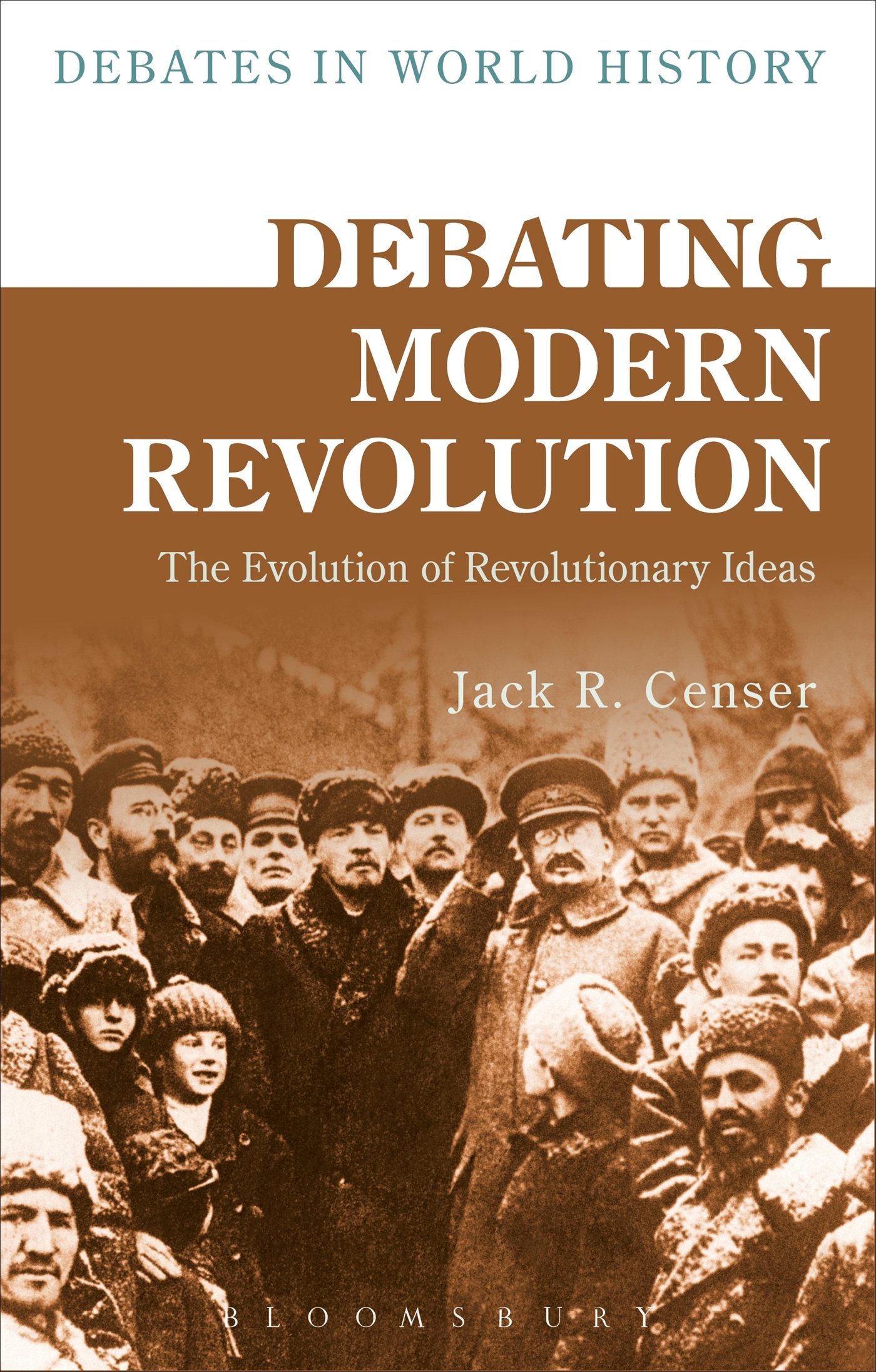
Debating Modern Revolution: The Evolution of Revolutionary Ideas (Debates in World History)
$29.95
by Jack R. Censer



Revolution is an idea that has been one of the most important drivers of human activity since its emergence in its modern form in the 18th century. From the American and French revolutionaries who upset a monarchical order that had dominated for over a millennium up to the Arab Spring, this notion continues but has also developed its meanings. Equated with democracy and legal equality at first and surprisingly redefined into its modern meaning, revolution has become a means to create nations, change the social order, and throw out colonial occupiers, and has been labelled as both conservative and reactionary. In this concise introduction to the topic, Jack R. Censer charts the development of these competing ideas and definitions in four chronological sections. Each section includes a debate from protagonists who represent various forms of revolution and counterrevolution, allowing students a firmer grasp on the particular ideas and individuals of each era. This book offers a new approach to the topic of revolution for all students of world history. “While most studies of revolution attempt to uncover timeless similarities in the causes and development of revolutions, Censer explores the transformations over two and a half centuries of the concept of revolution itself: the dramatic evolution in the justifications, objectives, and strategies proposed by philosophers and practitioners from Thomas Paine and Karl Marx through Frantz Fanon, Che Guevara, and the Ayatollah Khomeini. It is an original and enormously engaging tour d'horizon of the subject in a global perspective, ideally suited for students young and old.” ― Timothy Tackett, Univeristy of California - Irvine, USA “Censer has written a very readable narrative of revolution as a product of modern historical consciousness. Revolution has created an arc of self-redefinition; even as its meanings are layered, older ones are exchanged for newer ones to reach out to utopian ideals.” ― Prasenjit Duara, National University of Singapore “Jack Censer's aim is refreshingly bold: to conceptualise the different meanings of revolution in the modern era and to assess the importance of ideologies within them. He defines revolutions as cultural movements that set out to transform the existing order, both political and social, and in this book he adopts a global perspective, tracing the development of revolutionary ideas from America and France in the 1770s and 1790s to Iran and Tunisia today. The result is a wide-ranging and often provocative analysis that shows how the idea of revolution has evolved over the centuries and across continents.” ― Alan Forrest, University of York, UK “Jack Censer has provided an enviably concise, lucid and thoughtful introduction to this crucially important subject. For anyone interested in understanding the ideas underpinning modern revolutions, and how the phenomenon of revolution itself developed through the modern period, Debating Modern Revolution is the perfect starting point.” ― David Bell, Princeton University, USA “This is a sharp and insightful book and students will find it very useful in dealing with a whole range of topics.” ― Martin Simpson, University of the West of England, UK An introduction to global revolutions in modern history, tracing how the notion of revolution has evolved and surveying the key debates surrounding the topic. Jack R. Censer is Professor Emeritus of History at George Mason University, USA. He is the author of several books on the French Old Regime and Revolution, including Prelude to Power (l976; reissued 2019), The French Press in the Age of Enlightenment (1994) and, with Lynn Hunt, The French Revolution and Napoleon (2022; 2nd edition, Bloomsbury Academic). He has also explored the modern press in On the Trail of the D.C. Sniper (2010). His most recent work is Debating Modern Revolution (2016, Bloomsbury Academic). Peter N. Stearns is Professor Emeritus in the Dept of History at George Mason University. His most recent publications include, as author, Cultural Change in Modern World History (Bloomsbury, 2018), Peacebuilding Through Dialogue (Virginia, 2018), Shame: A Brief History (Illinois, 2017), Sexuality in World History , Ed.II (Routledge, 2017), The Industrial Revolution in World History Ed.IV (Westview, 2016), Globalization in World History , Ed.II (Routledge, 2016), Childhood in World History , Ed.III (Routledge, 2016), The Industrial Turn in World History (Routledge, 2016), Gender in World History (Routledge, 2015), Debating the Industrial Revolution (Bloomsbury, 2015); and as editor, The Oxford Encyclopedia of the Modern World: 1750 to the Present (Oxford, 2008). Peter N. Stearns is Provost of George Mason University, and teaches courses in world history and social history. Stearns is a past vice president of the American Historical Association, in charge of the Teaching Division. He currently serves as chair of the Advanced Placement World His