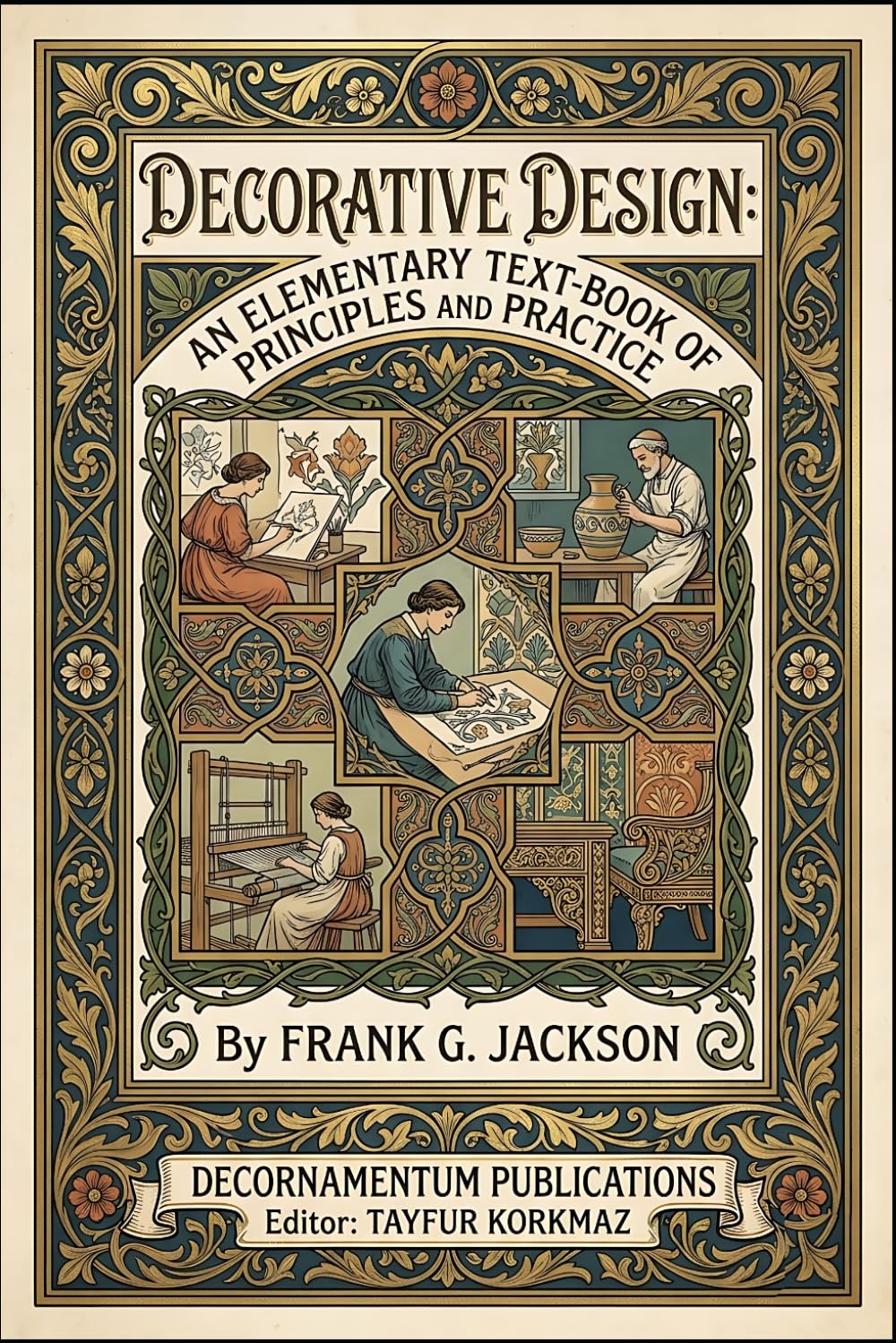
Decorative Design: An Elementary Text-Book of Principles and Practice (International Heritage Art Series: Global Ornament Archives, Decorative Designs
$10.00
by Decornamentum Publication



Frank G. Jackson was one of the most important figures at the beginning of the 20th century who argued that design was not merely "ornamentation" but a mathematical and organic discipline. Written during his time at the Birmingham Municipal School of Art, this work serves as a bridge connecting the complex and sometimes excessive aesthetic sensibilities of the Victorian era to the simple and rule-bound structure of modern design. Published in 1913, the book was considered not only a textbook but also a handbook for the burgeoning Arts and Crafts movement. Jackson's fundamental philosophy is based on the idea that design should not be a random creative process, but rather the stylization of forms found in nature through an analytical approach. This book answers the question of "why and how does a pattern work?" rather than "how does a pattern look beautiful?" The book's content follows a pedagogical sequence, starting with simple geometric forms and progressing to complex plant and animal motifs. Jackson first introduces the reader to the fundamental atoms of design: line, point, and space; He then explains how these elements come together to create "balance," "rhythm," and "harmony" (proportion, rhythm, harmony). One of the most valuable parts of the book is the section where nature is translated into art. The author takes the mathematics in the veins of a leaf or the symmetry in the petals of a flower and shows step-by-step how we can use them in an architectural border or a ceramic surface. The hundreds of illustrations included are not just examples; each one is a visual lesson teaching the designer how to "see." Ironically, the value of this work today comes from being an antidote to the "readiness" brought about by digitalization. Today, a graphic designer or illustrator can access thousands of ready-made designs with a single click; however, they cannot grasp the structural logic behind these designs, that is, the "construction." Jackson's book offers a basic education for those who want to enter the kitchen of design. The guidelines in the book are not only for artists who use pen and paper; Today, this book reminds even professionals working with vector graphics, typography, or concept art for the gaming world of the rules of composition in their purest form. In particular, the "conventionalization" technique offers a timeless perspective to those working in logo design and iconography, explaining how to transform a natural form into a decorative symbol without distorting it. The original 1913 edition has been meticulously restored, removing all the deformations of the last century. Stains, faded lines, and ink smudges on the pages have been individually cleaned, and the images and text have been brought up to today's printing quality standards. In this way, this edition, presented with the clarity of a modern book while retaining its historical texture, promises the reader the highest visual comfort and technical clarity. Beyond being a collector's item and an educational book, this book is an indispensable resource for anyone who wants to learn aesthetics by its rules, from tattoo artists to interior designers, fashion designers to craftspeople.