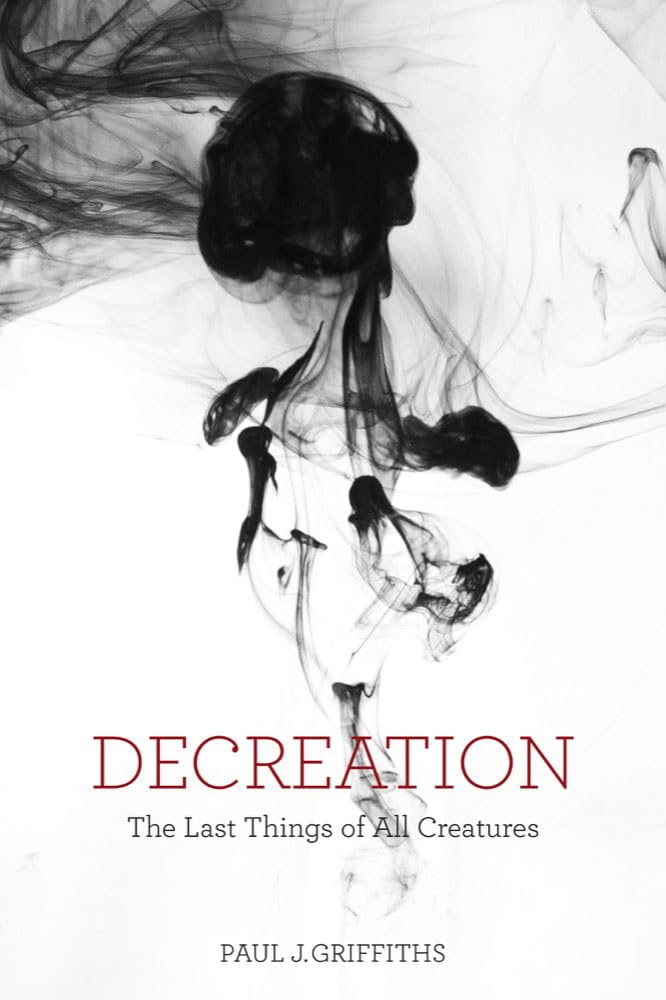



Death is not the end--either for humans or for all creatures. But while Christianity has obsessed over the future of humanity, it has neglected the ends for nonhuman animals, inanimate creatures, and angels. In Decreation , Paul J. Griffiths explores how orthodox Christian theology might be developed to include the last things of all creatures. Griffiths employs traditional and historical Christian theology of the last things to create both a grammar and a lexicon for a new eschatology. Griffiths imagines heaven as an endless, repetitively static, communal, and enfleshed adoration of the triune God in which angels, nonhuman animals, and inanimate objects each find a place. Hell becomes a final and irreversible separation from God--annihilation--sin's true aim and the last success of the sinner. This grammar, Griffiths suggests, gives Christians new ways to think about the redemption of all things, to imagine relationships with nonhuman creatures, and to live in a world devastated by a double fall. A consummate work of impressively detailed theological scholarship... -- Paul T. Vogel ― The Midwest Book Review Informed amateur theologians as well as trained ones, readers who enjoy a rigorously thoughtful writer, and Christians seeking to hone a greater intellectual connection to their faith will find this a rewarding and stimulating book. -- Russell E. Saltzman ― Aleteia A stimulating theological study. ― Choice A major work on the traditional theme of the last things. -- Neil Ormerod ― Theological Studies This is a remarkable book. In the clarity and care of its argumentation it is a model of theological method. While treating questions that have sometimes been relegated to the fringe of Christian theological enquiry, it sheds new light on topics across the range of theological concerns: the nature of time, tears, and political quietism, to name but a few. -- David Clough ― Anglican Theological Review No one reading this book can fail to admire the creativity, energy and originality of its author, and perhaps to some extent its audacity. -- Celia Deane-Drummond ― International Journal of Systematic Theology The book’s expansiveness shows how valuable and needed it is for theologians to reflect on the last things, and Griffiths’s volume will surely be a benchmark for a long time to come on this topic. -- David Cloutier ― The Journal of Religion There is a kind of sobriety in evidence here, most of all in the lucidity of the prose and the delimitations of the project. But there is also an enraptured, unadulterated pleasure of the soul at work…The result is sublime. -- Brad East ― Marginalia Review of Books …Griffiths' book feels like an invitation to join in, to gather together and think about what exactly our doctrine has given us. It is certainly difficult to think of a better stimulus to ecclesial conversation than what is contained in these pages. -- Thomas J. Millay ― Heythrop Journal Decreation is a remarkable book, a watershed. As the hymns of heaven attest, had we a thousand tongues we could not adequately describe what God has prepared for those who love him. All the more wonderful, then, to read a work of eschatological reasoning and reflection whose beauty is matched by its rigor, and whose energy and interest never flag. -- Richard Middleton ― Pro Ecclesia This is the finest work of speculative theology to appear on any topic in a long while. Beautifully straitened by Catholic doctrine, relentlessly rigorous in argument, Decreation brings an abundance of light to both familiar topics in eschatology and some hardly touched in Christianity’s long history of reflection on the last things. At a time when such work has practically vanished, Paul Griffiths confronts us anew with the ancient challenge of speculative theology: to see the truths upon which Christians must finally stake their lives. -- Bruce D. Marshall, Lehman Professor of Christian Doctrine, Southern Methodist University Paul J. Griffiths is Warren Chair of Catholic Theology at Duke Divinity School.