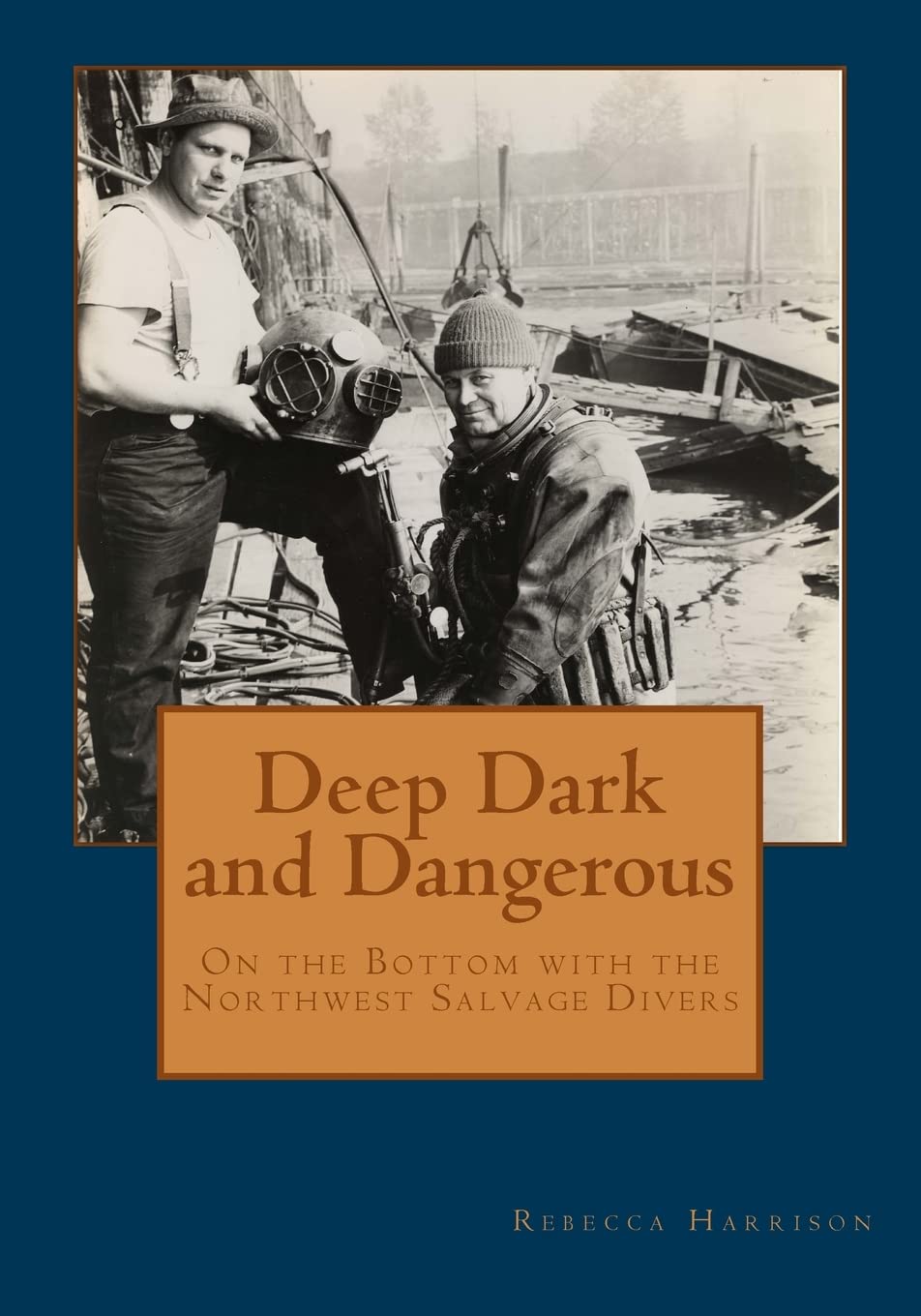
Deep, Dark and Dangerous: On The Bottom With The Northwest Salvage Divers
$15.99
by Rebecca Harrison



Salvage divers work underwater in a blinding darkness. In their cumbersome diving gear, these men have barely enough room to move around, while at the same time fighting the cold temperatures and fast currents. It is a dirty, unromantic and highly dangerous way of earning a living.Yet, these divers would not have traded their jobs for any other profession. From locating sunken boxcars to repairing concrete foundations for bridges, no task is too risky. Any underwater salvage or repair work becomes the job of these elite divers. Salvage divers must be carpenters, masons, riggers, hydraulic mechanics, ironworkers, welders, pile bucks and underwater engineers. They must be able to adapt all blueprints, tools and equipment to the harsh realities of the underwater environment. Afrightening yet fascinating trade, salvage diving stands as the Northwest'smost dangerous occupation. Over half of salvage divers perish ontreacherous dives in frigid waters. With her compelling and illuminating book,Rebecca Harrison chronicles the adventures of intrepid men and women as theysalvage sunken cargo, repair bridges or lay underwater cable. As you read, beprepared for struggling with deadly Devil Fish, retrieving silver booty, andwrestling a sunken locomotive from the turbulent Deschutes. Of course, the bigstories are the brave-hearted characters themselves who chose such a dangerousprofession. Slender,sixteen-year-old Marie DeRock inherits her father's risky trade because he hasno sons. And who would have guessed that adventurous Walt Morey, beloved authorof Gentle Ben, dove long before he wrote? Harrison's clear portrayal of manybreathtaking dives guarantees that readers will understand the depths of theNorthwest's brawny waters. -Craig Lesley (Craig Lesley is theauthor of Burning Fence and The Sky Fisherman) August 3, 2007Find out what it is really like to work underwater,I am a Pacific Northwest diver with an interest in the history of diving and inparticular, the hard hat divers who were pioneers in the fields of underwaterconstruction, demolition and salvage. I was lucky to find Deep Dark and Dangerous: On the Bottom with the Northwest SalvageDivers, by Rebecca Harrison. It is hard to explain to people what it is like to dive in theswirling current, low visibility and bone chilling cold of the pacific NorthWest. It is hard to explain to people the fears that arise underwater and thebravery of those people who made their livings or lost their lives working ashard hat divers. However, regardless of whether you are a diver or not thiswell written and well researched book can take you there in words and strikingpictures. Go ahead and meet the McCray's. Walter and his son Art were adiving dynasty, even after the son had to recover his father's lifeless bodyfrom and underwater trench one day and go back to finish the job the next day.Another character you will meet is Fred Devine whose exploits covered diving ona train wreck in a river in central Oregon to building the most powerfulsalvage barge on the west coast (and that you can still see in Astoria, Oregon). As a diver the story of the sinking and then theingenious salvaging of the cargo of the Diamond Knott is special becauseshortly after reading the story I was able to dive that famous wreck andexamine the work that they did for myself. If you are an actual diver, an armchair diveror just have an interest in how men explored and worked underwater in the early1900's I strongly recommend Deep Dark and Dangerous: On the bottom with theNorthwest Salvage Divers by Rebecca Harrison. - Andy Burlingham There is no shortage of biographical material written by old-time diverswhose literary ability does not quite match their underwater skills, so it isexciting to read a book that is so well written, and covers a number of diversover an even greater number of fascinating circumstances. The author has donean excellent job of oral and document research on the lives of many of thetoughest and most accomplished 'hard-hat' divers of the period 1800s into the1900s, working in the north-west region of the USA. And one of them is a woman- that has to be 'first'. John Bevan, himself a well-respected author, moderndiver and businessman, states, "(Harrison) has colourfully described manyof the gruelling, and sometimes gruesome jobs the divers carried out. Indeed,the book is an excellent representation of the work of the early helmetdivers." Bevan continues (in a review in Underwater ContractorInternational), "The main thing is the quality of the stories! Ithoroughly enjoyed reading this action-packed book. Unlike many other booksabout helmet diving, it is not about an ego, boasting about his personal prowess.It's about remarkable feats of a selection of some of the most capable, helmetdivers, as seen through someone else's eyes." I certainly am in noposition to disagree with anything Bevan has to say about diving, and make thepresumptious conclusion that he is right. It is a gre