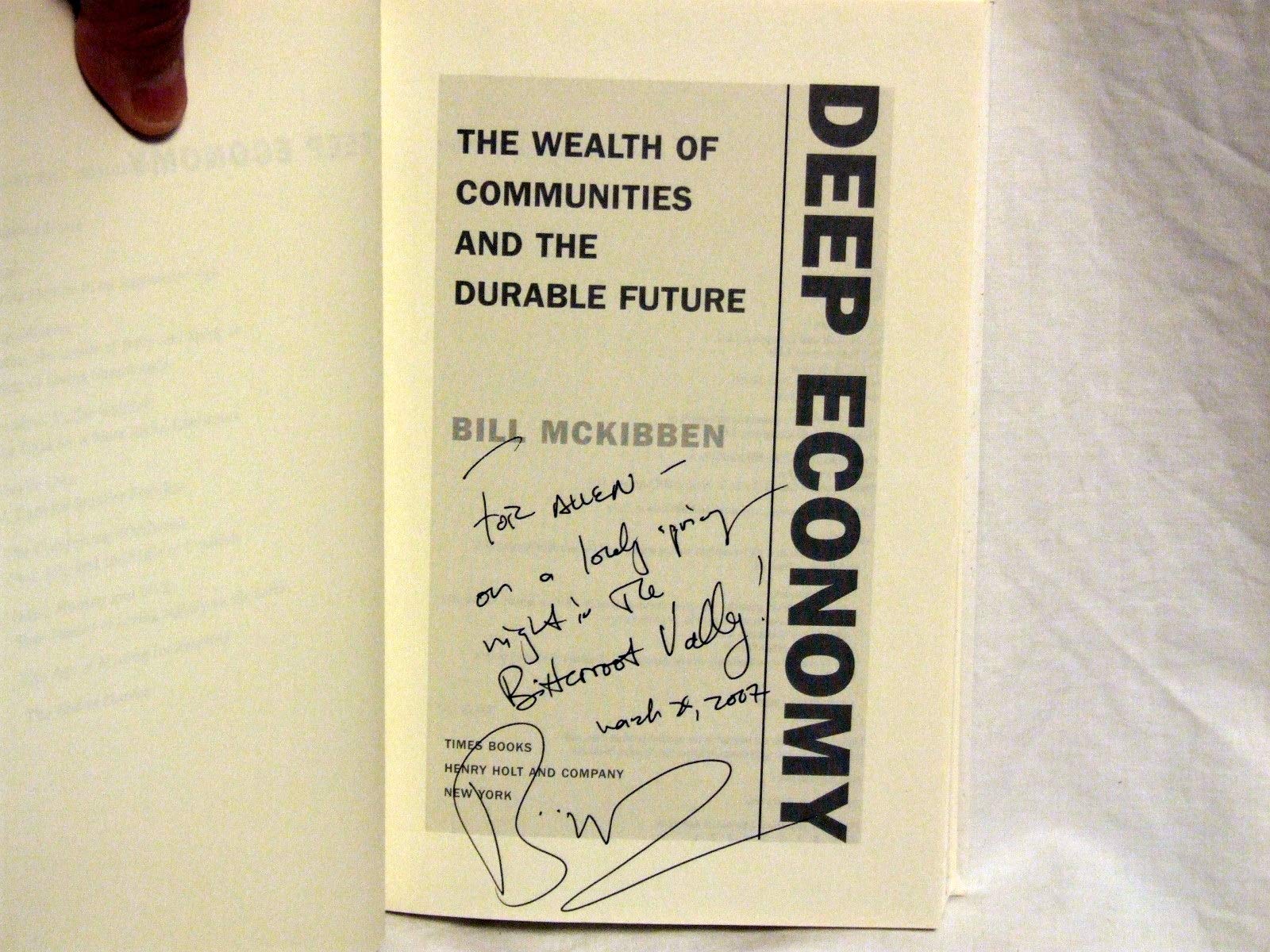



The bestselling author of The End of Nature issues an impassioned call to arms for an economy that creates community and ennobles our lives In this powerful and provocative manifesto, Bill McKibben offers the biggest challenge in a generation to the prevailing view of our economy. For the first time in human history, he observes, "more" is no longer synonymous with "better"--indeed, for many of us, they have become almost opposites. McKibben puts forward a new way to think about the things we buy, the food we eat, the energy we use, and the money that pays for it all. Our purchases, he says, need not be at odds with the things we truly value. McKibben's animating idea is that we need to move beyond "growth" as the paramount economic ideal and pursue prosperity in a more local direction, with cities, suburbs, and regions producing more of their own food, generating more of their own energy, and even creating more of their own culture and entertainment. He shows this concept blossoming around the world with striking results, from the burgeoning economies of India and China to the more mature societies of Europe and New England. For those who worry about environmental threats, he offers a route out of the worst of those problems; for those who wonder if there isn't something more to life than buying, he provides the insight to think about one's life as an individual and as a member of a larger community. McKibben offers a realistic, if challenging, scenario for a hopeful future. As he so eloquently shows, the more we nurture the essential humanity of our economy, the more we will recapture our own. In offering straightforward solutions to the looming environmental crisis, Bill McKibben has marched directly into the middle of a heated debate. Critics' personal beliefs and politics shaped their reviews, which described Deep Economy as, alternately, a "masterfully crafted, deeply thoughtful and mind-expanding treatise" ( Los Angeles Times ) and a "book-length sermon on what is wrong with the way we live" ( San Francisco Chronicle ). Some reviewers found McKibben's solutions practical and the author refreshingly unpretentious, while others considered his vision utopian and his attitude self-righteous. However, they did agree that McKibben writes compellinglywith warmth, sincerity, and a sharp sense of humor. His resolute hope for the future will resound with readers no matter where their loyalties lie. But will it change any minds? Copyright © 2004 Phillips & Nelson Media, Inc. *Starred Review* Beginning with his prescient treatise on global warming, The End of Nature (1990), McKibben has been investigating and elucidating some of the most confounding aspects of our lives. He now brings his signature clarity of thought and handsomely crafted prose to a pivotal, complicated subject, the negative consequences of our growth-oriented economy. McKibben incisively interprets a staggering array of studies that document the symbiotic relationship between fossil fuels and five decades of dizzying economic growth, and the many ways the pursuit of ever-higher corporate profits has led to environmental havoc and neglect of people's most basic needs. At once reportorial, philosophic, and anecdotal, McKibben, intoning the mantra "more is not better," takes measure of diminishing returns. With eroding security, a dysfunctional health system, floundering public schools, higher rates of depression, "wild inequity" in the distribution of wealth, and damage to the biosphere, McKibben believes a new paradigm is needed, that of a "deep economy" born of sustainable and sustaining communities anchored in local resources. Using the farmer's market as a template, he explains the logistics of workable alternatives to the corporate imperative based on ecological capacities and the "economics of neighborliness." With the threat of energy crises and global warming, McKibben's vision of nurturing communities rooted in traditional values and driven by "green" technologies, however utopian, may provide ideas for constructive change. Donna Seaman Copyright © American Library Association. All rights reserved "I'd like to see Deep Economy read in every Econ 101 class. Bill McKibben asks the central human question: What is the economy for ? The stakes here are terrifyingly high, but with his genial style and fascinating examples of alternative approaches, McKibben convinces me that economics is anything but dismal—if only we can learn to do it right!"—Barbara Ehrenreich, author of Nickel and Dimed "The cult of growth and globalization has seldom been so effectively challenged as by Bill McKibben in Deep Economy . But this bracing tonic of a book also throws the bright light of McKibben's matchless journalism on the vibrant local economies now springing up like mushrooms in the shadow of globalization. Deep Economy fills you with a hope and a sense of fresh possibility."—Michael Pollan, author of The Omnivore's Dilemma "How is o