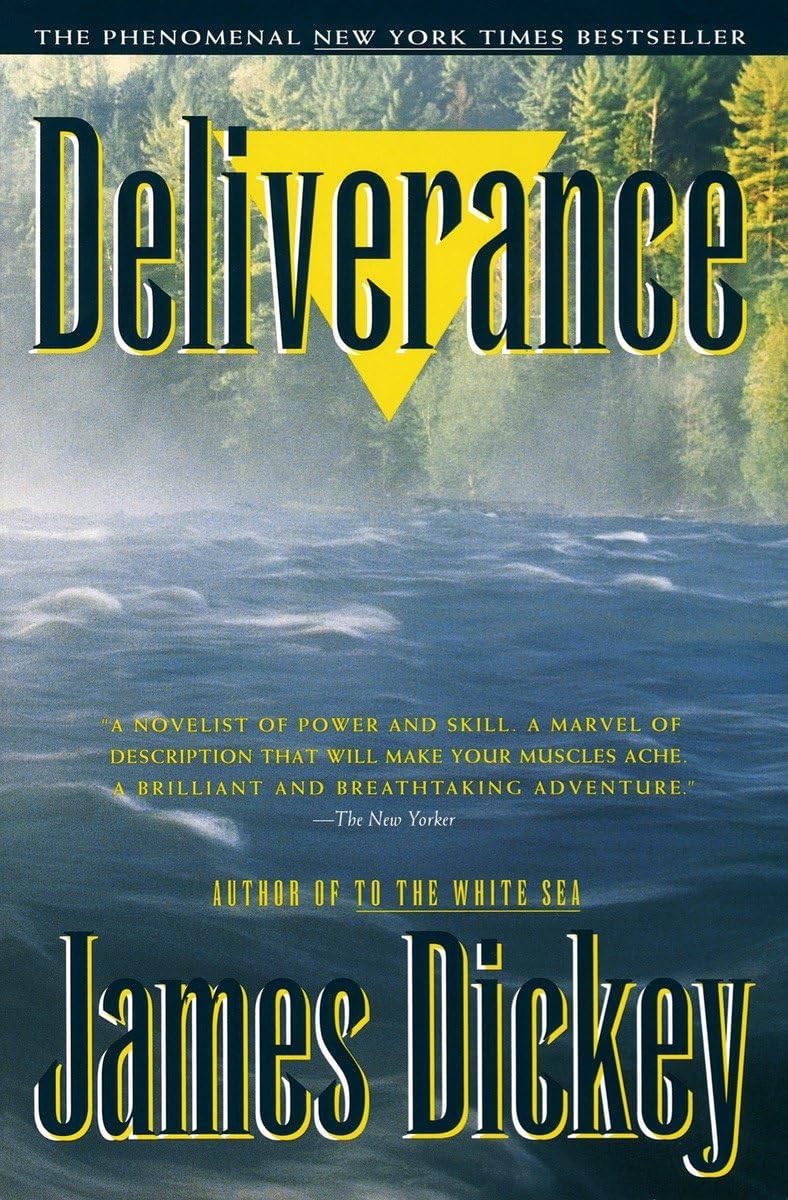



“You're hooked, you feel every cut, grope up every cliff, swallow water with every spill of the canoe, sweat with every draw of the bowstring. Wholly absorbing [and] dramatic.”— Harper's Magazine The setting is the Georgia wilderness, where the states most remote white-water river awaits. In the thundering froth of that river, in its echoing stone canyons, four men on a canoe trip discover a freedom and exhilaration beyond compare. And then, in a moment of horror, the adventure turns into a struggle for survival as one man becomes a human hunter who is offered his own harrowing deliverance. Praise for Deliverance “Once read, never forgotten.” —Newport News Daily Press “A tour de force . . . How a man acts when shot by an arrow, what it feels like to scale a cliff or to capsize, the ironic psychology of fear: these things are conveyed with remarkable descriptive writing.” — The New Republic “Freshly and intensely alive . . . with questions that haunt modern urban man.” — Southern Review “A fine and honest book that hits the reader's mind with the sting of a baseball just caught in the hand.” — The Nation “[James Dickey's] language has descriptive power not often matched in contemporary American writing.” — Time “A harrowing trip few readers will forget.” — Asheville Citizen-Times "A novel that will curl your toes . . . Dickey's canoe rides to the limits of dramatic tension." — New York Times Book Review "A brilliant and breathtaking adventure." — The New Yorker “You're hooked, you feel every cut, grope up every cliff, swallow water with every spill of the canoe, sweat with every draw of the bowstring. Wholly absorbing [and] dramatic.” — Harper's Magazine “Once read, never forgotten.” —Newport News Daily Press “How a man acts when shot by an arrow, what it feels like to scale a cliff or to capsize, the ironic psychology of fear: these things are conveyed with remarkable descriptive writing.” — The New Republic “Freshly and intensely alive . . . with questions that haunt modern urban man.” — Southern Review “A fine and honest book that hits the reader's mind with the sting of a baseball just caught in the hand.” — The Nation “[James Dickey's] language has descriptive power not often matched in contemporary American writing.” — Time “A harrowing trip few readers will forget.” — Asheville Citizen-Times "A novel that will curl your toes . . . Dickey's canoe rides to the limits of dramatic tension." — New York Times Book Review "A brilliant and breathtaking adventure." — The New Yorker "A tour de force." — New Republic "A novel that will curl your toes...Dickey's canoe rides to the limits of dramatic tension."-- The New York Times Book Review "A brilliant and breathtaking adventure."-- The New Yorker "A novel stunning power."-- The Nation "A tour de force."-- The New Republic Released for the first time in trade paperback, this is the classic tale of four men caught in a primitive and violent test of manhood. The setting is the Georgia wilderness, where the states most remote white-water river awaits. In the thundering froth of that river, in its echoing stone canyons, four men on a canoe trip discover a freedom and exhilaration beyond compare. And then, in a moment of horror, the adventure turns into a struggle for survival as one man becomes a human hunter who is offered his own harrowing deliverance. James Dickey was born in Atlanta. One of America's best known poets and a winner of the National Book Award for Buckdancer's Choice , he is the author of the National bestseller To The White Sea , a member of the National Institute of Arts and Letters, a fellow in the American Academy of Arts and Sciences, and the Carolina Professor and Poet-in-Residence at the university of South Carolina. THERE WAS SOMETHING about me that usually kept me from dreaming, or maybe kept me from remembering what I had dreamed; I was either awake or dead, and I always came back slowly. I had the feeling that if it were perfectly quiet, if I could hear nothing, I would never wake up. Something in the world had to pull me back, for every night I went down deep, and if I had any sensation during sleep, it was of going deeper and deeper, trying to reach a point, a line or border. This time the wind woke me, and I dragged upward and tried, with the instinct of survival, to get clear of where I had been, one more time. I was used to hearing Martha’s breath bring me back, for she breathed heavily, but this time it was the wind. First the wind by itself and then the wind ringing a little set of metal figures on strings that Martha had put out on the patio — bronze figures of birds surrounding an owl which, because of a long wind vane attached to him, moved when the air moved and touched the others, making a chiming sound something like the one made by the Chinese glass wind-bells that everybody used to have in the thirties, when I was growing up. It was a small, inconstant sound,