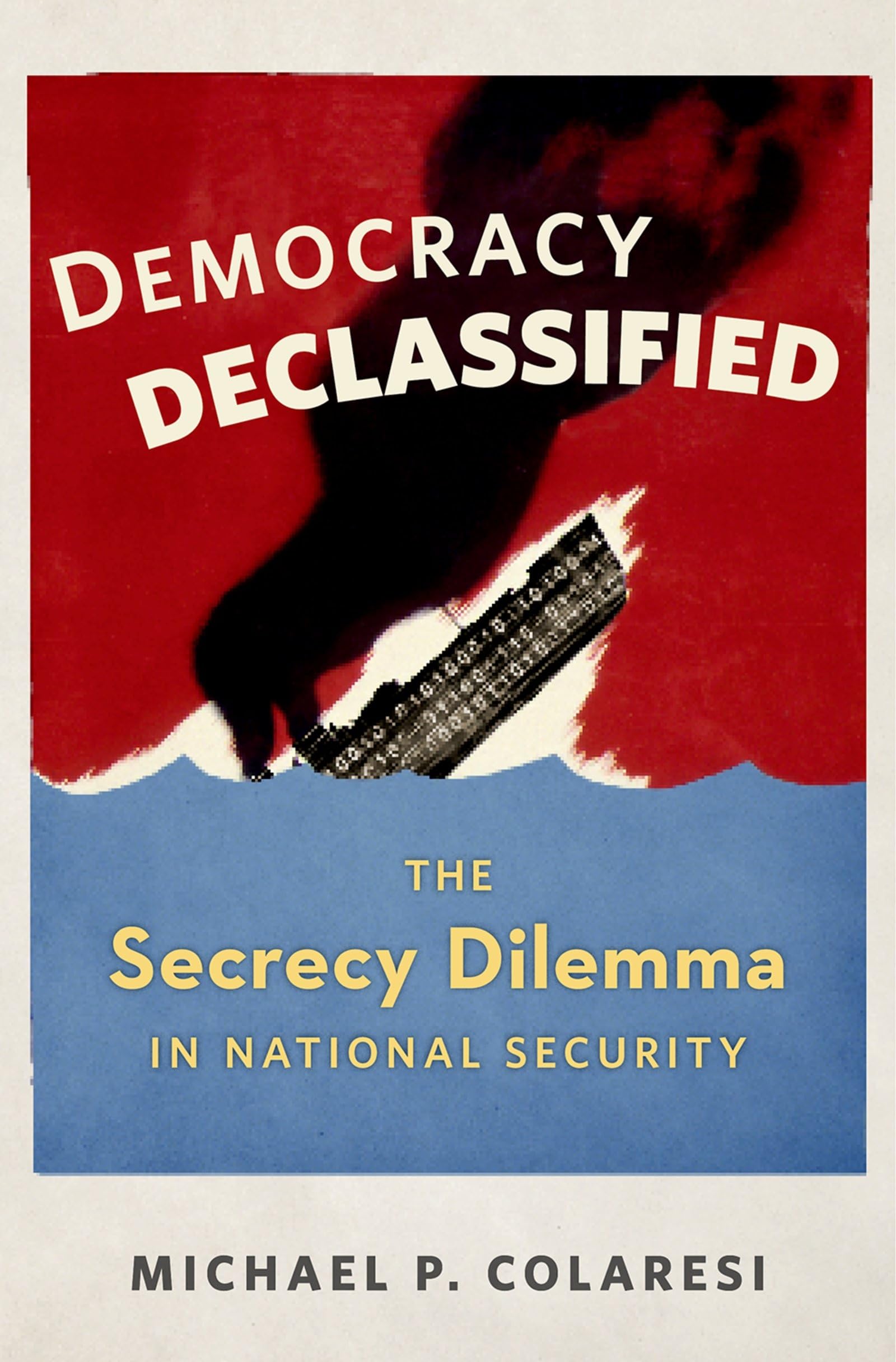
Democracy Declassified: The Secrecy Dilemma in National Security
$29.30
by Michael P. Colaresi



Recent scandals like WikiLeaks and Edward Snowden's disclosure of NSA documents have brought public debates over government accountability and secrecy bubbling to the surface. How can modern democracies balance the need for privacy in delicate foreign policy matters with the necessity of openness in gaining and maintaining the trust of citizens? Democracies keep secrets from potential enemies and their citizens. This simple fact challenges the surprisingly prevalent assumption that foreign policy successes and failures can be attributed to public transparency and accountability. In fact, the ability to keep secrets has aided democratic victories from the European and Pacific theatres in World War II to the global competition of the Cold War. At the same time, executive discretion over the capacity to classify information created the opportunity for abuse that contributed to Watergate, as well as domestic spying and repression in France, Norway and Canada over the past forty years. Therefore, democracies face a secrecy dilemma. Secrecy is useful, but once a group or person has the ability to decide what information is concealed from a rival, citizens can no longer monitor that information. How then can the public be assured that national security policies are not promoting hidden corruption or incompetence? As Democracy Declassified shows, it is indeed possible for democracies to keep secrets while also maintaining useful national security oversight institutions that can deter abuse and reassure the public. Understanding secrecy and oversight in democracies helps us explain not only why the Maginot Line rose and the French Republic fell, or how the US stumbled but eventually won the Cold War, but more generally how democracies can benefit from both public consent and necessary national security secrets. At a time when ubiquitous debates over the issue of institutional accountability and transparency have reached a fever pitch, Democracy Declassified provides a grounded and important view on the connection between the role of secrecy in democratic governance and foreign policy-making. " Democracy Declassified is a superb book that will transform the debate over how democratic governments work in the national security sphere. Michael Colaresi has used careful theorizing, an outstanding series of deeply informative case studies, and beautifully presented quantitative analysis based on original data to evaluate the balance called for between the demands for transparency in democracies and the need for secrecy. Not only does Colaresi explore in a completely original way the balance between secrecy and transparency, he also proposes practical policy solutions to ensure that the right balance is struck... Democracy Declassified is a tour de force in theory development and testing. It should be read by everyone interested in how democracy works or how national security operates. It is a masterful book." --Bruce Bueno de Mesquita, Julius Silver Professor of Politics, New York University " Democracy Declassified makes a very important and innovative contribution towards understanding international relations in the twenty-first century. Its focus on oversight institutions not only sheds new light on the general connection between domestic political institutions and foreign policy, it also helps frame recent events such as the WikiLeaks and Edward Snowden disclosures. It is essential reading for scholars, students, and policy-makers." --Dan Reiter, Professor of Political Science, Emory University "Colaresi has written a really exceptional book, which lays solid foundations for an important new research agenda on democracy, secrecy and foreign policy. But Democracy Declassified does much more; in scope, execution and timeliness, it has fundamental implications for various research traditions in political science as well as policy. The mastery of historical detail, care of modeling and attention to detail in its carefully collected new data and analysis make this book an example of the very best scholarship." --Hein Goemans, Associate Professor of Political Science, University of Rochester "Edward Snowden's and Chelsea Manning's recent leaks have reignited the long-running debate over the widespread classification of national security information. Our national security depends on some degree of secrecy, but democratic oversight thrives on transparency. Professor Michael P. Colaresi poses a fascinating iteration of this dilemma." --^lHarvard Law Review A discussion of how democracies can effectively balance secrecy and public accountability in foreign policy Michael P. Colaresi is Professor of Political Science at Michigan State University.