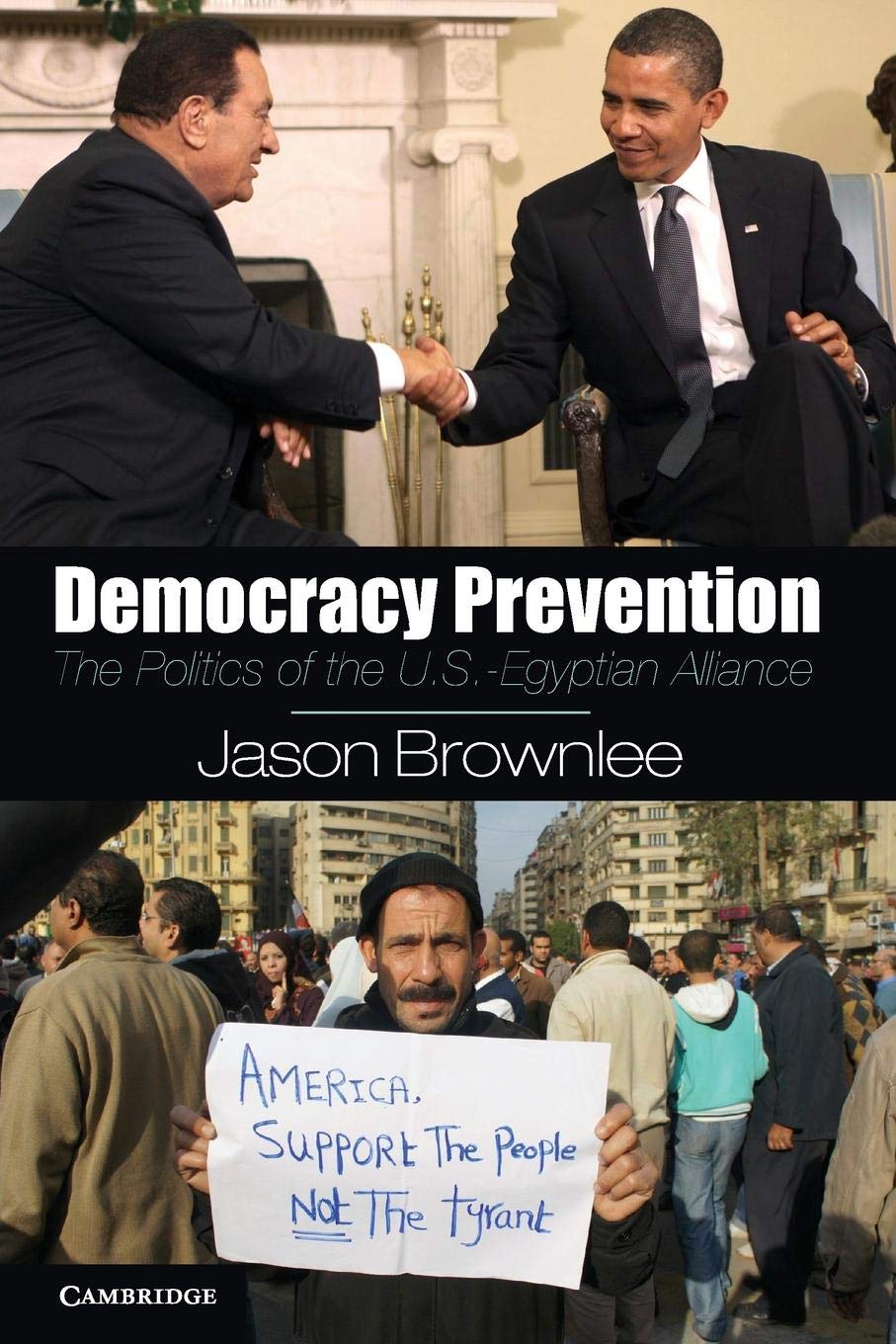



When a popular revolt forced long-ruling Egyptian President Hosni Mubarak to resign on February 11, 2011, U.S. President Barack Obama hailed the victory of peaceful demonstrators in the heart of the Arab World. But Washington was late to endorse democracy – for decades the United States favored Egypt's rulers over its people. Since 1979, the United States had provided the Egyptian regime more than $60 billion in aid and immeasurable political support to secure its main interests in the region: Israeli security and strong relations with Persian Gulf oil producers. During the Egyptian uprising, the White House did not promote popular sovereignty but instead backed an "orderly transition" to one of Mubarak's cronies. Even after protesters derailed that plan, the anti-democratic U.S.-Egyptian alliance continued. Using untapped primary materials, this book helps explain why authoritarianism has persisted in Egypt with American support, even as policy makers claim to encourage democratic change. “If ‘the economy, stupid’ explains voting behavior in the United States, then ‘the security, stupid’ explains why and how the United States co-constituted and sustained the long rule of Hosni Mubarak in Egypt. In the process of tracing the U.S.-Egyptian relationship since 1979, Jason Brownlee helps us understand three important issues: why dictators endure; why the United States is not, even after the Cold War, always a champion of democratic change; and why the fall of dictators does not always or easily translate into the rise of democracy.” - Valerie Bunce, Aaron Binenkorb Professor of International Studies and Professor of Government, Cornell University “A searching study on a neglected topic in post-Cold War U.S. foreign policy―United States support for modern day ‘friendly tyrants.’ Brownlee’s probing approach takes the reader behind the veil of U.S. pro-democracy rhetoric to the realities of policy choices and compromises. The picture he paints is as sobering as it is revealing.” - Thomas Carothers, Vice President for Studies, Carnegie Endowment for International Peace “In this carefully researched and strongly argued book, Jason Brownlee examines the strain in American policy toward Egypt between hard strategic interests and the more idealistic goal of promoting democracy. He shows convincingly that from the time of the Egyptian-Israeli peace agreement in 1979 onward, strategic interests have been at the core of the relationship, even during the brief period when George W. Bush was promoting his ‘democracy agenda’ in 2005. One might expect that in the aftermath of the Egyptian uprising in January 2011 that ousted Husni Mubarak that things might change, but Brownlee cautions that elites on both sides of the U.S.-Egyptian relationship are likely to try to limit the impact of Egypt's democratic turn. I hope he is wrong, but his pessimistic conclusion is worth bearing in mind.” - William B. Quandt, Professor of Politics, University of Virginia "This outstanding book by Brownlee (Univ. of Texas Austin) is a through, scholarly study of the dynamics of Washington's alliance with Cairo during the Sadat and Mubarak eras. The author demonstrates unusual boldness in documenting the US role in perpetuating authoritarianism" - G. E. Perry, emeritus, Indiana State University, CHOICE Democracy Prevention explains how America's alliance with Egypt has impeded democratic change and reinforced authoritarianism over time. Jason Brownlee is Associate Professor of Government at the University of Texas at Austin. He has been traveling to Egypt and conducting research there for seventeen years. In addition to his previous book, Authoritarianism in an Age of Democratization, Professor Brownlee's writings have appeared in Current History, the Journal of Democracy and numerous scholarly journals. In 2010–11 he was a visiting fellow at the Woodrow Wilson International Center for Scholars.