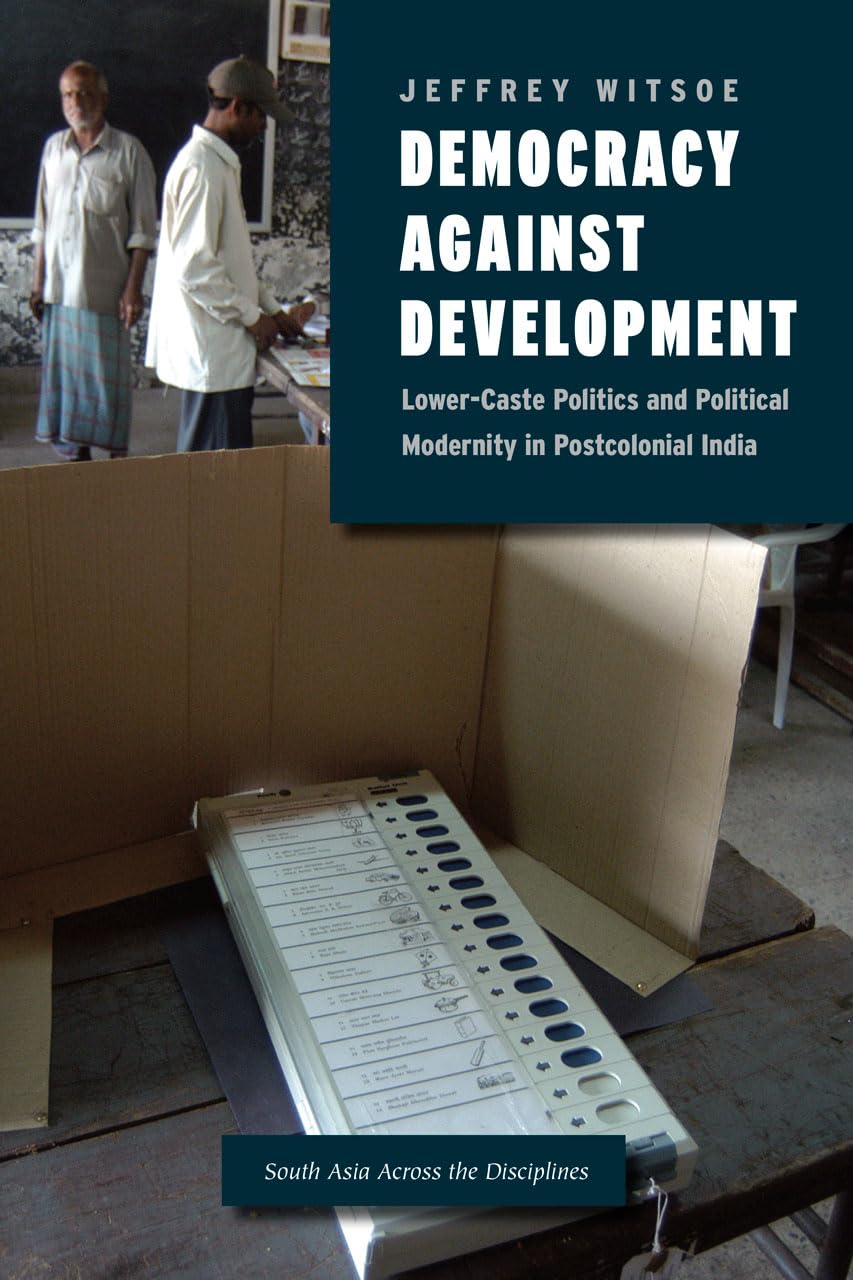
Democracy against Development: Lower-Caste Politics and Political Modernity in Postcolonial India (South Asia Across the Disciplines)
$32.00
by Jeffrey Witsoe



Hidden behind the much-touted success story of India’s emergence as an economic superpower is another, far more complex narrative of the nation’s recent history, one in which economic development is frequently countered by profoundly unsettling, and often violent, political movements. In Democracy against Development , Jeffrey Witsoe investigates this counter-narrative, uncovering an antagonistic relationship between recent democratic mobilization and development-oriented governance in India. Witsoe looks at the history of colonialism in India and its role in both shaping modern caste identities and linking locally powerful caste groups to state institutions, which has effectively created a postcolonial patronage state. He then looks at the rise of lower-caste politics in one of India’s poorest and most populous states, Bihar, showing how this increase in democratic participation has radically threatened the patronage state by systematically weakening its institutions and disrupting its development projects. By depicting democracy and development as they truly are in India—in tension—Witsoe reveals crucial new empirical and theoretical insights about the long-term trajectory of democratization in the larger postcolonial world. “ Democracy against Development realizes a lot of the promise of the new political anthropology of India. Jeffrey Witsoe’s ethnographic focus ensures that the rich and diverse struggle over caste and its political forms can be revealed. He is able to show precisely how colonially structured caste, as identity and power, is reshaped in the working of Indian democracy.” -- Kalyanakrishnan Sivaramakrishnan, Yale University “This is a most convincing ethnographic account of the ‘silent revolution’ that is taking place in North India. Jeffrey Witsoe analyzes the political rise of the lower castes in Bihar at the village level in a very perceptive way—without ignoring its limitations—and shows how it prepared the ground for economic development, which is the main plank of the Bihar government today. The result is a must-read for anyone who wants to understand the democratization process at work in a state that used to be India’s black spot.” -- Christophe Jaffrelot, Center for International Studies and Research, Sciences Po Paris Jeffrey Witsoe is assistant professor of anthropology at Union College in Schenectady, NY.