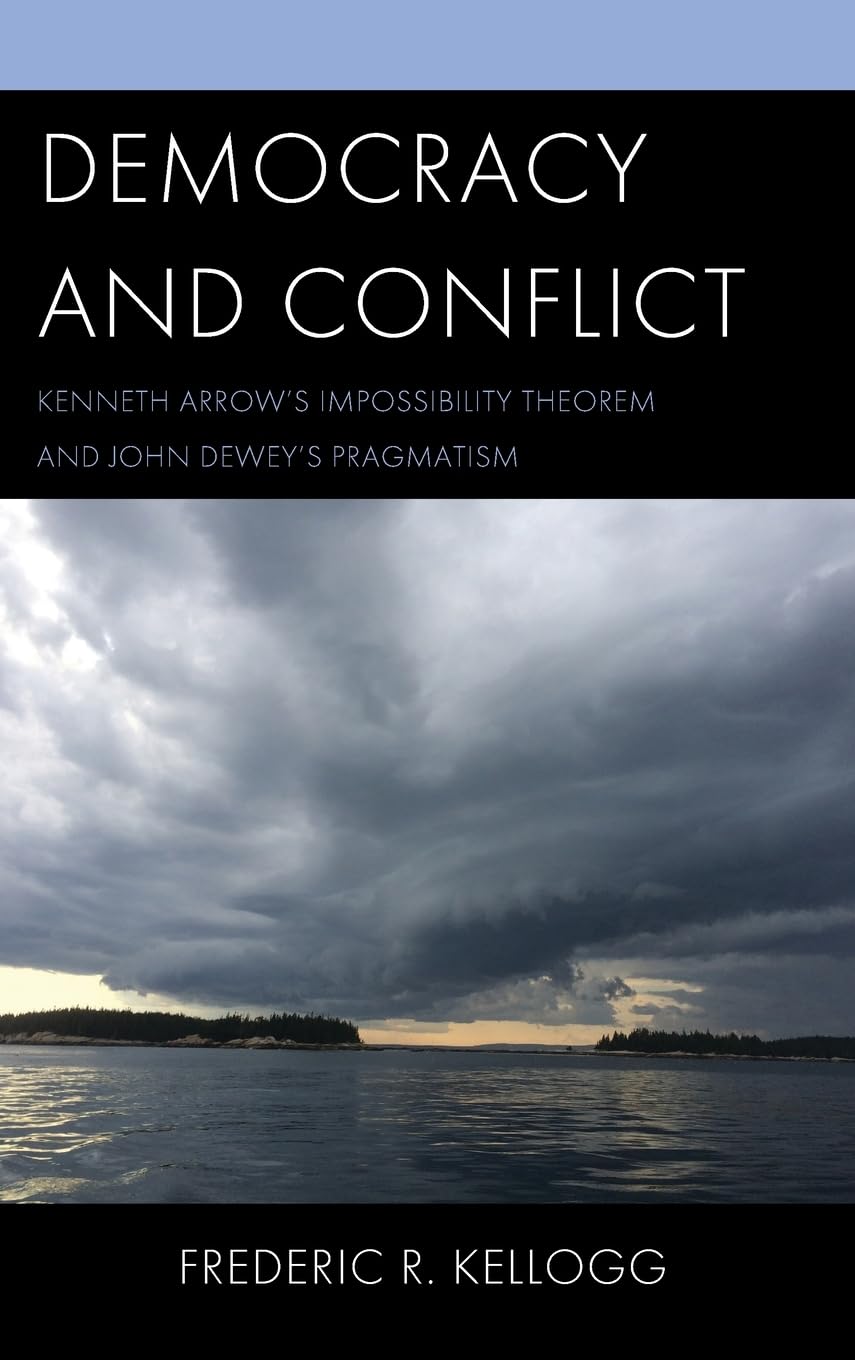
Democracy and Conflict: Kenneth Arrow's Impossibility Theorem and John Dewey's Pragmatism
$100.00
by Frederic R. Kellogg



The economist Kenneth Arrow proved in 1951 that a society of diverse individual preferences could only by ordered by dictatorship. His impossibility theorem is still an axiom of contemporary welfare economics and has never been seriously challenged. The American philosopher John Dewey, who died in 1952, had claimed that voting and electoral mechanisms do not define democratic self-government. His broad conception of social conflict addresses preference diversity and resolves Arrow’s impossibility. Since the 1980s, political scientists have focused on decision through democratic “deliberation.” Dewey saw that conversation alone is inadequate for resolution of conflicts in a democracy. Conflict is accompanied by discourse, but preferences are grounded in habits. Social habits resist adjustment in response to discourse alone, but demonstrably adjust in the process of conflict resolution, Preference conflict is distinguished from Marxist and later models, as a discovery and transformation process. It advances an original, updated theory of social conflict in a democracy relevant to today's problematic situations from discrimination to climate change and political polarization. “In 1951, Kenneth Arrow produced a theory that made democratic resolution of social conflict seem impossible. Recent events have made the theory look good. But what about the real cases in which impasses have been broken democratically, yielding benefits to all? Arrow’s theory is too narrow to be right. With John Dewey’s help, Frederic Kellogg takes a broader, more fluid, more hopeful view. If you want to know how democratic change can happen, look at how it has.” ―Jeffrey Stout, Princeton University, author of Democracy and Tradition “If anyone can theorize a purely homegrown approach to the conflicts raging in the America of our times, it is Frederic Kellogg. His deep and subtle grasp of our heritage in classical pragmatism founds a wide-ranging and comprehensive case for looking to resources on this side of the Atlantic as a cure for what ails us. A profoundly scholarly, and hopeful, read.” ―Catherine Kemp, John Jay College “In this timely work, Kellogg unearths the flawed assumptions in Kenneth Arrow’s highly influential General Possibility Theorem using John Dewey’s concept of organic democracy. In so doing, Democracy and Conflict illustrates the role that extended conflict plays in continuously reconstructing the preferences and values of the public in the process of democratic deliberation. The book is a welcomed resource for readers concerned with the heightened polarization of our democratic processes as it replaces Arrow’s overly abstract and synchronic understanding of aggregated preferences with a diachronic and situated model of constant preference and habit reformation in public, democratic debate.” ―Seth Vannatta, Morgan State University “Pragmatism has at last elaborated a theory of legal jurisprudence worthy of jurist Oliver Wendell Holmes Jr., who composed a masterful philosophy of law, and of philosopher John Dewey, who did not. The intertwined destinies of political economy and democratic governance are woven tighter through the empirical logic of legal inquiry. Utilitarian, formalism, realism, positivism, and neoliberal paradigms have taken their turns. With Kellogg we can now understand why pragmatism is the right precedent for judging high courts essential to this experiment we call democracy.” ―John Shook, Bowie State University Frederic R. Kellogg is research scholar at The George Washington University.