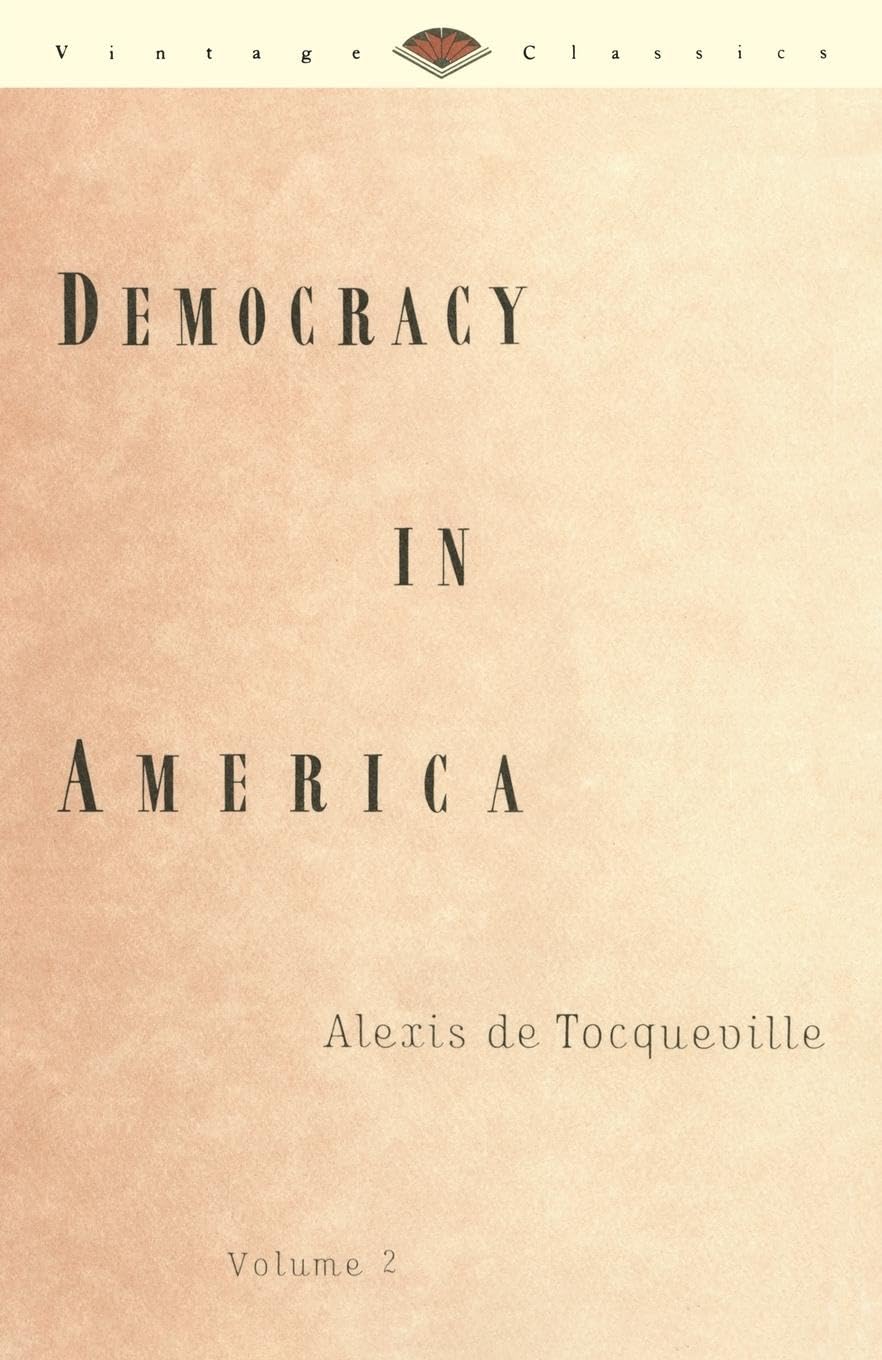



Volume 2 of the classic commentary on the influence of democracy on the intellect, feelings, and actions of Americans. With an introduction by Phillips Bradley. Democracy in America is the classic analysis of America's unique political character, quoted heavily by politicians and perennially popping up on history professors' reading lists. The book's enduring appeal lies in the eloquent, prophetic voice of Alexis de Tocqueville (1805-1859), a French aristocrat who visited the United States in 1831. A thoughtful young man in a still-young country, he succeeded in penning this penetrating study of America's people, culture, history, geography, politics, legal system, and economy. Tocqueville asserts, "I confess that in America I saw more than America; I sought the image of democracy itself, with its inclinations, its character, its prejudices, and its passions, in order to learn what we have to fear or hope from its progress." In addition to a brilliant, perceptive outline of "the philosophical method of the Americans," Volume II of Democracy in America includes the oddly modern-sounding "Why the Americans Are So Restless in the Midst of Their Prosperity," the surprising and provocative "How Americans Understand the Equality of the Sexes," and the more archaic "The Study of Greek and Latin is Peculiarly Useful in Democratic Communities." This edition--which many consider the best--contains the Henry Reeve text, revised by Francis Bowen, and further edited with introduction, editorial notes, and bibliographies by Phillips Bradley. "No better study of a nation's institutions and culture than Tocqueville's Democracy in America has ever been written by a foreign observer; none perhaps as good." -- The New York Times Praise for the work of Joseph Epstein: "Epstein is one of the premier contemporary American essayists...What is so remarkable about Epstein as an essay writer is that he'll begin a discussion at some personal place...and end up in another place relevant to us all. He enjoys making language work, not making it jump through hoops for show." -- Booklist "Joseph Epstein is an essayist in the brilliant tradition of Charles Lamb. He moves so effortlessly from the amusingly personal to the broadly philosophical that it takes a moment before you realize how far out into the intellectual cosmos you've been taken." --Tom Wolfe "Joseph Epstein's essays no more need his identifying byline than Van Gogh's paintings need his signature. Epstein's style--call it learned whimsy--is unmistakable; for Epstein addicts, indispensable." --George Will "Joseph Epstein is the liveliest, most erudite and engaging essayist we have." --James Atlas "If Epstein's ultimate ancestor is Montaigne, his more immediate master is Mencken. Like Mencken, he has fashioned a style that successfully combines elegance and even bookishness with street-smart colloquial directness. And there is nothing remote or aloof about him." --John Gross, Chicago Tribune Volume 2 of the classic commentary on the influence of democracy on the intellect, feelings, and actions of Americans. With an introduction by Phillips Bradley. Volume 2 of the classic commentary on the influence of democracy on the intellect, feelings, and actions of Americans. With an introduction by Phillips Bradley. Alexis de Tocqueville (1805–1859) was a French politician and theorist. He wrote Democracy in America after visiting the United States during which he observed various elements of the prison system. He continued on to serve in the French parliament and also wrote many works, including The Old Regime and the Revolution . CHAPTER III: SOCIAL CONDITION OF THE ANGLO-AMERICANS A social condition is commonly the result of circumstances, sometimes of laws, oftener still of these two causes united; but wherever it exists, it may justly be considered as the source of almost all the laws, the usages, and the ideas which regulate the conduct of nations; whatever it does not produce it modifies. It is therefore necessary, if we would become acquainted with the legislation and the manners of a nation, to begin by the study of its social condition. THE STRIKING CHARACTERISTIC OF THE SOCIAL CONDITION OF THE ANGLO-AMERICANS IN ITS ESSENTIAL DEMOCRACY The first emigrants of New England--Their equality--Aristocratic laws introduced in the South--Period of the Revolution--Change in the law of descent--Effects produced by this change--Democracy carried to its utmost limits in the new States of the West--Equality of education. Many important observations suggest themselves upon the social condition of the Anglo-Americans, but there is one which takes precedence of all the rest. The social condition of the Americans is eminently democratic; this was its character at the foundation of the Colonies, and is still more strongly marked at the present day. I have stated in the preceding chapter that great equality existed among the emigrants who settled on the shores of New