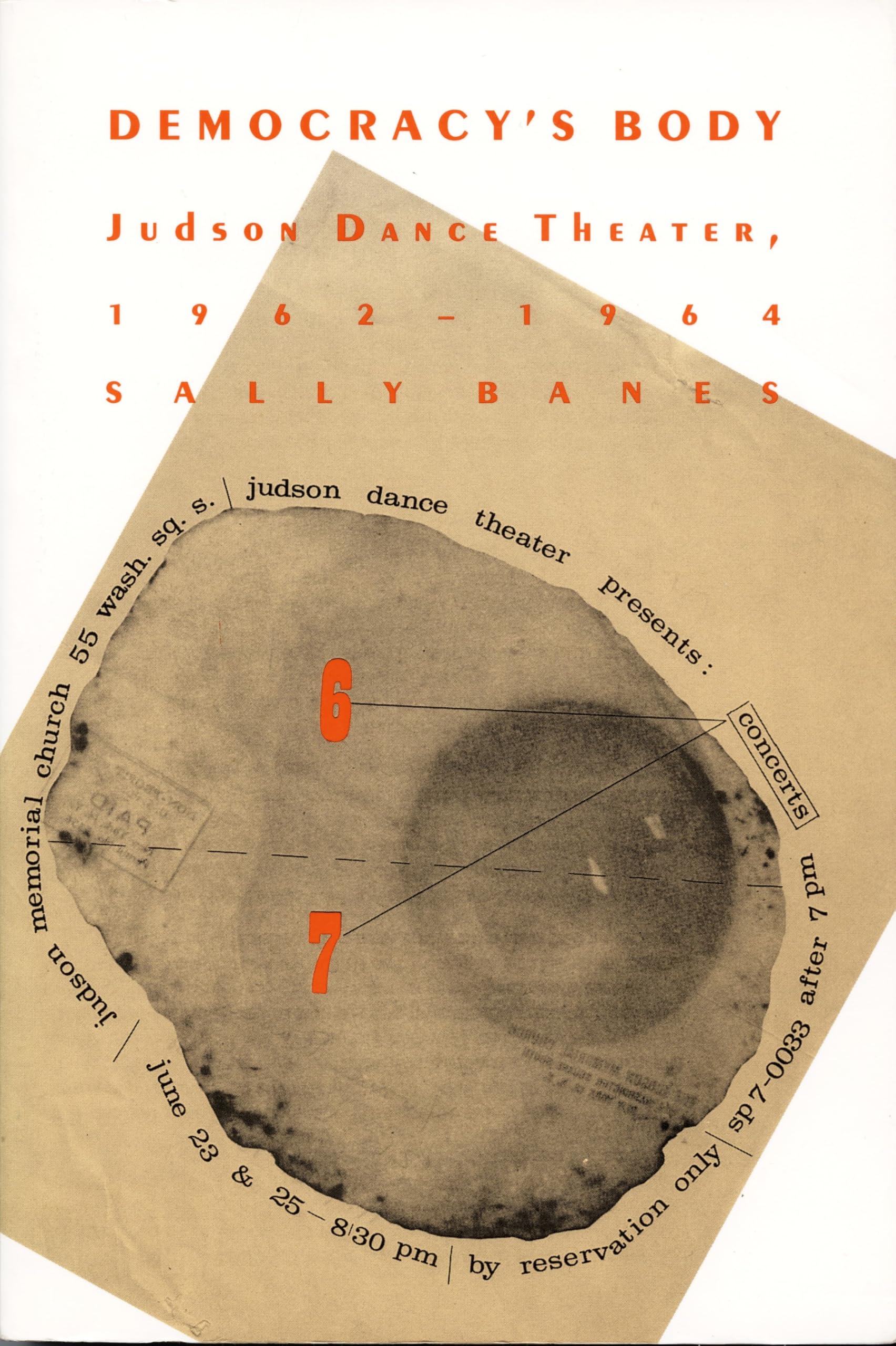



Democracy's Body offers a lively, detailed account of the beginnings of the Judson Dance Theater--a popular center of dance experimentation in New York's Greenwich Village--and its place in the larger history of the avant-garde art scene of the 1960s. JDT started when Robert Dunn, a student of John Cage, offered a dance composition class in Merce Cunningham's studio. The performers--many of whom included some of the most prominent figures in the arts in the early sisties--found a welcome performance home in the Judson Memorial Church in the Village. Sally Banes's account draws on interviews, letters, diaries, films, and reconstructions of dances to paint a portrait of the rich culture of Judson, which was the seedbed for postmodern dance and the first avant-garde movement in dance theater since the modern dance of the 1930s and 1940s. Originally published in 1983, this edition brings back into print a highly regarded work of dance history. "Anyone interested in choreography or methods of teaching composition must have this book on the shelf. . . Th[is] book is crucial in understanding our history and in appreciating the shape of dance today. Dancers and choreographers need to read it to learn about their heritage, historians to discover clarity about a rambunctious and exciting period of dance history that has been fuzzy with myth and misunderstanding. . . It must be read."—Sally Sommer, Dance Research Journal (from a review of the 1983 edition) "Ms. Banes is widely respected as the leading scholar/historian writing about this seminal and neglected period of contemporary dance history. . . Her books are indispensable for any serious dance historian or student of this era. . . Democracy's Body is the type of inaugural survey of a period of art that will undoubtedly inspire other books."—Janice Ross, Stanford University "Sally Banes is one of the most influential dance historians in America right now. The Judson Era, which Democracy's Body examines in meticulous detail, is a key moment in American dancing."—Mindy Aloff, Dance Critic, The New Yorker "Anyone interested in choreography or methods of teaching composition must have this book on the shelf. . . Th[is] book is crucial in understanding our history and in appreciating the shape of dance today. Dancers and choreographers need to read it to learn about their heritage, historians to discover clarity about a rambunctious and exciting period of dance history that has been fuzzy with myth and misunderstanding. . . It must be read."--Sally Sommer, "Dance Research Journal" (from a review of the 1983 edition) Democracy's Body Judson Dance Theater, 1962-1964 By Sally Banes Duke University Press Copyright © 1993 Sally Rachel Banes All rights reserved. ISBN: 978-0-8223-1399-1 Contents List of Illustrations, Acknowledgments, Introduction, 1 Robert Dunn's Workshop, 2 "A Concert of Dance" at Judson Church, 3 The Judson Workshop, 4 The Plot Thickens, 5 Dance in the Sanctuary and in the Theater, 6 From Great Collective to Bus Stop, Notes, Illustrations, Bibliography, Index, CHAPTER 1 Robert Dunn's Workshop John Cage asked Robert Dunn to teach a class in choreography at the Merce Cunningham studio in the fall of 1960. Dunn had taken Cage's class in "Composition of Experimental Music," taught at the New School for Social Research from 1956 to 1960, as had the writers Jackson MacLow and Dick Higgins, the composer Toshi Ichiyanagi, and Al Hansen, George Brecht, and Allan Kaprow, all of whom were later associated with Happenings and Events. The classes Cage gave were small and participatory. Cage later wrote of his teaching method: I began each series of classes by meeting the students, attempting to find out what they had done in the field of music, and letting them know what I myself was doing at the time. The catalogue had promised a survey of contemporary music, but this was given only incidentally and in reference to the work of the students themselves or to my own work. For, after the first two classes, generally, the sessions were given over to the performance and discussion of student works. Dick Higgins remembers that Cage spoke about notation, prepared a piano, gave the class problems to solve, and when the students demonstrated their solutions, discussed the philosophy of each piece. "The technique of the piece was seldom mentioned, except that inconsistencies and incongruities would be noted." Higgins, who credited the class with contributing to the development of Happenings, writes that "the best thing that happened to us in Cage's class was the sense he gave us that 'anything goes,' at least potentially." Al Hansen came to Cage's class interested chiefly in film; he had read in writings by Sergei Eisenstein that "all the art forms meet in the film frame." Hansen also traces Happenings back to Cage's course and his own realization, by the end of it, that "all art forms ... meet ... in the eyeball. In the