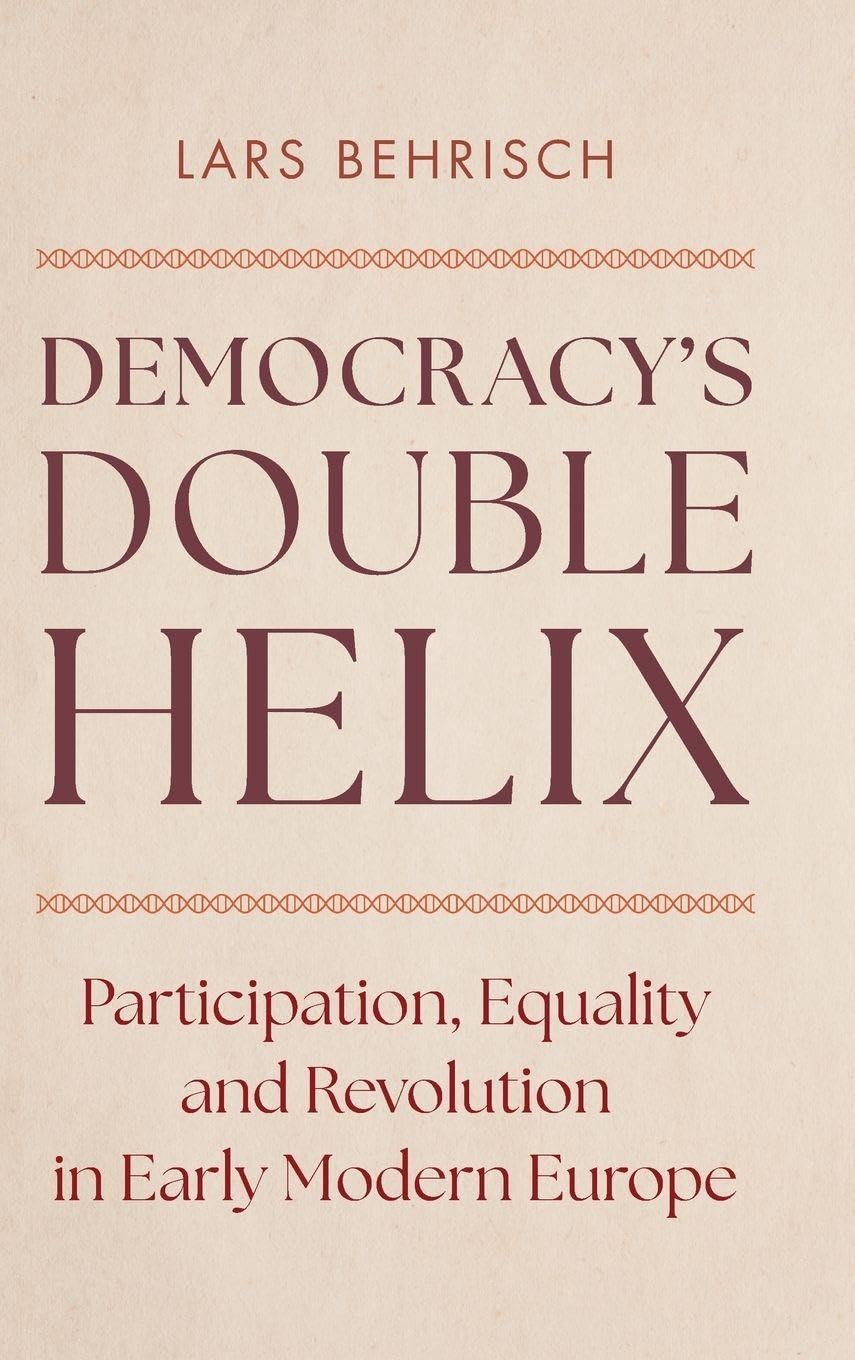
Democracy's Double Helix: Participation, Equality and Revolution in Early Modern Europe
$44.32
by Lars Behrisch



Where does our modern democracy come from? It is a composite of two very different things: a medieval tradition of political participation, pluralistic but highly elitist; and the notion of individual equality, emerging during the early modern period. These two things first converged in the American and French revolutions – a convergence that was not only unexpected and unplanned but has remained fragile to this day. Democracy's Double Helix does not simply project and trace our modern democracy back into history, assuming that it was bound to come about. It looks instead at the political practices and attitudes prevailing before its emergence. From this perspective, it becomes clear that there was little to predict the coming of democracy. It also becomes clear that the two historical trajectories that formed it obey very different logics and always remain in tension. From this genuinely historical vantage point, we can therefore better understand the nature of our democracy and its current crisis. ‘Lars Behrisch has written an important and intriguing book about the roots of modern democracy in early modern Europe, showing in a clear and original manner how practices of equality and participation developed both before and during the ‘age of revolution.' This is a volume that will be of interest to historians, political theorists, and historical sociologists alike.' David Bell, author of Men on Horseback: The Power of Charisma in the Age of Revolution ‘This book reopens a much needed conversation about the tension between democracy and political participation. With countless fresh insights along the way Behrisch shows that they are not, as often thought, identical, and that we ignore the tensions at our peril. His double helix sets a new standard for debate on modern politics.' Lynn Hunt, author of The Invention of Human Rights ‘Ranging across the European continent and the Atlantic from the Middle Ages to the 19th century, Lars Behrisch's Democracy's Double Helix is a major intervention of astonishing scope and great explanatory power. Chronicling the “accidental” origins of democracy, it provides the best causal account we have to date of the modern emergence of the ideal and practice of individual equality in all its promise and elusive frustration.' Darrin M. McMahon, author of Equality: The History of an Elusive Idea Explains the emergence of modern democracy in an entirely new way as a convergence of political participation and individual equality. Lars Behrisch teaches early modern political history at Utrecht University. His research focuses on comparative European history, exploring early modern politics in its variegated societal, religious and cultural settings. He has authored two monographs in German, including Die Berechnung der Glückseligkeit. Statistik und Politik in Deutschland und Frankreich im späten Ancien Régime [The Calculation of Public Happiness: Statistics and Politics in Germany and France in the late Ancien Régime] (2016), awarded the prestigious Carl Erdmann Prize by the German Historical Association.