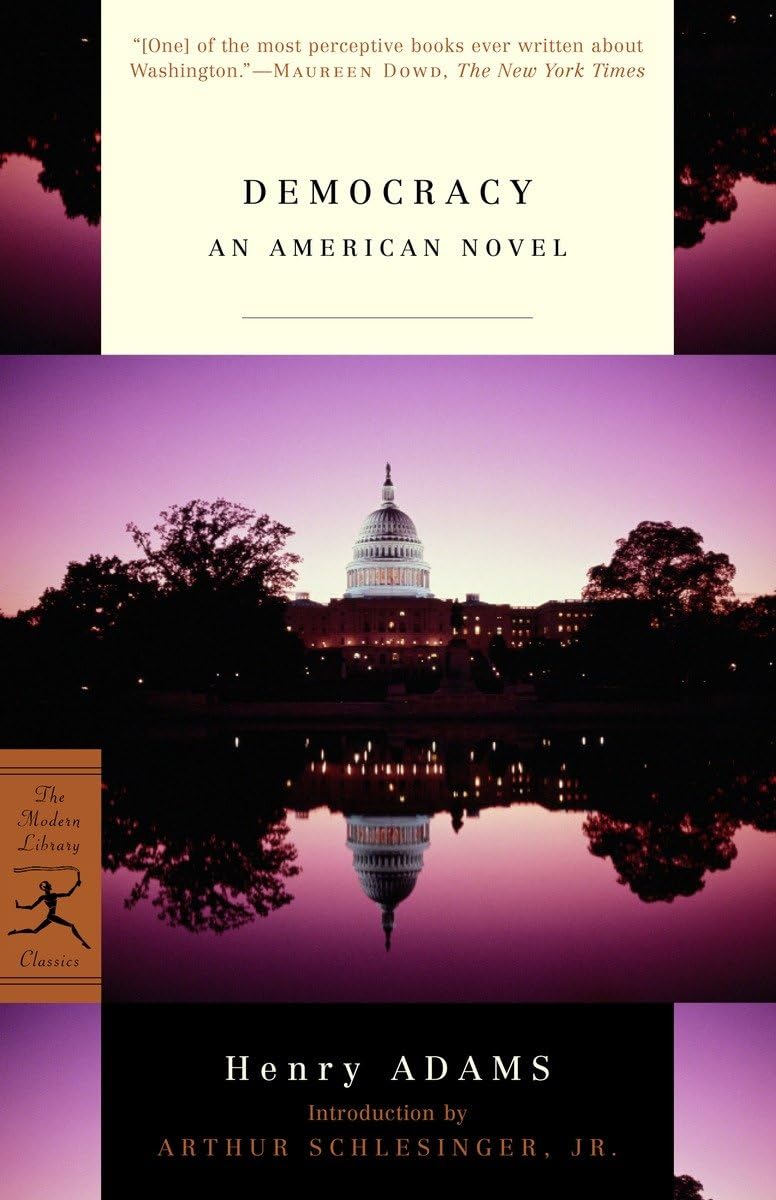



An immediate bestseller upon its publication in 1880, the anonymously penned Democracy prompted widespread speculation and guessing games as to its author’s identity. It is the story of Mrs. Lightfoot Lee, a society widow, and Silas Ratcliffe, the most influential member of the Senate, who, throughout the novel, pursues Mrs. Lee while at the same time battling her for power. Set in Washington in the 1870s, Democracy presents a scathing and incisive look at the intricate inner workings of politics and corruption that remains relevant today. This Modern Library Paperback Classic is set from the 1880 first edition and includes a contemporary review from The Atlantic Monthly. “[One] of the most perceptive books ever written about Washington.” —Maureen Dowd, The New York Times An immediate bestseller upon its publication in 1880, the anonymously penned "Democracy prompted widespread speculation and guessing games as to its author's identity. It is the story of Mrs. Lightfoot Lee, a society widow, and Silas Ratcliffe, the most influential member of the Senate, who, throughout the novel, pursues Mrs. Lee while at the same time battling her for power. Set in Washington in the 1870s, "Democracy presents a scathing and incisive look at the intricate inner workings of politics and corruption that remains relevant today. This Modern Library Paperback Classic is set from the 1880 first edition and includes a contemporary review from "The Atlantic Monthly. Arthur Schlesinger, Jr. , is a Pulitzer Prize–winning historian and biographer. His many books include A Thousand Days: John F. Kennedy in the White House and, most recently, A Life in the 20th Century . He lives in New York City. Chapter I For reasons which many persons thought ridiculous, Mrs. Lightfoot Lee decided to pass the winter in Washington. She was in excellent health, but she said that the climate would do her good. In New York she had troops of friends, but she suddenly became eager to see again the very small number of those who lived on the Potomac. It was only to her closest intimates that she honestly acknowledged herself to be tortured by ennui. Since her husband’s death, five years before, she had lost her taste for New York society; she had felt no interest in the price of stocks, and very little in the men who dealt in them; she had become serious. What was it all worth, this wilderness of men and women as monotonous as the brown stone houses they lived in? In her despair she had resorted to desperate measures. She had read philosophy in the original German, and the more she read, the more she was disheartened that so much culture should lead to nothing—nothing. After talking of Herbert Spencer for an entire evening with a very literary transcendental commission-merchant, she could not see that her time had been better employed than when in former days she had passed it in flirting with a very agreeable young stock-broker; indeed, there was an evident proof to the contrary, for the flirtation might lead to something—had, in fact, led to marriage; while the philosophy could lead to nothing, unless it were perhaps to another evening of the same kind, because transcendental philosophers are mostly elderly men, usually married, and, when engaged in business, somewhat apt to be sleepy towards evening. Nevertheless Mrs. Lee did her best to turn her study to practical use. She plunged into philanthropy, visited prisons, inspected hospitals, read the literature of pauperism and crime, saturated herself with the statistics of vice, until her mind had nearly lost sight of virtue. At last it rose in rebellion against her, and she came to the limit of her strength. This path, too, seemed to lead nowhere. She declared that she had lost the sense of duty, and that, so far as concerned her, all the paupers and criminals in New York might henceforward rise in their majesty and manage every railway on the continent. Why should she care? What was the city to her? She could find nothing in it that seemed to demand salvation. What gave peculiar sanctity to numbers? Why were a million people, who all resembled each other, any way more interesting than one person? What aspiration could she help to put into the mind of this great million-armed monster that would make it worth her love or respect? Religion? A thousand powerful churches were doing their best, and she could see no chance for a new faith of which she was to be the inspired prophet. Ambition? High popular ideals? Passion for whatever is lofty and pure? The very words irritated her. Was she not herself devoured by ambition, and was she not now eating her heart out because she could find no one object worth a sacrifice? Was it ambition—real ambition—or was it mere restlessness that made Mrs. Lightfoot Lee so bitter against New York and Philadelphia, Baltimore and Boston, American life in general and all life in particular? What did she want? Not social position, for she herself was an eminently res