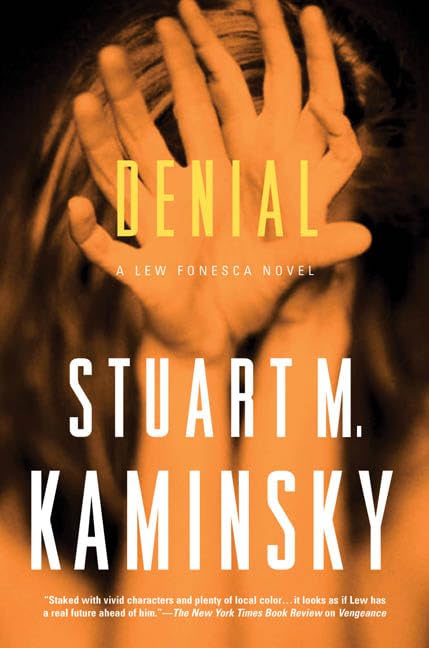



Lew Fonesca is a man who does things for people. He makes small problems go away and tries to keep the larger ones from landing his clients in jail. He finds deadbeats, errant spouses, and generally keeps the populace of Sarasota on the up and up. Now Lew is faced with one case that will try his patience...and another that may break his heart. The first involves an elderly woman who swears she's witnessed a murder in her old age home despite the fact that everyone she tells her story to: her family, the hospital staff, and finally the cops all tell her that it just couldn't have happened. The other has Lew trying to find out the identity of a hit and run driver who killed a 14 year old boy. This task dredges up old memories and a lot of pain, for Lew fled Chicago years ago, after a drunk driver killed his beloved wife. As Lew begins to dig deeper into both cases he finds that they are tied together in ways he can't hope to untangle. And when someone tries to run him down, Lew knows that he's getting close to some nasty home truths and he is going to have get the answers if he is to survive. Lew Fonesca, former investigator for Illinois' Cook County State's Attorney's Office, is serving a self-imposed life sentence in Florida. Over the past three mysteries in Kaminsky's series, readers have seen Fonesca as struggling to get by as a hard-up Sarasota process server, living in the tiny space behind his grungy office and consumed with grief over his wife's death in a hit-and-run accident. Fonesca is so miserable that he can be a real pain for a reader to hang with, even portrayed by as gifted a writer as Kaminsky. But in this latest entry, Fonesca moves from irritating sad sack to intriguing stumbler into the light. Here, he looks for two murderers: the person accused by a resident of Seaside Assisted Living of killing another resident, and the hit-and-run driver who killed a local actress' 14-year-old son. The book begins and ends with the word " No ," but there's a world of difference in what those words mean in the context of the story. Connie Fletcher Copyright © American Library Association. All rights reserved "Readers will be demanding the sequel before they've finished the debut."--Booklist (starred) on Vengeance "Kaminsky is such a pro that the pages fly by, and even though Lew is often such a sad sack, it's hard not to root for him."--The Chicago Tribune on Retribution "Lew is still a triumph: a Lew Archer type with nerve endings so sensitive that when he's asked, 'anybody dead?' he replies, 'Most of the people who ever lived.'"--Kirkus Reviews on Retribution Stuart M. Kaminksy is the Edgar Award-winning author of the critically acclaimed Inspector Rostinkov, Toby Peters, and Abe Lieberman mystery series. He lives with his family in Sarasota, Florida 1No A single word. No period. No exclamation mark needed. I wrote the word on the back of a yellow three-folded sheet with a black fine-point Sharpie pen.The sheet had come to me in the mail, an invitation in a flood of typefaces, an invitation to take the Scotch tape off the attached key, hurry down to the Toyota dealer on Bee Ridge Road and drive home a new Tacoma if the key worked.I took the Scotch tape off, dropped the key into the partly filled wastebasket next to my desk and slipped the sheet with that single word under the door of my office onto the sunlit landing outside.Someone knocked. I didn’t answer. My No answered any questions he or she might ask.I turned, barefoot, looked around my office. Desk. A thick black-covered notebook the size of an old Life magazine on top of it. Two chairs. Walls empty now except for the book-cover size dark painting of a thick patch of Amazon jungle swirled in mist, with shadow, black mountain in the background with a single tiny dab of color, of a bird in flight above the trees.I shuffled into the small room behind my office, the space in which I did what others referred to as living. Cot with blankets, a couple of pillows. Closet with few clothes neatly folded. Chair, wooden, with arms. Sitting on the chair was my slightly soiled Cubs baseball cap. At the foot of my cot were a dented portable dorm-size refrigerator piled not too high with things that could be eaten—protein bars, cereal, something made of tofu guaranteed to last a century without spoiling and promising no taste. Inside the refrigerator were three gallons of tap water in recycled plastic milk cartons. Next to the refrigerator, on a table with a tender leg, sat my television and VCR. My stacks of VHS tapes were piled neatly on the floor.Thus was all my space taken.Another knock. The visitor on my doorstep had taken his or her time to absorb the single word I had written. Or maybe he or she had been puzzling over the missing automobile key?There was no mirror in the room, but if the blinds were open, which they were not, and the light was right, I could look at what I appeared to be, a slightly-less-than-average-size, thin, bal