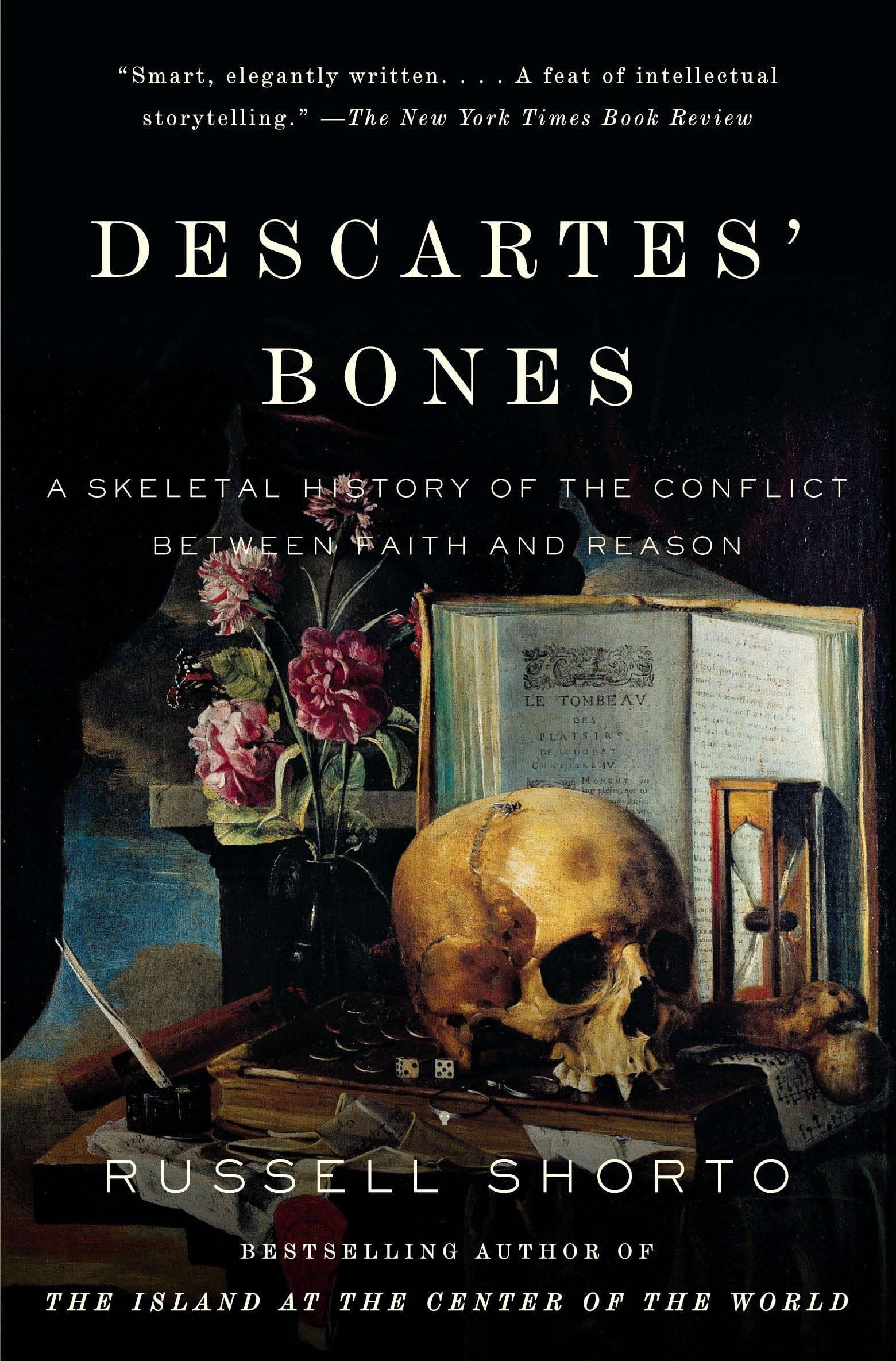
Descartes' Bones: A Skeletal History of the Conflict Between Faith and Reason
$11.67
by Russell Shorto



Sixteen years after René Descartes' death in Stockholm in 1650, a pious French ambassador exhumed the remains of the controversial philosopher to transport them back to Paris. Thus began a 350-year saga that saw Descartes' bones traverse a continent, passing between kings, philosophers, poets, and painters. But as Russell Shorto shows in this deeply engaging book, Descartes' bones also played a role in some of the most momentous episodes in history, which are also part of the philosopher's metaphorical remains: the birth of science, the rise of democracy, and the earliest debates between reason and faith. Descartes' Bones is a flesh-and-blood story about the battle between religion and rationalism that rages to this day. A New York Times Notable Book “Smart, elegantly written. . . . A feat of intellectual story-telling.” — The New York Times Book Review “A kind of intellectual adventure story.... Fanciful and beguiling.... Shorto writes with wit, verve and style. On every page, he offers up some new bafflement, curiosity or delight.” — Los Angeles Times “Shorto’s insights are keen.... He delves into the oddest and most unappetizing aspects of Descartes’ story along with the inspiringly lofty ones.”— The New York Times “Shorto is a skilled raconteur. He distills centuries of scientific and religious debate while keeping his story brisk and engaging.”— San Francisco Chronicle “Shorto is a skilled raconteur. He distills centuries of scientific and religious debate while keeping his story brisk and engaging.” — San Francisco Chronicle “Beautifully written. . . . The reader will find [Shorto's] intellectual insights entertaining, enlightening, and, perhaps, disturbing.” —Lisa Jardine, Nature “With the fascinating Descartes' Bones , Russell Shorto has produced another compelling intellectual detective story, one that illuminates the present as much as the dusty past.”—Jeffrey Toobin, author of The Nine "This is a beguiling book about the architecture of the way we live now. As Russell Shorto points out, Descartes is claimed by both the ferociously secular and the ferociously religious, but the truth is more complicated. The sooner we recognize that the world is too wild to be reduced to glib categorization, Shorto writes, the sooner we may be able to find ways to talk to, rather than yell at, one another."—Jon Meacham, author of Franklin and Winston and American Gospel "A fascinating, colorful, and very readable account of early modern ideas and personalities. Shorto has a gift for storytelling. He brings the seventeenth century to life while doing justice to the philosophy."—Professor Steven Nadler, author of Rembrandt's Jews and Spinoza: A Life Russell Shorto is the author of five books and is a contributing writer at the The New York Times Magazine . His books have been published in fourteen languages and have won numerous awards. From 2008 to 2013, he was the director of the John Adams Institute in Amsterdam. THE MAN WHO DIED IN THE SOUTHERN EDGE OF STOCKHOLM'S OLD Town stands a four-story building that was constructed during the busy, fussy period called the Baroque. Its red-brick facade is ornamented with sandstone cherubs and crests. Two upright cannons flank the entry; bearded busts gaze down sternly on those who approach the door. If you could somehow ignore the designer handbag shop and the upscale "Glenfiddich Warehouse" restaurant/bar occupying the ground floor, and the streams of tourists moving past on a summer afternoon, the structure would probably seem very much of the year--1630--when a merchant named Erik von der Linde built it. In the dead of night in the dead of winter in the year 1650, the most solemn rite of passage was playing out on an upper floor of this building. People hurried between rooms, past windows that looked out onto the dark, icy harbor below, exchanging information and worried looks. But if the occasion was grave, it wasn't quiet. For someone close to death, the man who lay in bed--not quite fifty-four years old, small-boned, ashen, the center of everyone's attention--was alarmingly active. It was fury that gave him these last bursts of adrenaline. His friend and protege Pierre Chanut, the French ambassador to Sweden, in whose house he lay dying, was at his side constantly, trying to manage the man's anger while feeling doubly guilty: it was he who had urged Rene Descartes to come to this frozen land and he who had first contracted a fever, through which Descartes had nursed him before catching it himself. Chanut fervently believed that Descartes was in the process of transforming the world with his revolutionary thinking. In this he was essentially correct. A change took place in the middle of the 1600s. People began to employ a new, sweeping kind of doubt, to question some of their most basic beliefs. The change was in a way more profound than the American and French revolutions, the Industrial Revolution, or the information age, because it underlay