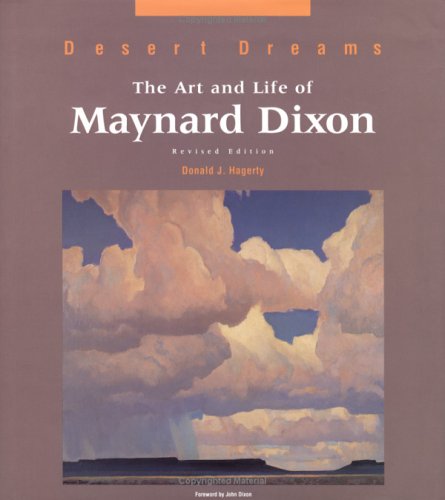
Desert Dreams: The Art and Life of Maynard Dixon, Revised Edition
$219.00
by Donald J Hagerty



"I know my West some, but to realize how big and splendid and free and magnificent and God-made it really is, once in a while, I have to look on Maynard Dixon's pictures," said Wilbur Hall in 1937. Added to this new edition are 20 newly discovered Dixon paintings, along with 12 previously unpublished black-and-white photographs, many of them portraits of Dixon taken by Dorothea Lange. This beautiful book captures the magnificence of Dixon's work and his unique personality. DESERT DREAMS: The Art and Life of Maynard Dixon by Donald J. Hagerty. (Gibbs-Smith: $65.) Born in 1875 in the southern San Joaquin Valley, Dixon grew up among the rocky arroyos, cattle ranches, cottonwoods and wide open praries he later painted. His heroes were Kit Carson, Sitting Bull, Stonewall Jackson, Geronimo and Joaquin Murietta. By the age of 16 he decided to devote himself to "illustrating the old west," and sent two sketchbooks to Frederic Remington. Remington's encouragement began Dixon's career as an illustrator. This beautiful book shows the range of Dixon's work; from tender blurred watercolors to bold, graphic magazine covers for the Overland Monthly, and murals like the one at left ("The Legend of Earth and Sun," 1929, courtesy of the Biltmore Hotel in Phoenix, Ariz.). But most of the book is page after startling page of Dixon's oil paintings, of Mexico and the West, of Native Americans, mesas and mountains. Susan Reynolds. (Susan Reynolds Los Angeles Times 1993-08-08) Ansel Adams once commented that for Maynard Dixon, "the West was uncrowded, unlittered, unorganized and free." Adams might have added that Dixon would allow no fences to surround him, imaginary or real. Ultimately Dixon argued that American painting could best work its influence on the lives and thoughts of people when painters based their work upon native material and their native reaction to it. Maynard Dixon was a regionalist long before the term arrived, with confirmed belief in the vitality of America. His region was the arid landscape of southern California, Nevada, Utah, Arizona, and New Mexico. Although he was geographically isolated from the mainstream, Maynard Dixon should be regarded as a pivotal connection between late-nineteenth-century and contemporary American art. His work opens the way for the sparse rock-, cloud-, and desertscapes vocabulary developed by a number of artists, including Georgia O'Keeffe, Conrad Buff, Helen Frankenthaler, and Ed Mell. Dixon's long, productive life was, in itself, a work of art. From the beginning Dixon was different: an authentic, inconoclastic, self-created individual. Born in Fresno, California, in 1875, Dixon ended his formal art training in early 1893 after three miserable months at San Francisco's Mark Hopkins Institute of Art. Most of his American contemporaries made an obligatory pilgrimage to Paris for study; Maynard did not go. Instead he became an active outspoken, if sometimes ambivalent, participant in California's cultural life. By the middle 1890s, in an era acknowledged as the Golden Age of Illustration, he was one of the country's foremost purveyors of nostalgic Old West in books by such authors as Jack London, John Muir, O. Henry, Mary Austin, Eugene Manlove Rhodes, and Clarence Mulford (of Hopalong Cassidy series). After 1912, when he concluded he could no longer protray the West in "false" terms Dixon devoted increasing attention to easel and mural painting, decoration, while still pursuing a career in commercial are, particularly poster design. In 1921, supported and encouraged by his second wife, photographer Dorothea Lange, Dixon downplayed his commercial art career. He was interested in modern art techniques, but he rejected any assessment of a "one best way," and scorned experimental painting borrowed from European movements. The "narrow orthodoxy of modernism, where self-expression is used as an alibi for idiocy" angered him.... Through long and sympathetic obervation, he learned how plains rise and fall as they flow toward the horizon and how the architecture of mesa and butte marches rhythmically over the landscape into the infinite freedom of a deep blue sky. Whether Dixon painted in the field or studio, he portrayed the West in its own colors, its own light, its own forms, shaping his work with an instinctive feeling for landscape elements, demanding a standard beyond objectivity. Maynard Dixon had something to say. Where many have looked, few have seen. Among these few is Maynard Dixon. Donald J Hagerty, is a teacher and administrator at the University of California at Davis. This comprehensive monograpd on Maynard Dixon is the product of fifteen years of research. It reflects the cooperation of Dixon's family, musuems, galleries, libraries and collectors around the country. Introduction On an early summer morning before the traffic arrives, walk south from Broadway on San Francisco's Montgomery Street. Accompanied by drifting, trailing fog, you will soon come to the 700 bloc