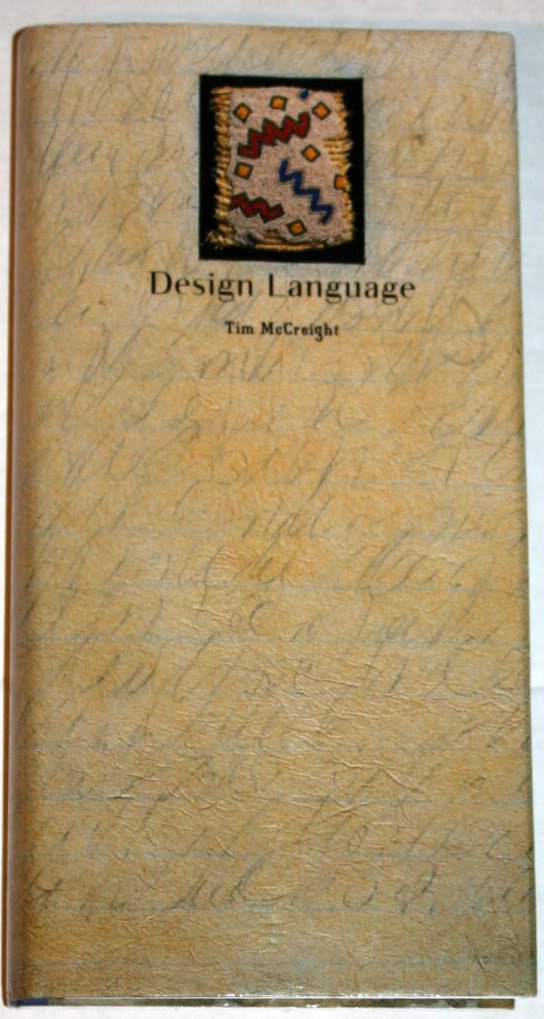



Design Language brings fresh insight to students and practicing designers by examining the words they use. This compact volume presents 100 keywords with background etymology and commentary. Whether the word is as familiar as edge or perhaps new to you like synesthesia, youll find yourself moving easily from one entry to the next, intrigued by the rich layers of meaning you discover. Design Language understands that a book cant teach design. Instead, it helps people learn design, by using vocabulary to explore style, form, and composition. What a delightful find! This small hand-sized book explodes with a thoughtful contemplation of design principles capable of energizing anyone who posses a thread of creativity and who strives to improve his or her artistic work. Tim McCreight creates jewelry as his personal from of art and is perhaps best known for his excellent instructional books on jewelry making. His natural teacher's knack for explaining difficult techniques carries over to his design book. Design can be a difficult subject to grasp, shrouded in ostentatiousness and "art speak". As in his other books McCreight strips away all pretensions and presents the material in an easy-to-digest manner. In his introduction McCreight describes design as "a private, idiosyncratic affair" which is "never truly meaningful until it has been creatively put to use". He presents reflections on the principles of design by exploring their terminology. Each of the 100 keywords is examined using it's dictionary definition and etymology, a quote from a visual or verbal artist, and then references to related terms- you can easily move around the book, following your interests, not a predetermined path, as the terms are arranged alphabetically in a non-hierarchical manner. Definitions are brief and purposefully subjective - the reader brings content to the reading via his or her own interpretations and thereby customizes the lesson to personal at-the-moment needs. Repeated readings reveal different meanings as the readers outlook changes. While no pictures accompany the text, McCreight encourages us to use it with the pictures we select ourselves and to use the book as an art tool- "make notes in the margins, add to the lists and bend a few pages". Pick a term to start on your own personal journey of exploration in design and see where it leads you. Your art will be improved by it, and you'll enjoy the journey of self-discovery much more than any class you'll ever take. --Art Quilt magazine Design Language was conceived as an alternative to the traditional approach to design texts, which rely on photographs, didactic explanations, and an imposed hierarchy. While each of these factors has merit, they come at the cost of allowing students and readers to discover personal definitions of design. The low cost and open spaces of this book invite readers to add to the text, truly shaping it into a valuable, idiosyncratic language. This book was born from my experience as a college teacher. I find I'm most effective when I sneak up on a student and whisper a brief aside. As they sort out the connection between what they were thinking and an apparently unrelated observation, real learning takes place-light bulbs go off. I hope Design Language captures a little bit of this magic on the printed page. Did you ever notice the similarity between the words textile, texture and textbook? Would you be interested to know that they share the same Latin root, textus, which means "woven thing"? Knowing this enlarges our understanding of literature, where lines of words connect like warp and weft to make a fabric of meaning, and helps us realize the importance of structure in a tactile object. Each of the 100 basic art-related terms in Design Language is examined with scholarship and wit. Each keyword entry contains selected dictionary definitions, pronunciation guide, etymology, subjective commentary, a provocative quotation, and a list of associated terms. Design Language brings fresh insight to students and practicing designers by examining the words they use. This compact volume presents 100 keywords with background, etymology and commentary. Whether the word is as familiar as edge or perhaps new to you, like synesthesia, you'll find yourself moving easily from one entry to the next, intrigued by the rich layers of meaning you discover. Teachers of design will appreciate the brief, clear, and inclusive presentation. The dynamic layout invites notation, making the book a starting point for personal vocabulary, both visual and literal. The sewn binding is tough enough for years of studio use, and the compact size will fit into a toolbox or pocket. Design Language understands that a book can't teach design. Instead, it helps people learn design, by using vocabulary to explore style, form, and composition. Tim McCreight is a metalsmith, designer and teacher. He has written 9 books in on jewelrymaking and metals, and contributes regula