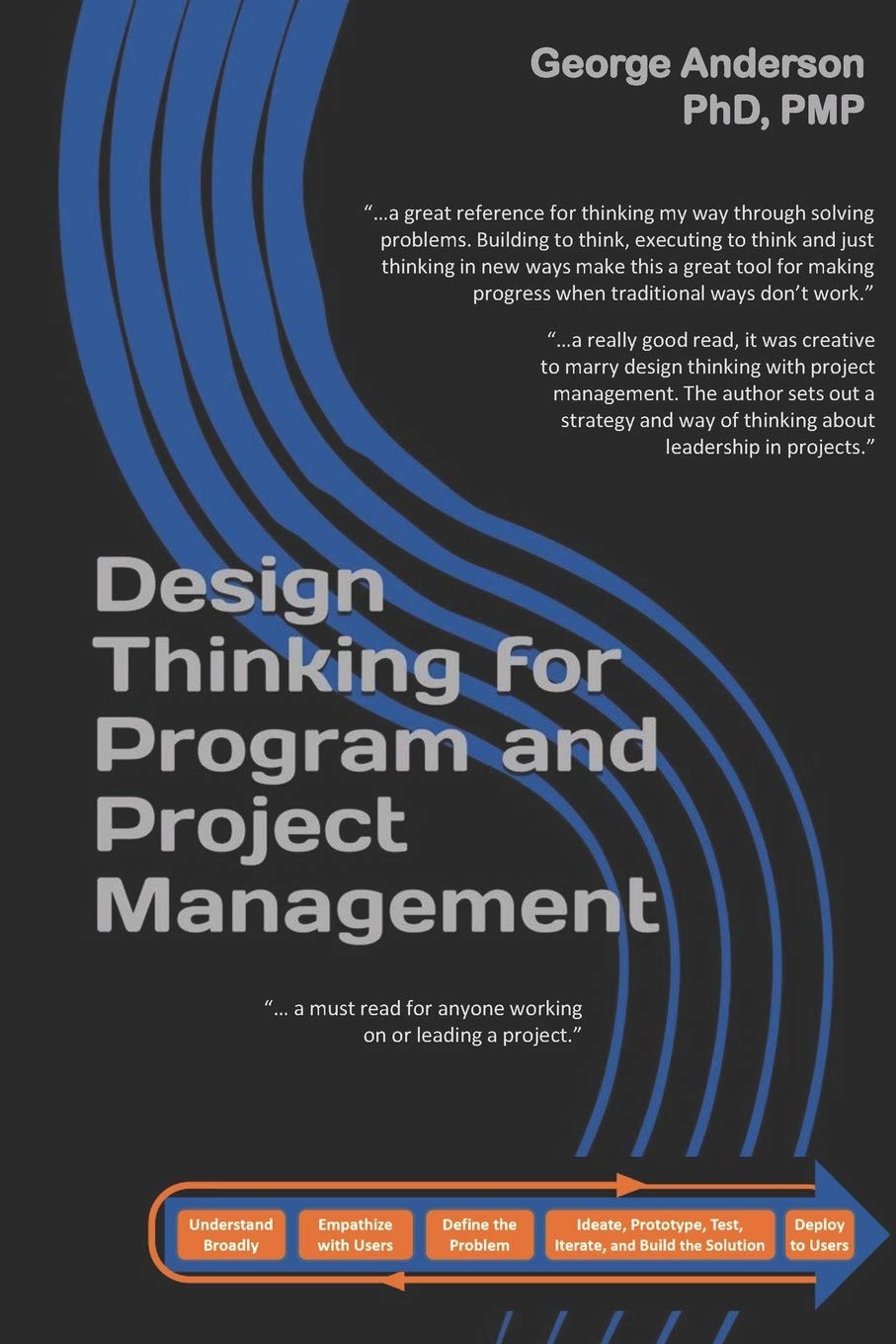



How do you become a better Project Manager or Program Manager? For starters, you might need to Think differently to Lead more effectively. Complexity, ambiguity, and time are the greatest enemies to solving hard problems. Complex problem-solving today requires arming both the problem solvers AND those who Lead and Manage the problem solvers -- from executives to PMPs, PgMPs, managing architects, and other project leaders -- with a tool bag of proven Design Thinking techniques that can help us identify and manage risks better, communicate better, think in new ways, navigate the unknown, and more... "I was fortunate enough to receive an early copy of this book to review from the author. So much has been written about program and project management over the last few years that it is difficult to imagine a new and valuable addition to the canon, but Anderson has managed it, thanks to his experience of combining it with the discipline of Design Thinking. Books that are of the variety "x meets y!" can be difficult to pull off (often because you wonder by the end if anything was even improved by the meeting). However, the author achieves it here, mainly because his knowledge of both domains is deep, and because he has clearly thought through the most appropriate way to apply his findings. It is written in such a way to appeal to beginners without disappointing the expert. Rather than throw away the traditional approaches of program and project management, he thoughtfully adds to the discipline, allowing PMs (and in fact anyone who manages ambiguous work) to add to their toolkit in a highly effective manner. I am particularly drawn to the topic area, because underlying this is a refusal to accept that solving hard problems is something to be avoided. In a world where we have access to unlimited compute power, and unparalleled ways to harness human ingenuity, we should not constantly be avoiding "boiling the ocean" or earnestly capturing "low hanging fruit". This book on its own will not drive solutions to some of our most challenging problems, but it does provide us with some strong guidance on how to attack them. I'm looking forward to reading more, but more importantly, applying these ideas to my own work." Paul Slater, Director of Business ProgramsMicrosoft Corporation "The author and the contributors provide an excellent pragmatic approach to program/project management. The unique combination of using the viewpoint of design thinking makes it a visionary learning experience. The other dimension which I find invaluable is the constant return to looking at the outcomes from the customer perspective. This view increases the chance of delighting the customer. A trap some current approaches fall into is to focus on the deliverables alone from a technical aspect. The Design Thinking element is key to starting and completing projects with explicit attention on how to work with the customer from strategy to tactics. Many current approaches provide the "how-to" from a process perspective. This approach advances the state of the art by combing the cultural, interpersonal, and team dynamics that are required to excel at the discipline of project management. This book is a must-read for those wanting to stay ahead of the curve." Bryan M. Complexity, ambiguity, and time are the greatest enemies to solving hard problems. Chief among these problems today are the challenges organizations face when transforming their businesses and operations. Transformation expert George Anderson contends that a broader human-centric leadership approach is overdue. Complex problem-solving today requires arming the problem solvers as well as those who lead and manage the problem solvers with a tool bag of proven Design Thinking techniques. Explore more than 70 of these techniques, aligned around the five phases of traditional Program and Project Management and applied through a unique five step Design Thinking model. Apply Design Thinking to Program and Project Management: - Build to Think Mentality - Managing Expectations - Human-centric Leadership - Understanding Broadly - Working through Ambiguity - Empathizing Deeply - Trust & Cultural Intelligence - Diversity by Design Some of the Design Thinking Techniques Applied Inside: Adjacent Spaces * Aligning Strategy to Time Horizons * Silent Design * Probing for Understanding * Empathy Mapping * Mind Maps * Persona Analysis * Ideating & Brainstorming * Inclusive & Sensitive Design * Increasing Shared Identity * Day in the Life Analysis * Edge Case Thinking * Story Telling * Modular Building * Prototyping * Iterating * The Five Why's * Scaling for Effectiveness * Testing to Learn * Simple Rules * Guiding Principles * The Rule of Threes * Premortems * Brainstorming in Reverse * Backporting * Standardized Templates * Inverse Power Law * And many more! George Anderson is a Program Director for Microsoft Services and an Adjunct Professor and guest lecturer for several universitie