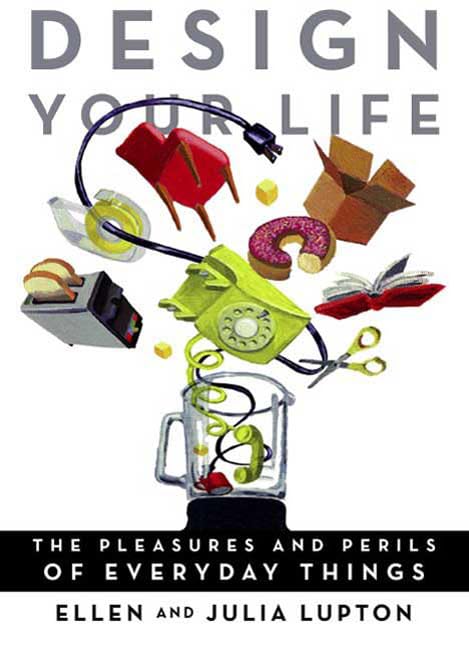



Design Your Life is a series of irreverent and realistic snapshots about objects and how we interact with them. By leading design thinker Ellen Lupton and her twin sister Julia Lupton, it shows how design is about much more than what’s bought at high-end stores or the modern look at IKEA. Design is critical thinking: a way to look at the world and wonder why things work, and why they don’t. Illustrated with original paintings of objects both ordinary and odd, Design Your Life casts a sharp eye on everything from roller bags, bras, toilet paper, and stuffed animals to parenting, piles, porches, and potted plants. Using humor and insight Ellen and Julia explore the practical side of everyday design, looking at how it impacts your life in unexpected ways and what you can do about it. Speaking to the popular interest in design as well as people’s desire to make their own way through a mass-produced world, this thoughtful book takes a fresh and humorous approach to make some serious points about the impact of design on our lives. Find out what's wrong with the bras, pillows, potted plants, and the other hopeless stuff you use, buy, clean, water, or put away everyday. Discover how to secretly control the actions of those around you by choosing and placing objects carefully. Find out how roller bags are threatening civilization, and how the layout of your own house might be making you miserable. Use the tools of self-publishing to take the power of branding into your own hands. Taking a fresh, funny look at parenthood, housekeeping, entertaining, time management, crafting, and more, Design Your Life shows you how to evaluate the things you use, and how to recognize forms of order that secretly inhabit the messes of daily life, be it a cluttered room or a busy schedule. Use this book to gain control over your environment and tap into the power of design to communicate with friends, family, and the world. ELLEN LUPTON is curator of contemporary design at the Cooper- Hewitt Museum and director of the MFA program at Maryland Institute College of Art. She is the author of Thinking with Type and D.I.Y.: Design It Yourself . JULIA LUPTON teaches at the University of California, Irvine and is co-chair of the Design Alliance. She is the author of several books on Shakespeare and co-authored D.I.Y. Kids with her sister Ellen. Design Your Life HERE AND THEREMOVING THE FURNITUREI found myself in a narrow room. Two vinyl-covered armchairs faced the foot of my bed; a small steel table on wheels was stationed in a far corner. Was it a minimum security prison for inside traders? No, it was the hospital room where I was sent to rest after delivering my second baby. Holding my newborn daughter against my chest and grateful for the basic comforts of this ordinary room, I didn't give a second thought to how it was designed.My husband Abbott, however, paced around the room, seeing flaws in its arrangement and seeking ways to improve it. He brings this creative and critical eye everywhere he goes. At his sister's house one holiday, he reshuffled the light bulbs in the living room, changing the wattage in each lamp to make the setting more sociable--brighter here, dimmer there. Invited to lecture at a university, he realigned a rigid battalion of chairs into relaxed, staggered waves.Here in this hospital room, our son would meet his baby sister for the first time, and my parents would hold their newest granddaughter. The poorly sited armchairs would have placed our guests at the end of my weary body, so Abbott moved them near the window and alongside the bed. He commandeered an extra chair from the hallway and added it to this newly assembled seating area. The steel table migrated there as well, providing a resting spot for cups of coffee and cans of Coke as well as a vase of flowers.As I cradled our sleeping daughter in my arms, I watched an indifferently planned space become a room that welcomed visitors and encouraged lingering and conversation.Ten years later, the kids and I have learned a lot from Abbott's penchant for moving furniture. Although we are sometimes mystified by his constant attention to how things are arranged, in the end, he nearly always succeeds in making the spaces we live in brighter, or more comfortable, or simply refreshed and renewed. Change, in itself, keeps our rooms alive."Daddy is a poltergeist," I say to our kids, explaining how massive pieces of furniture have managed to move from room to room while we were out playing at the park."Daddy has a furniture problem," I declare, as Abbott enters the house one Sunday heaving along two vintage Florence Knoll end tables and a George Nelson desk purchased from a local antique dealer."They had just arrived in the store when I got there," he exclaims, glowing with exertion and delight."How much?""Not cheap.""Where will they go?""I'll find a place."A clunky ballet ensues as tables, chairs, and sofas seek alternate lodging throughout the house, where