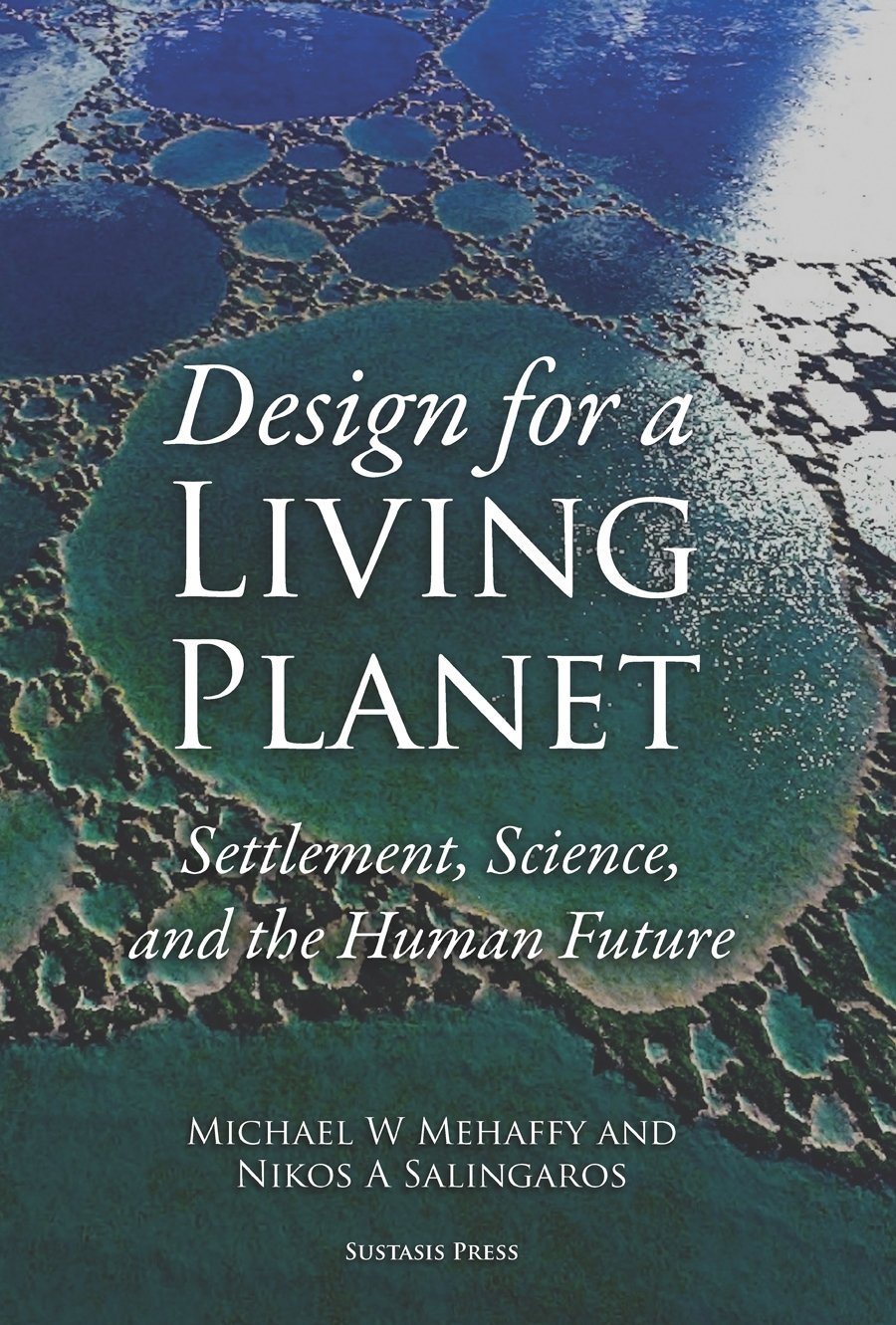
Design for a Living Planet: Settlement, Science, and the Human Future
$19.95
by Michael W. Mehaffy



In this brief, accessible volume, the authors -- an urban philosopher and a mathematician-physicist -- explain the surprising new findings from the sciences that are beginning to transform environmental design in the modern era. Michael Mehaffy and Nikos Salingaros explore fractals, networks, self-organization, dynamical systems and other revolutionary ideas, describing them to non-science readers in a direct and engaging way. The book also examines fascinating new topics of design, including Agile, Wiki, Design Patterns and other "open-source" approaches from the software world. The authors conclude that a profound transformation is under way in modern design -- and today's students and practitioners will need to be aware of its implications for our future. "A brilliant critical discussion of contemporary architectural enterprise as well as guidelines to a practice... The authors of this wise and insightful book, devoid of the usual academic 'jargon', address the issues of a built environment that need not only fresh insight but also changes in the practical realm." -- Almantas Samalavicius, Journal of Architecture and Urbanism "Lucidly describes what's coming in the world of design -- and what needs to come." -- Ward Cunningham, Inventor of wiki, and pioneer of Pattern Languages of Programming, Agile, and Scrum "Essential reading for all urban designers." -- Jeff Speck, Author of Walkable City . "Inspired, compelling and fascinating... Recognizes that a true architecture can be dug from the facts, insights, and theories, that occur with a broadening of science to include the human being." -- Christopher Alexander, Author of A Pattern Language and Notes on the Synthesis of Form . "This new science of design is the most exciting frontier there is presently in the fields of architecture, urban design and planning. Mehaffy and Salingaros offer easy access to the true potential of living design that can heal our sensibilities and realign our collective future on this planet. This is the genetic building block of a new science for building and rebuilding human settlements and all built form across the urban, suburban and rural spectrum." -- Mahesh Butani, architect. The reader finds collected here a series of essays on twenty related topics that we wrote to introduce designers and design students to new developments in the sciences underlying modern design, with a focus on the design of human settlement. These topics outline, in a brief and introductory way, the early stages of a remarkable transformation in the science and art of design. The core conclusion of the findings reported in this book is revolutionary: sustainability depends upon the geometry of design . In this brief, accessible volume, the authors -- an urban philosopher and a mathematician-physicist -- explain the surprising new findings from the sciences that are beginning to transform environmental design in the modern era. Michael Mehaffy and Nikos Salingaros explore fractals, networks, self-organization, dynamical systems and other revolutionary ideas, describing them to non-science readers in a direct and engaging way. The book also examines fascinating new topics of design, including Agile, Wiki, Design Patterns and other "open-source" approaches from the software world. The authors conclude that a profound transformation is under way in modern design -- and today's students and practitioners will need to be aware of its implications for our future. Michael Mehaffy is an urbanist and design theorist, and a periodic visiting professor or adjunct in five graduate universities in four countries and three disciplines (architecture, urban planning and philosophy). He has been a close associate of the architect and software pioneer Christopher Alexander, and a Research Associate with the Center for Environmental Structure, Alexander's research center founded in 1967. He is currently executive director of Portland, Oregon based Sustasis Foundation, and editor of Sustasis Press. Nikos A. Salingaros is a mathematician and polymath known for his work on urban theory, architectural theory, complexity theory, and design philosophy. He has been a close collaborator of the architect and computer software pioneer Christopher Alexander. He is Professor of Mathematics at the University of Texas at San Antonio and has been on the Architecture faculties of universities in Italy, Mexico, and The Netherlands.