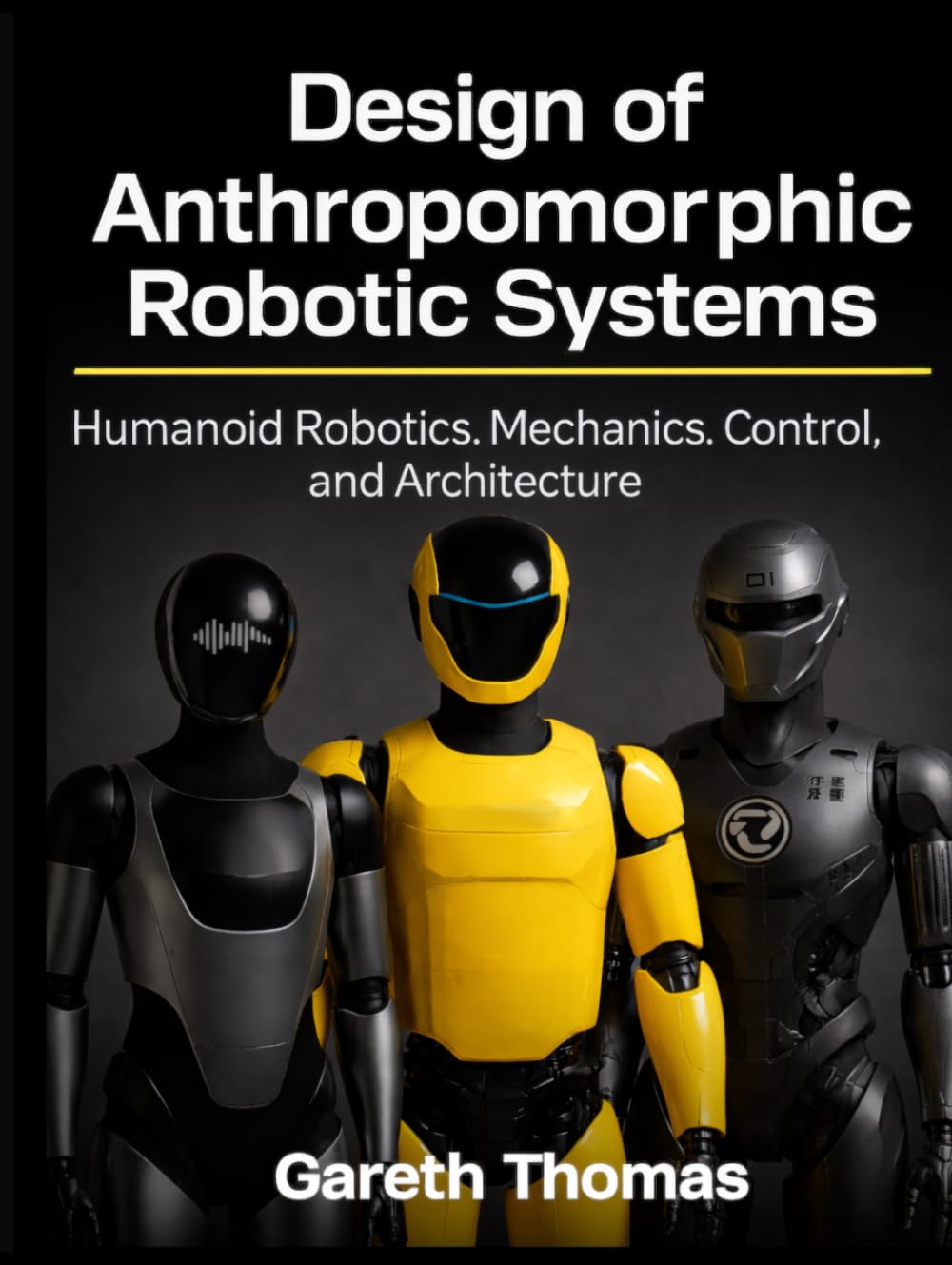
Design of Anthropomorphic Robotic Systems: Humanoid Robotics Mechanics, Control, and Architecture (Humanoid Robotic Systems Engineering: Design,
$44.97
by Gareth Thomas



Serious humanoid systems are not built from intuition. They are built from mathematics, structure, and constraint. This book is written for readers who want that level of clarity. It develops humanoid robotics from first principles through to full system integration, using the same formal tools used in high-end research and engineering environments. Kinematics, dynamics, control, estimation, perception, and planning are not treated as separate topics, but as components of a single, coherent system. The progression is deliberate. Mathematical foundations lead directly into rigid-body kinematics and Jacobian methods. These extend into inverse kinematics, redundancy resolution, and optimization-based formulations. Dynamics are developed in full—Newton–Euler, Lagrangian structure, and floating-base systems—then applied to contact-rich humanoid scenarios. Locomotion is treated through formal models including ZMP, capture point theory, and trajectory optimization. Whole-body control is expressed using operational-space dynamics and quadratic programming, with explicit constraint handling and task hierarchies. Estimation, perception, manipulation, and system integration are addressed with the same emphasis on mathematical consistency and engineering applicability. This is not a survey. It is a structured, technical treatment intended for readers who want to understand how these systems are actually formulated and implemented. What you gain from this book: A unified mathematical framework for modeling and controlling humanoid robots - The ability to derive and implement forward and inverse kinematics for high-DOF systems - A working understanding of rigid-body dynamics, including floating-base formulations - Practical methods for handling constraints, contacts, and multi-contact locomotion - Clear formulations of whole-body control using optimization and task prioritization - Insight into actuator design, impedance control, and physical system behavior - State estimation techniques grounded in Lie group methods and sensor fusion - A rigorous approach to grasp mechanics and dexterous manipulation - Integration of perception, planning, and control into a coherent system architecture - Exposure to real-time systems, simulation, and validation workflows used in practice The result is not just familiarity with humanoid robotics, but the ability to reason about it at a system level—mathematically, computationally, and physically. This text is suited to graduate-level study, research, and engineering work where precision matters and approximations are not enough.