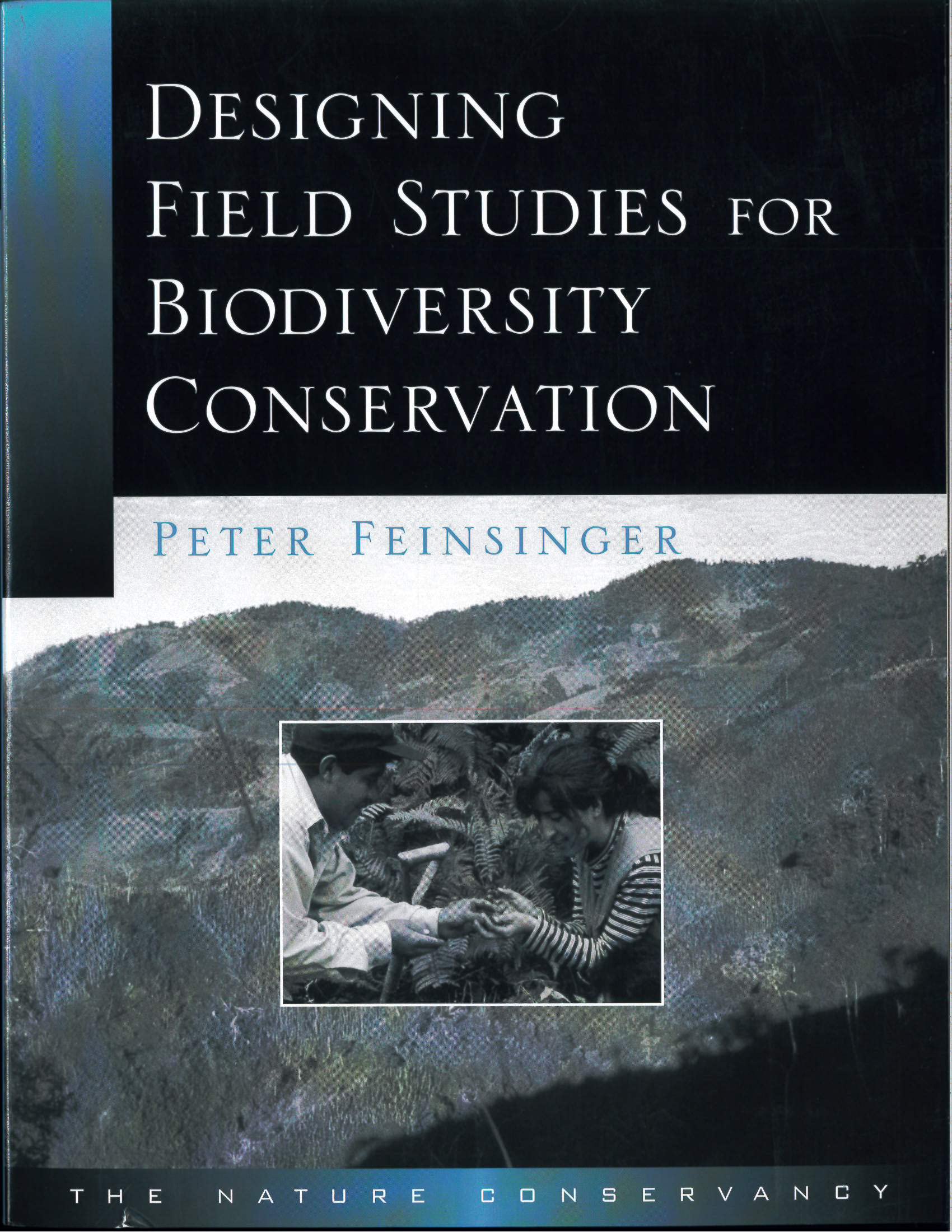



Anyone working in biodiversity conservation or field ecology should understand and utilize the common-sense process of scientific inquiry: observing surroundings, framing questions, answering those questions through well-designed studies, and, in many cases, applying results to decision making. Yet the interdisciplinary nature of conservation means that many workers are not well versed in the methods of science and may misunderstand or mistrust this indispensable tool. Designing Field Studies for Biodiversity Conservation addresses that problem by offering a comprehensible, practical guide to using scientific inquiry in conservation work. In an engaging and accessible style, award-winning tropical ecologist and teacher Peter Feinsinger melds concepts, methods, and intellectual tools into a unique approach to answering environmental questions through field studies. Focusing on the fundamentals of common sense, independent thinking, and natural history, he considers: framing the question and designing the study - interpreting and applying results through judicious use of statistical inference - taking into account the natural history of plants, animals, and landscapes - monitoring and assessing progress through approaches such as "bioindicator species" or "species diversity measures" - helping other interested parties (park guards, local communities, school teachers) use scientific inquiry in addressing their own concerns Detailed appendixes explain technical issues, while numerous sidebars and illustrations provide important background and thought-provoking exercises. Throughout, the author challenges the reader to integrate conceptual thinking with on-the-ground practice in order to make conservation truly effective. Feinsinger concentrates on examples from Latin America but stresses that the approach applies to local conservation concerns or field biology questions in any landscape. Designing Field Studies for Biodiversity Conservation is an essential handbook for staff and researchers working with conservation institutions or projects worldwide, as well as for students and professionals in field ecology, wildlife biology, and related areas. Peter Feinsinger is Adjunct Professor of Biology at Northern Arizona University in Flagstaff, Arizona, and conservation fellow with the Wildlife Conservation Society. The book was sponsored by The Nature Conservancy, an international nonprofit organization dedicated to preserving biodiversity through the protection of critical habitat. Designing Field Studies for Biodiversity Conservation By Peter Feinsinger ISLAND PRESS Copyright © 2001 The Nature Conservancy All rights reserved. ISBN: 978-1-55963-878-4 Contents About Island Press, About The Nature Conservancy, Title Page, Copyright Page, Dedication, Table of Figures, List of Tables, Preface, Acknowledgments, CHAPTER 1 - Introduction: What's Science Got to Do with It?, CHAPTER 2 - The Inquiry Process, CHAPTER 3 - So, What's the Question?, CHAPTER 4 - Design: Matching Data Collection to the Scope of the Question, CHAPTER 5 - Small Samples and Big Questions: The Role of Statistical Inference, CHAPTER 6 - Points of View: Taking Natural History into Account, CHAPTER 7 - Contents and Context: Taking the Whole Landscape into Account, CHAPTER 8 - Indicators versus Targets: Shortcuts to the Landscape's "Health"?, CHAPTER 9 - Species Diversity: Easy to Quantify, but What Does It Mean?, CHAPTER 10 - Extending the Reach of Inquiry, APPENDIX A - Calculating Confidence Limits for the Population Mean, APPENDIX B - Deciding on Sample Size, APPENDIX C - Resources Especially for Latin American Readers, APPENDIX D - Design and Statistics without the Jargon: A Play in Two Acts, Literature Cited, Notes, Index, About the Author, Island Press Board of Directors, CHAPTER 1 Introduction: What's Science Got to Do with It? Despite the potential of applied ecology, there is still disagreement about the extent to which ecological science is applicable to real-world problems. —Alicia Castillo and Victor M. Toledo (2000) This book is intended for all those who work toward sustainable and sustained conservation of the landscapes that surround them along with the native biota those landscapes support. What does conservation mean, though? It seems that each of us has a unique and constantly changing definition. At this moment my own definition of conservation is the field of study and action that concerns the management of the landscape so as (1) in the short and medium term, to minimize or buffer negative effects of human beings on nature, which includes the landscape's human inhabitants ourselves, and (2) in the long term, to provide other living beings with the maximum number of alternatives for tolerating and surviving our species' brief presence on this planet. Getting at Conservation How might conservation be achieved? The effects—positive, negative, and neutral—of humans