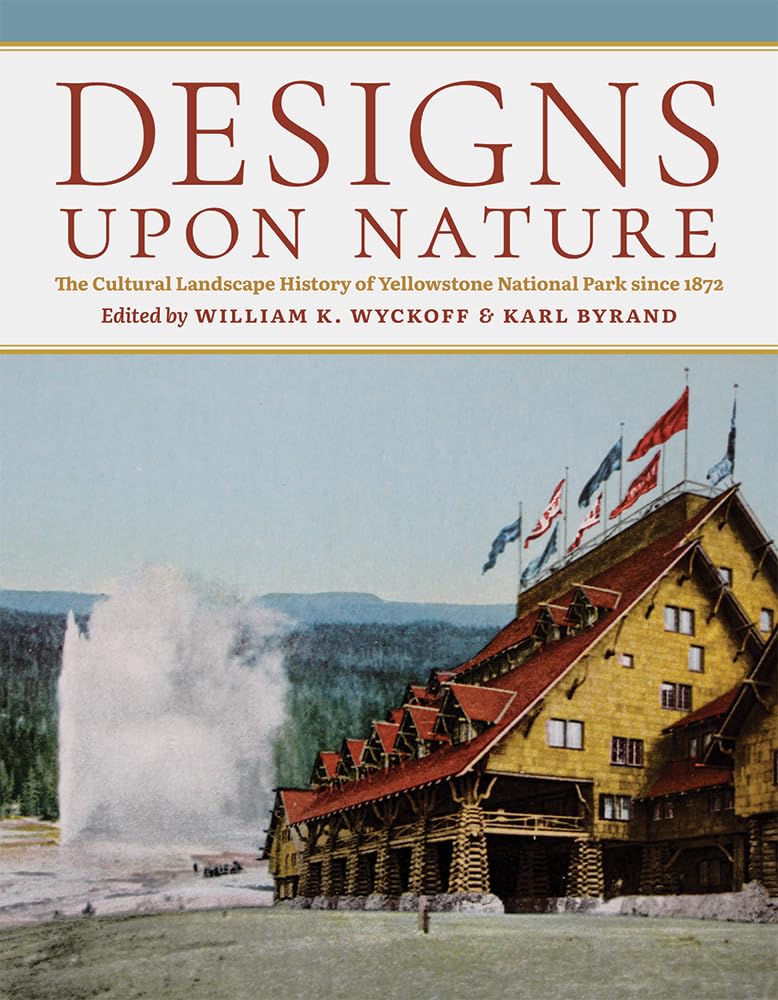
Designs upon Nature: The Cultural Landscape History of Yellowstone National Park since 1872
$35.39
by William K. Wyckoff



Designs upon Nature traces how and why the cultural landscapes—the built environment—of America’s first national park have evolved since its creation in 1872. Yellowstone National Park will always be defined by its geysers, wild animals, and natural setting, yet visitor experiences in the park are also shaped by the lodges, campgrounds, museums, ranger talks, boardwalks, roads, trails, and viewpoints they encounter. These richly illustrated essays explore the evolution of these cultural features amid this unique natural landscape and explain how they have served ever-changing visitor needs over the past 150 years. Chapters in the book follow the park’s traditional “Grand Tour,” which often began for visitors at park headquarters at Mammoth Hot Springs and then moved on to Old Faithful and the Upper Geyser Basin, the glistening waters of Yellowstone Lake, the unforgettable waterfalls of the Yellowstone River’s Grand Canyon, and the western hospitality found at Roosevelt Lodge near Tower Falls. Authors consider how visitor experiences and cultural landscapes within the park have changed dramatically since 1872. Early horseback trips were replaced by an era of railroad tourism and grand hotels. The later arrival of automobiles invited a more casual visitor experience among rustic lodges and campgrounds. Travel accommodations for the twenty-first-century visitor continue to affect cultural landscapes through larger parking lots and further road improvements. The result is indeed a “design upon nature,” an engineered imprint upon a wild place that has forever shaped and changed its character. Designs upon Nature is a rich and nuanced narrative that encourages us to see the park in a way we never have before. It is a significant addition to our understanding of Yellowstone and the evolution of the national park idea as seen there—how experiencing wild nature is made possible by human designs upon the land. “This volume alters the way Americans think about their national parks and the social and cultural forces that create and sustain them.” —Geoffrey L. Buckley, Ohio University “An important and overdue book whose compelling text and engaging illustrations are critical to our understanding of the cultural landscapes of America’s first national park.” —Terence Young, California State Polytechnic University “An important title that adds much to our knowledge of Yellowstone, the American West, and the cultural landscape of America.” —Arnold R. Alanen, University of Wisconsin–Madison William K. Wyckoff is a cultural and historical geographer of the American West and emeritus professor of earth sciences at Montana State University. He is a coeditor of The Mountainous West and the author of six books on the American landscape, including Mac McCloud’s Five Points , Riding Shotgun with Norman Wallace , How to Read the American West , On the Road Again , Creating Colorado , and The Developer’s Frontier . In 2016, he received the Aubrey Haines Award from the National Park Service and in 2023 was awarded the Lifetime Achievement Honor of the American Association of Geographers. Karl Byrand is a cultural and historical geographer and retired professor and department chair at the University of Wisconsin–Sheboygan.