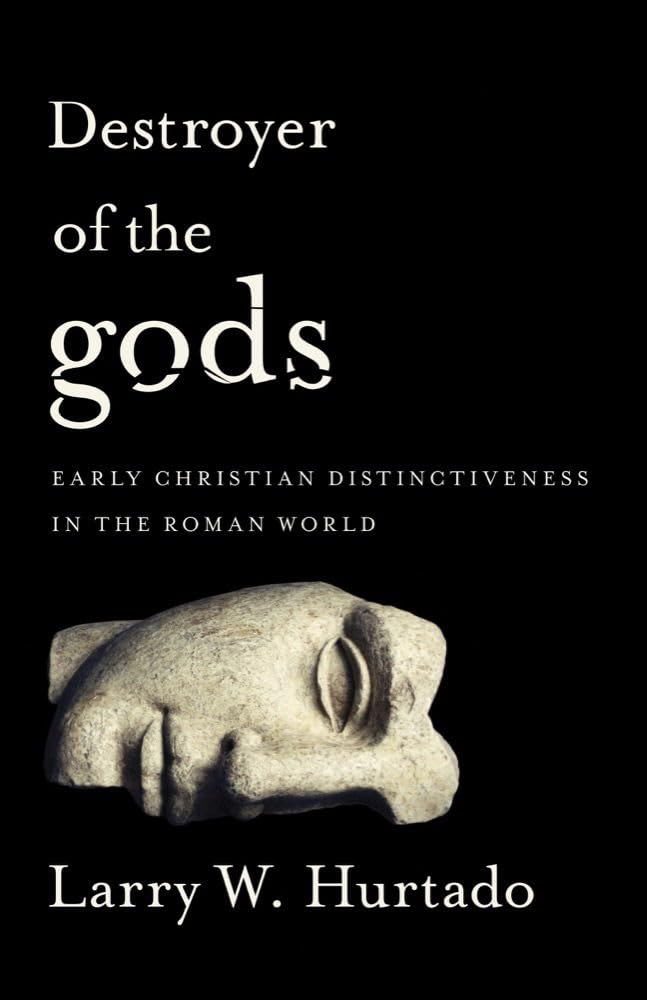
Destroyer of the gods: Early Christian Distinctiveness in the Roman World
$23.73
by Larry W. Hurtado



"Silly," "stupid," "irrational," "simple." "Wicked," "hateful," "obstinate," "anti-social." "Extravagant," "perverse." The Roman world rendered harsh judgments upon early Christianity--including branding Christianity "new." Novelty was no Roman religious virtue. Nevertheless, as Larry W. Hurtado shows in Destroyer of the gods , Christianity thrived despite its new and distinctive features and opposition to them. Unlike nearly all other religious groups, Christianity utterly rejected the traditional gods of the Roman world. Christianity also offered a new and different kind of religious identity, one not based on ethnicity. Christianity was distinctively a "bookish" religion, with the production, copying, distribution, and reading of texts as central to its faith, even preferring a distinctive book-form, the codex. Christianity insisted that its adherents behave differently: unlike the simple ritual observances characteristic of the pagan religious environment, embracing Christian faith meant a behavioral transformation, with particular and novel ethical demands for men. Unquestionably, to the Roman world, Christianity was both new and different, and, to a good many, it threatened social and religious conventions of the day. In the rejection of the gods and in the centrality of texts, early Christianity obviously reflected commitments inherited from its Jewish origins. But these particular features were no longer identified with Jewish ethnicity and early Christianity quickly became aggressively trans-ethnic--a novel kind of religious movement. Its ethical teaching, too, bore some resemblance to the philosophers of the day, yet in contrast with these great teachers and their small circles of dedicated students, early Christianity laid its hard demands upon all adherents from the moment of conversion, producing a novel social project. Christianity’s novelty was no badge of honor. Called atheists and suspected of political subversion, Christians earned Roman disdain and suspicion in equal amounts. Yet, as Destroyer of the gods demonstrates, in an irony of history the very features of early Christianity that rendered it distinctive and objectionable in Roman eyes have now become so commonplace in Western culture as to go unnoticed. Christianity helped destroy one world and create another. Hurtado, emeritus professor of New Testament language, literature, and theology in the School of Divinity at the University of Edinburgh, discusses the history and evolution of ecumenical Christian practices in this elegantly straightforward book...Hurtado does an excellent job of walking readers through...how very odd early Christianity was for its place and time and how it came to overturn and replace ancient systems and beliefs. Hurtado writes with a measured tone and learned authority. Those wishing to know more about early Christianity will find much here. ― Publishers Weekly Hurtado's book, written to appeal to a wide audience, explains just how odd and objectionable Jesus' followers, their counter-establishment church, and even their writings looked during the first three centuries of the Christian movement. ― The Christian Century An important scholarly look at the birth of Christianity within the Roman embrace. ― Library Journal Whether one applauds or disdains the values of contemporary Western culture, what we assume to be good, true, and normal has been shaped to a surprising degree by early Christianity. Demolishing taken-for-granted assumptions about what religion was, is, and can be, Hurtado’s provocative exploration deserves a broad audience. -- Matthew W. Bates, Quincy University ― OnScript Larry Hurtado…reminds us that early Christianity emerged as a profoundly countercultural movement, one that could never be mistaken as mirroring the values of its environment. -- Ronald P. Byars ― Presbyterian Outlook D estroyer of the gods is a very clear and readable book and is essential reading for anyone who wants to understand issues dealt with in early Christian writers, particularly Paul’s letters. I thoroughly recommend it to students of the New Testament and more widely as a reminder that there is a cost to a church which stands out in its social and cultural setting. -- Tim Gill ― ANVIL: Journal of Theology and Mission Hurtado’s clear and well-reasoned voice serves as an authoritative guide through the tangle of earliest Christianity in its Roman environment. From Roman accounts of early Christian oddity to early Christian book culture, Hurtado collects arcane pieces of knowledge that could well serve as material for pub quizzes and amasses them into a plausible and largely compelling analysis. It remains to be seen how someone else will take his work and build upon it. -- Jonathon Lookadoo ― Marginalia Review of Books D estroyer of the Gods i s an intriguing and wide-ranging examination of several key features of Christianity that distinguished it from the various religi