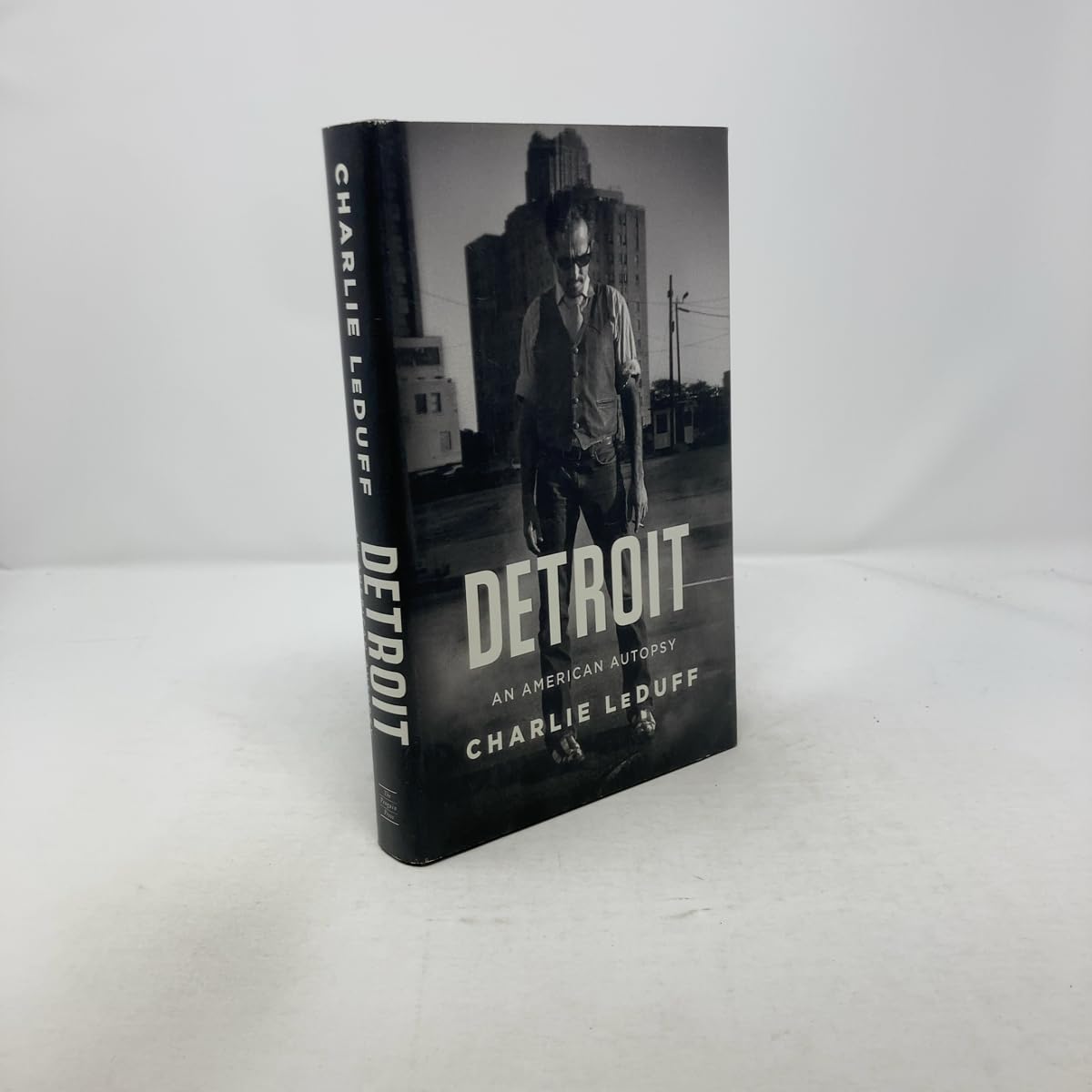



A New York Times Bestseller “A book full of both literary grace and hard-won world-weariness... Iggy Pop meets Jim Carroll and Charles Bukowski” – Kirkus , STARRED REVIEW Back in his broken hometown, Pulitzer Prize–winning journalist Charlie LeDuff searches through the ruins for clues to its fate, his family’s, and his own. Detroit is where his mother’s flower shop was firebombed in the pre-Halloween orgy of arson known as Devil’s Night; where his sister lost herself to the west side streets; where his brother, who once sold subprime mortgages with skill and silk, now works in a factory cleaning Chinese-manufactured screws so they can be repackaged as “May Be Made in United States.” Having led us on the way up, Detroit now seems to be leading us on the way down. Once the richest city in America, Detroit is now the nation’s poorest. Once the vanguard of America’s machine age—mass production, blue-collar jobs, and automobiles—Detroit is now America’s capital for unemployment, illiteracy, dropouts, and foreclosures. It is an eerie and angry place of deserted factories and abandoned homes and forgotten people. Trees and switchgrass and wild animals have come back to reclaim their right¬ful places. Coyotes are here. The pigeons have left. A city the size of San Francisco and Manhattan could neatly fit into Detroit’s vacant lots. After revealing that the city’s murder rate is higher than the official police number—making it the highest in the country—a weary old detective tells LeDuff, “In this city two plus two equals three.” With the steel-eyed reportage that has become his trademark and the righteous indignation only a native son possesses, LeDuff sets out to uncover what destroyed his city. He embeds with a local fire brigade struggling to defend its city against systemic arson and bureaucratic corruption. He investigates politicians of all stripes, from the smooth-talking mayor to career police officials to ministers of the backstreets, following the paperwork to discover who benefits from Detroit’s decline. He beats on the doors of union bosses and homeless squatters, powerful businessmen and struggling homeowners, and the ordinary people holding the city together by sheer determination. If Detroit is America’s vanguard in good times and bad, then here is the only place to turn for guid¬ance in our troubled era. While redemption is thin on the ground in this ghost of a city, Detroit: An American Autopsy is no hopeless parable. LeDuff shares an unbelievable story of a hard town in a rough time filled with some of the strangest and strongest people our country has to offer. Detroit is a dark comedy of the absurdity of American life in the twenty-first century, a deeply human drama of colossal greed and endurance, ignorance and courage. After a career as a Pulitzer Prize–winning reporter with the New York Times, LeDuff answered the longing to return to his roots in Detroit, a city that was once at the forefront of American industry and growth. What he returned to was a city now more famous for its corruption and decay. LeDuff reprises the shenanigans of Mayor Kwame Kilpatrick and city councilwoman Monica Conyers and others before the slow-moving justice process caught up with them. Among the other signs of decay: a police department so broke that cops take the bus to crime scenes and a fire department so bereft it sells its brass poles as scrap. He reports on surreptitious meetings with police officers to counter rosy reports of declining crime rates. He also reports on the personal toll the city’s decline has taken on its citizens, including his own family, with grim stories of his brothers’ chronic unemployment and his sister’s and niece’s deaths from drug overdoses. With the emotions of personal connection and the clear-eyed detachment of a reporter, LeDuff examines what Detroit’s decline means for other American cities. --Vanessa Bush "LeDuff returns, by the books end, to the bar where his sister was last seen, only to find it unrecognizable. A black man outside explains the changes. 'they trying to put something nice up' in this hellhole he says, speaking of the bar specifically, though his words spread across the city and pay tribute, in equal measure, to its dreamers, its pessimists and to those, resigned and wrung out, who love it despite all. 'Can't say it's working. But what you gonna do? You ain’t gonna be reincarnated, so you got to do the best you can with the moment you got. Do the best you can and try to be good.' LeDuff has done his best, and his book is better than good." —Paul Clemens, New York Times Book Review "One cannot read Mr. LeDuff's amalgam of memoir and reportage and not be shaken by the cold eye he casts on hard truths... A little gonzo, a little gumshoe, some gawker, some good-Samaritan— it is hard to ignore reporting like Mr. LeDuff's." — The Wall Street Journal “Pultizer-Prize-winning journalist LeDuff ( Work and Other Sins ) delivers an edgy portrait of the decl