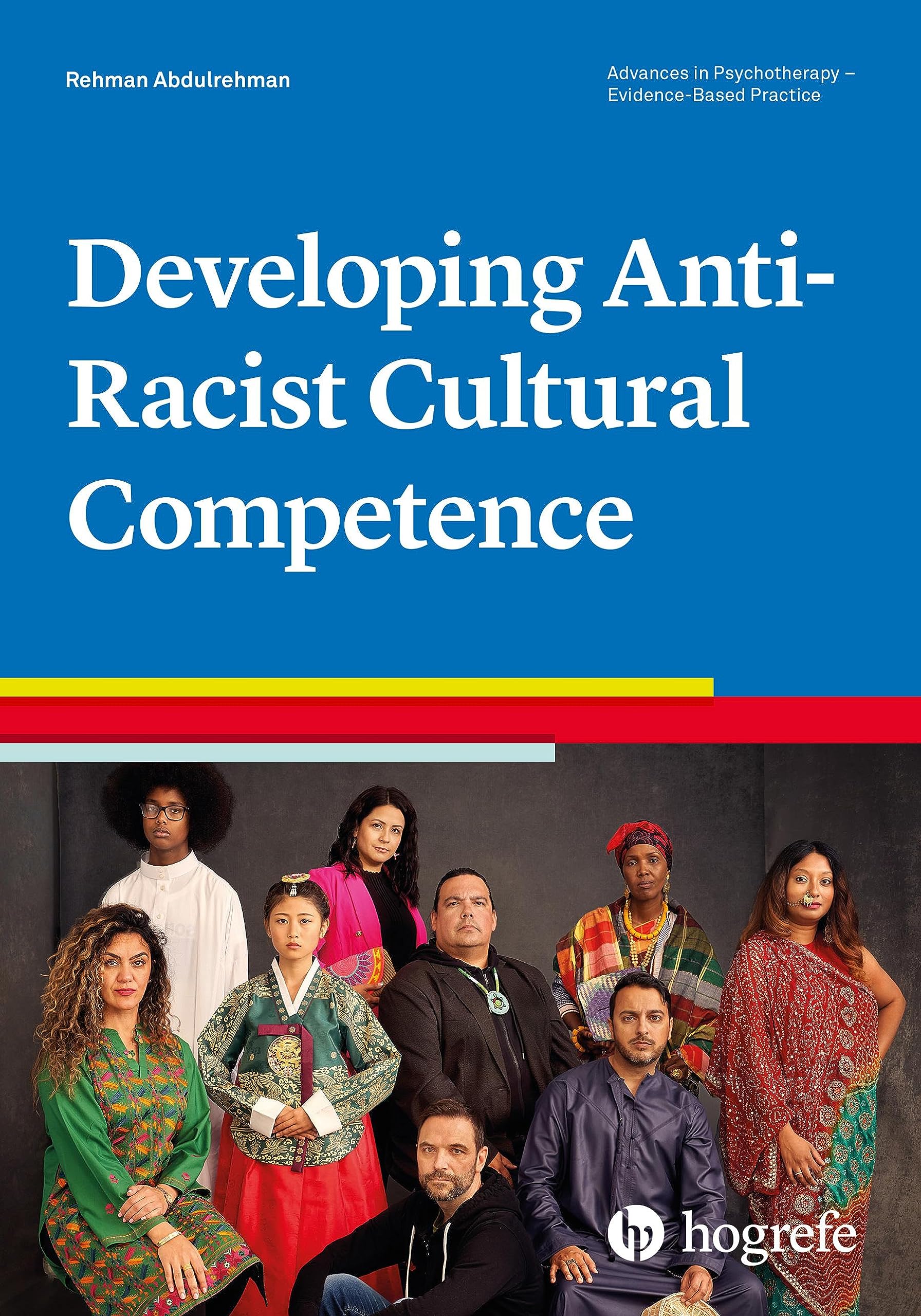
Developing Anti-Racist Cultural Competence (Advances in Psychotherapy: Evidence-Based Practice, 53)
$29.80
by Rehman Abduhlrehman



Learn to understand how you see others with this no-nonsense, practical guide Teaches cultural humility - Provides practical guidance - Addresses internalized racism In today’s society, anti-racist cultural competence is an essential skill everyone needs to develop, and not something meant only to be addressed by some. The ability to deal with racism and diverse cultural points of views effectively is often hindered by fear, anxiety, and a misunderstanding of what it means to be culturally competent without making people feel like outsiders. While many other models of cultural competence approach the issue as though looking into a fishbowl, this book views the issue as everyone swimming in the water together, as part of a common ecosystem and community. Abdulrehman provides a direct, no-nonsense, and practical approach to this challenging and complex topic, using real-life examples to help the reader to approach sensitive cultural issues confidently and humbly. He looks in detail at how we can understand our biases and how they impact our engagement and trust with marginalized people of color. The less addressed issues of ethnic and cultural identity development, and understanding internalized racism and how it too can impact cross-cultural engagement are also presented. This book provides a unique perspective that addresses anti-racism and cross-cultural interactions as a process for better understanding how you see the world – a very different process than merely describing how others see the world differently from you. This volume is suitable not only for psychology professionals, but anyone who wants to explore what it means to be anti-racist and culturally competent. This book serves as a guide to self-reflective practices and recognition of unintentional biases in therapeutic and work-related contexts. Dr. Abdulrehman has worked in corporate America, written podcasts, and been recognized by the Society for Consulting Psychology for excellence in diversity and inclusion consulting. Therapists could incorporate ideas presented to lead to any allyship approach to helping client growth. This book is relevant and can be used in multicultural groups across all settings, educational, professional sports, non-profits, and corporate. Reviewed by Sherie Huber, MS, Benedictine University, Lisle, IL, in Doody’s Reviews (June 2024) I am proud to endorse Dr. Abdulrehman’s book. It not only provides essential knowledge but also serves as a testament to his own commitment to advancing our collective understanding and promoting equity. I plan to make this book required reading for all of my students. By Monnica Williams, PhD, ABPP, Canada Research Chair for Mental Health Disparities, University of Ottawa, ON, Canada. Rehman Abdulrehman, PhD, is a clinical and consulting psychologist whose work has spanned continents and cultures, with a focus on the intersection of mental health; diversity, equity, and inclusion; and leadership. Dr. Abdulrehman has supported many organizations to address diversity, equity, and inclusion including Google/YouTube, Mastercard Foundation, the Canadian Broadcasting Corporation, and the Government of Canada. He has developed and hosted a podcast, Different People, addressing difficult conversations on racism, and the Bias Outside the Box tool, which went viral, to help people begin a conversation with themselves about the biases they hold. Dr. Abdulrehman was also a TEDx speaker with his talk “Resolving Unconscious Bias,” and his work has been recognized by the Society of Consulting Psychology for Excellence in Diversity & Inclusion Consulting. He is also an assistant professor with the Department of Clinical Health Psychology at the University of Manitoba and has held three visiting professor positions at Zanzibar University, the State University of Zanzibar, and Muhimbili University of Health and Allied Sciences, due to his development work in Tanzania. Review quote: I am proud to endorse Dr. Abdulrehman’s book. It not only provides essential knowledge but also serves as a testament to his own commitment to advancing our collective understanding and promoting equity. I plan to make this book required reading for all of my students. By Monnica Williams, PhD, ABPP, Canada Research Chair for Mental Health Disparities, University of Ottawa, ON, Canada.