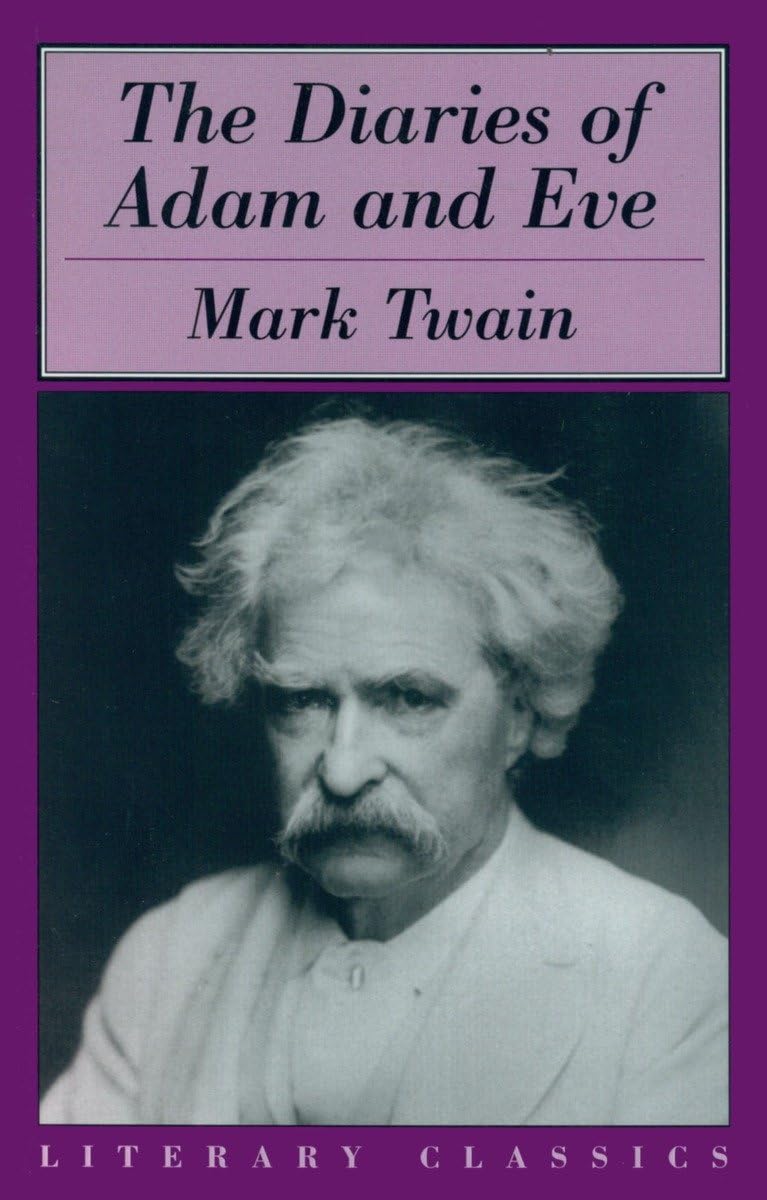



In this witty, charming work Mark Twain retells the Garden of Eden story in the first person, presenting the separate perspectives in diary form of the legendary father and mother of the human race. In Twain's version Adam comes across as the original couch potato, grumpily uninterested at first in the new long-haired creature with the different shape who keeps pestering him with her new ideas. Eve, by contrast, is the talkative, ever-curious experimenter whose inquisitive nature prompts her to name all the animals in the garden and leads her to the discovery of fire, among other things. Cain and Abel also make brief appearances as squawking infants whom Adam largely ignores while Eve does all the hard work of child-rearing. It doesn't dawn on him till they are almost full-grown that these puzzling new creatures are his children.This is a funny and touching retelling of the age-old myth, full of Twain's sarcastic humor, incisive intelligence, and subtle touches of pathos for the foibles of human nature. MARK TWAIN was born Samuel Langhorne Clemens in Florida, Missouri, on November 30, 1835, the son of John Marshall Clemens, an avowed freethinker, and his wife, Jane, a believer and connoisseur of the occult. These two opposing forces—freethought and spiritualism—colored the young Twain's view of the world and would later serve as material for his books. As a child, Twain knew both violence and tragedy. In the town of Hannibal, Missouri, where he lived from 1839 to 1853, shootings and attempted shootings were not unusual events. Twain's older brother Benjamin died when Twain was only six; a few months later, the family lost their home to debt. When Twain was twelve, his father died. It was at this time that Twain left school to go to work in order to help his financially strapped family, first as a printer's apprentice and later as a journeyman printer; he was also a river pilot, a prospector, and a roving newspaper reporter. Twain's journalistic travels took him throughout the United States as well as to South America, Europe, and the Middle East, from where he sent back entertaining travel letters. While a reporter for the Virginia City Territorial Enterprise, he adopted the pen name Mark Twain. His scathing, observant articles began to earn him a wide and loyal readership. Samuel Clemens/Mark Twain made his readers, and later his listeners during his lecture tours, familiar with his life: skillfully blending the real and the fictional, he created the character of Mark Twain whom Americans—and the world—recognized and loved in his many books, including The Celebrated Jumping Frog of Calaveras County, and Other Sketches (1867); Innocents Abroad (1869); Roughing It (1872); The Adventures of Tom Sawyer (1876); and his masterpiece, Adventures of Huckleberry Finn (1884). Eulogized by William Dean Howells as "the Lincoln of our literature," Twain achieved great fame from his writing and earned a fortune. He lost this, however, following his involvement in a failed publishing house venture; thereafter, Twain lectured to clear his debts. The final two decades of Twain's life were marked, as were his first years, by a series of tragedies: during these years he lost in quick succession his beloved wife, Livy; a favorite nephew; his daughters Susy and Jean; and his sister, Pamela. Twain had toyed with the idea that life is a dream and that human emotions and experiences are delusions. His work at this time reflects his growing gloominess, pessimism, and contempt for organized religion: Extracts from Adam's Diary (1904) and Eve's Diary (1906) satirized Scripture; Christian Science (1907) ridiculed Mark Baker Eddy's new religion. This is the period, too, of Twain's vitriolic Letters from the Earth (1906; first published in 1962) and The Mysterious Stranger, several versions of which were written during 1905-06 and which was posthumously published in 1916. Here Twain denies the existence of a benign Providence, a soul, or an afterlife. Indeed, reality itself is taken away as the Stranger in this antireligious tale—the angel-boy, Satan—asserts that "nothing exists; all is a dream." This and the other works of Twain's last years belie that popular image of the easy, affable American humorist; they reveal instead a man engaged in an often tortuous struggle to discover what life is and what meaning, if any, it holds. Mark Twain died in Redding, Connecticut, on April 21, 1910. Used Book in Good Condition